
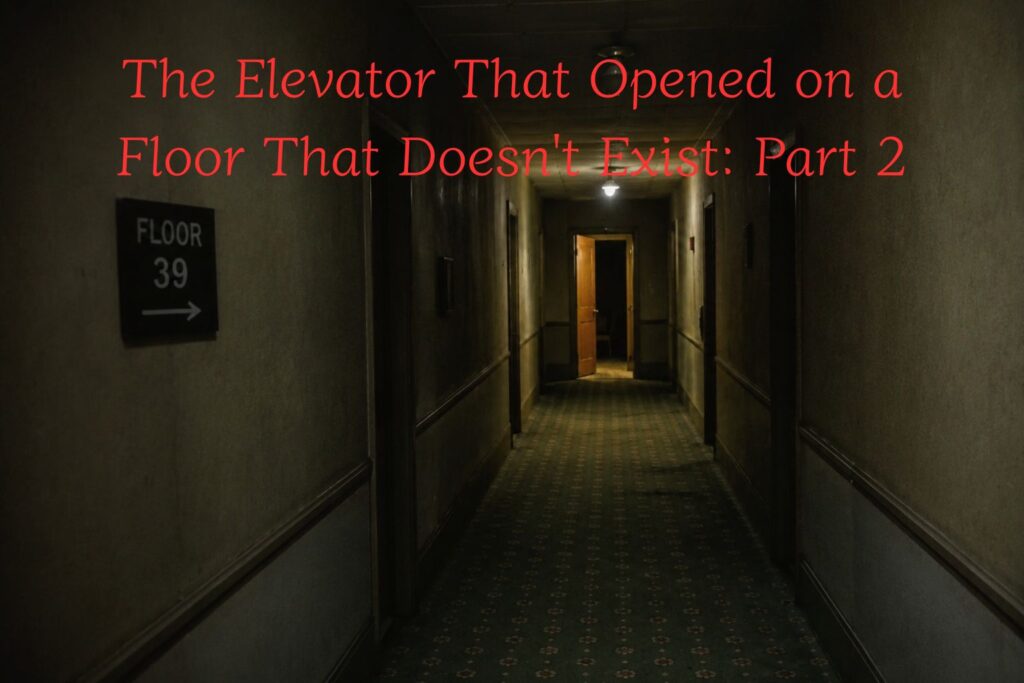
The Elevator That Opened on a Floor That Doesn’t Exist
Part 2: Floor 39
The telephone stopped ringing.
For several seconds, I stood perfectly still in the middle of the corridor, listening for anything that might explain where I was.
A voice.
A door closing.
Footsteps.
The hum of office equipment.
Anything.
But the hallway remained silent.
Behind me, the elevator doors were still open.
That should have reassured me.
It didn’t.
The elevator no longer felt like an escape.
It felt like a mouth waiting to close.
I turned toward it, suddenly certain that I had already gone too far.
Then the lights inside the cabin flickered.
Once.
Twice.
The doors began to slide shut.
I ran.
“Wait!”
I threw my hand between them.
The safety sensor should have stopped the doors.
It didn’t.
The metal panels continued closing, pressing against my arm with surprising force.
I pulled back just before they met.
The doors sealed.
The display above them went black.
I pressed the call button.
Nothing.
Again.
Nothing.
I hit it with the side of my fist.
“Come on.”
No response.
The elevator had left me there.
Except I hadn’t heard it move.
There was no vibration.
No sound of cables.
Nothing inside the wall.
It was as though the cabin had simply ceased to exist.
I stood facing the closed doors, breathing harder than I wanted to admit.
For the first time that night, I felt real fear.
Not confusion.
Not unease.
Fear.
The hallway behind me now seemed darker.
Longer.
I took out my phone.
The time read 11:52 p.m.
No signal.
Battery: 63 percent.
I opened the camera and took a photograph of the elevator display.
The photo appeared normal at first.
Then I zoomed in.
Above the doors, where the number 39 had been displayed moments earlier, the photograph showed something else.
A blank black screen.
I lowered the phone and looked up.
The number 39 was glowing again.
I took another picture.
Blank.
A third.
Blank.
I switched to video.
On the screen, the display remained dark.
With my own eyes, I could clearly see the red number.
39.
I ended the recording.
My hands had started to tremble.
“This isn’t happening,” I whispered.
The hallway gave no answer.
Then the telephone began ringing again.
Farther ahead.
One ring.
Two.
Three.
This time it didn’t stop.
I followed the sound.
I wish I could say I did it because I was brave.
The truth was more embarrassing.
I didn’t know what else to do.
The elevator wouldn’t respond.
There were no visible stairs.
No emergency exit signs.
The corridor behind me ended at a wall.
The phone was the only sign that another human being might be nearby.
So I walked.
The old carpet absorbed every step.
The walls were lined with closed wooden doors, each fitted with a small frosted-glass panel.
Most had no names.
A few contained faded numbers.
3902.
3904.
3907.
The numbers looked wrong.
Not because of the floor.
Because they had been painted directly onto the glass in black lettering, the way office doors had been marked decades ago.
I passed a framed photograph hanging between two lamps.
It showed the Hawthorne Building.
At least, I thought it did.
The structure in the photograph had the same narrow tower, the same stone base, and the same rows of windows.
But something was different.
The top of the building extended higher.
Above the modern thirty-seventh floor were two additional levels.
Thirty-eight.
Thirty-nine.
I moved closer.
The photograph was black and white.
Dozens of people stood outside the building entrance, dressed in old suits and long coats.
Under the image was a metal plaque.
HAWTHORNE TOWER — GRAND OPENING, OCTOBER 1978
That was impossible.
The Hawthorne Building hadn’t opened in 1978.
I knew that because the company had celebrated the building’s thirty-year anniversary shortly after I started working there.
It had opened in 1986.
At least, that was what everyone had been told.
The telephone kept ringing.
It came from an office near the end of the hall.
The door was slightly open.
Warm yellow light spilled through the gap.
I stopped several feet away.
“Hello?”
The ringing continued.
I reached toward the door.
My fingertips touched the brass handle.
It was warm.
Not room temperature.
Warm like someone had just been holding it.
I pushed the door open.
The office was small.
A heavy wooden desk stood near the window.
A green-shaded lamp cast a circle of light across stacks of paperwork.
A black rotary telephone rang beside an overflowing ashtray.
Behind the desk was an empty leather chair.
Everything looked used.
Not preserved.
Used.
A half-finished cup of coffee sat beside the phone.
Steam rose from it.
A cigarette burned slowly in the ashtray.
Gray smoke curled toward the ceiling.
Someone had been there seconds earlier.
I stepped inside.
“Hello?”
The phone stopped ringing.
Silence returned.
I stared at the receiver.
Then it rang again.
The sudden sound made me jump.
I hesitated before answering.
Every reasonable part of my mind told me not to touch it.
But reason had become useless ten minutes earlier.
I picked up the receiver.
“Hello?”
Static.
Low and irregular.
Then breathing.
Someone was on the other end.
“Who is this?”
The breathing stopped.
A man’s voice spoke.
Faint.
Distorted.
“Daniel?”
My grip tightened around the receiver.
“Yes?”
The line crackled.
“You shouldn’t be there.”
I felt the blood drain from my face.
“Who is this?”
No answer.
“How do you know my name?”
More static.
Then the voice returned.
“You have to get back to the elevator.”
“It’s not working.”
“It is.”
“I tried it.”
“You didn’t wait.”
“Wait for what?”
The line went silent for several seconds.
Then he whispered:
“For yourself.”
A click.
The connection ended.
I held the receiver against my ear.
“Hello?”
Nothing.
I placed it back on the cradle.
Almost immediately, the phone rang again.
I didn’t answer.
Instead, I backed away from the desk.
That was when I noticed the nameplate.
It had been partially hidden beneath a stack of folders.
I pulled the papers aside.
The brass plate read:
DANIEL J. CARTER
SENIOR ACCOUNTS DIRECTOR
I stared at it until the letters blurred.
My full name was Daniel James Carter.
I had never been a senior accounts director.
I was a mid-level analyst.
And I had never worked in this office.
I looked around again.
There were framed certificates on the wall.
I stepped closer.
The first one came from Northwestern University.
The degree belonged to Daniel James Carter.
The graduation year was 2009.
That was correct.
The second was an employee award from Hawthorne Financial Group.
Outstanding Performance — 2018
I had received that exact award.
But not from Hawthorne Financial Group.
My company was called Benton & Shaw Consulting.
Hawthorne was only the name of the building.
The third frame contained a photograph.
I recognized myself immediately.
I was standing beside three people I had never seen before.
I appeared older.
Maybe fifty.
My hair was graying at the temples.
I was smiling, but something about the expression looked forced.
A woman stood beside me, holding my arm.
On the other side was a teenage girl.
In front of us stood a young boy.
A family.
My family.
Except I had never been married.
I didn’t have children.
On the back of the frame, someone had written in blue ink:
Lake Geneva, summer 2034. Best week of our lives.
My throat tightened.
I turned the frame over again.
The woman beside me looked strangely familiar.
I couldn’t place her.
Then I noticed a small detail.
A silver necklace around her neck.
A crescent moon.
I had seen it earlier that evening.
Rachel wore the same necklace.
The same shape.
The same thin chain.
I nearly dropped the frame.
“No.”
I studied the woman’s face more closely.
Older.
Different hairstyle.
Fine lines around the eyes.
But it was her.
Rachel.
My coworker.
In the photograph, she was my wife.
I placed the picture back on the shelf.
My first instinct was to laugh.
Not because anything was funny.
Because the alternative was panic.
Someone had created this office.
Someone had gathered information about me.
My graduation year.
My full name.
Rachel.
The employee award.
Maybe it was an elaborate setup.
A prank.
Some twisted corporate experiment.
That explanation was ridiculous, but still easier to accept than the truth.
I pulled open the top desk drawer.
Inside were pens, paper clips, a pocket calculator, and several business cards.
I picked one up.
Daniel J. Carter
Senior Accounts Director
Hawthorne Financial Group
Below the title was an office phone number.
An email address.
And a date handwritten across the back.
November 14, 2036
I looked at my phone.
It was November 14.
But the year was 2025.
I opened the second drawer.
Folders.
Dozens of them.
Each labeled by year.
All the way to 2036.
The folder marked 2025 was nearly empty.
Inside were printouts of emails, performance reports, and financial documents.
Some were familiar.
One was the quarterly report I had just completed downstairs.
The same file.
The same numbers.
The same mistake I had corrected at 11:36 p.m.
The correction was already there.
I checked the print date.
November 14, 2025 — 11:42 p.m.
I had printed nothing.
I pulled out another document.
It was an internal employee notice.
Subject: Incident Report — Elevator B
The notice was dated the following morning.
November 15, 2025.
I read the first paragraph.
At approximately 12:08 a.m., security personnel were notified that an employee had failed to exit the building after his identification card registered activity on the twenty-ninth floor.
My eyes moved faster.
The employee, Daniel Carter, was last seen on surveillance entering Elevator B at 11:48 p.m.
My breathing stopped.
Elevator records indicate the cabin descended normally to the lobby. However, no passenger exited.
I read the next line twice.
Mr. Carter remains missing.
The page slipped from my hands.
I stepped backward.
The chair rolled slightly behind me.
The report continued on the floor, face-up.
There was a photograph attached.
My employee ID picture.
Under it:
MISSING PERSON
I looked at the date again.
Tomorrow.
The report had been written tomorrow.
A sound came from the hallway.
A footstep.
Slow.
Measured.
I turned toward the open door.
Another step.
Someone was approaching.
I grabbed the report and moved behind the desk.
The footsteps stopped outside.
A shadow appeared beneath the door.
“Who’s there?”
No response.
The door began to open wider.
I picked up the nearest object.
A heavy glass ashtray.
The door moved another inch.
Then stopped.
A hand appeared around the edge.
Pale fingers.
A dark suit sleeve.
I raised the ashtray.
The man stepped inside.
For one confused second, I thought I was looking into a mirror.
He had my face.
Not exactly as it looked now.
Older.
Thinner.
His hair was almost completely gray.
Deep lines ran across his forehead and around his mouth.
He looked exhausted.
His eyes were the same as mine.
But they carried something I had never seen in my own reflection.
Recognition.
“Put that down,” he said.
The voice from the telephone.
I couldn’t move.
He closed the door behind him.
“Who are you?”
He glanced at the ashtray.
“You already know.”
“No.”
“Yes.”
I shook my head.
“No.”
He took one careful step toward me.
I raised the ashtray higher.
“Don’t come any closer.”
He stopped.
“You have every right to be afraid.”
“What is this place?”
He looked around the office.
“This was my office.”
“Your office?”
“Our office.”
I felt sick.
“You’re saying you’re me?”
“I’m saying you will become me if you don’t leave this floor.”
“That doesn’t make sense.”
“Nothing here follows the rules you know.”
“You expect me to believe you’re from the future?”
“No.”
He looked toward the hallway.
“I expect you to survive long enough to understand that the future is the least dangerous thing in this building.”
The older man moved toward the window.
I kept the ashtray raised.
Outside, Chicago looked wrong.
At first, I couldn’t understand why.
The buildings were there.
The streets were there.
But many windows were dark.
No moving traffic.
No aircraft lights.
No illuminated billboards.
The city looked empty.
The older Daniel pulled the blinds closed.
“You shouldn’t look outside for too long.”
“Why?”
“Because sometimes something looks back.”
I stared at him.
He seemed serious.
“What year is this?”
He didn’t answer immediately.
“There is no single answer.”
“What does that mean?”
“Floor 39 doesn’t belong to one year.”
“Then where are we?”
“In a place the building was designed to hide.”
“Designed by who?”
“The original owners.”
“The Hawthorne family?”
He looked surprised.
“You know about them?”
“No. I saw the opening photograph.”
His expression changed.
“Which photograph?”
“The one in the hallway.”
“There wasn’t a photograph when I arrived.”
A cold sensation moved across my back.
“When did you arrive?”
“Eleven years ago.”
“Eleven years?”
“To me.”
He lowered his voice.
“For everyone downstairs, I disappeared tonight.”
I pointed toward the report on the floor.
“That says I disappear.”
“You do.”
“But you’re still here.”
“This is where missing and gone stop meaning the same thing.”
He moved toward the desk and opened the lowest drawer.
Inside was an old revolver.
He checked the cylinder.
I stepped back.
“What the hell are you doing?”
“It won’t kill them.”
“Kill who?”
“But it slows them down.”
“Who?”
The hallway lights flickered.
The older Daniel froze.
Somewhere beyond the door, the telephone in another office began ringing.
Then another.
Then another.
Within seconds, dozens of phones were ringing throughout the floor.
The sound filled the corridor.
The older Daniel grabbed my arm.
“We have to move.”
I pulled away.
“Not until you tell me what’s happening.”
The ringing stopped at once.
Complete silence.
The older man looked terrified.
“They know you’re here.”
“Who knows?”
He stared at the door.
“The employees.”
We left the office.
The hallway had changed.
I was certain of it.
The elevator had been at the far end.
Now the corridor extended in both directions.
More doors had appeared.
Dozens.
Maybe hundreds.
The old wall lamps continued farther than I could see.
“This wasn’t here before,” I whispered.
“It changes when it needs space.”
“That doesn’t mean anything.”
“It will.”
The older Daniel moved quickly.
I followed because staying alone seemed worse.
We passed an office with an open door.
Inside, five people sat at desks.
All wore dark business clothes from different decades.
One man used a typewriter.
A woman stared at a computer monitor from the 1990s.
Another employee wrote numbers into a ledger.
None of them looked at us.
None blinked.
The only sounds were typing and scratching pens.
“Are they real?” I whispered.
The older Daniel didn’t look inside.
“Some of them were.”
One employee suddenly stopped typing.
The others continued.
Slowly, the man turned his head toward the hallway.
His face was wrong.
The features seemed blurred, as though someone had tried to erase them.
The older Daniel pushed me forward.
“Don’t let them see you stop.”
We walked faster.
Behind us, a chair scraped across the floor.
Footsteps entered the hallway.
I didn’t turn around.
The older Daniel led me through a door marked ARCHIVES and locked it behind us.
The room was filled with metal shelves.
Hundreds of boxes stretched toward a low ceiling.
A single fluorescent tube buzzed overhead.
The footsteps stopped outside.
The door handle moved.
Once.
Twice.
Then became still.
I pressed both hands against my mouth to control my breathing.
Something scratched the other side of the door.
Slowly.
From top to bottom.
Then a voice spoke.
Rachel’s voice.
“Daniel?”
I stared at the older version of myself.
He shook his head.
“Daniel, open the door.”
It sounded exactly like her.
The same tone.
The same slight Chicago accent.
“I know you’re in there.”
The handle moved again.
“Please.”
I stepped toward it.
The older Daniel blocked me.
“That isn’t her.”
“How do you know?”
“Because Rachel never came here.”
Outside, she began crying.
“Daniel, I’m scared.”
My chest tightened.
The sound was perfect.
Not almost perfect.
Perfect.
“Open the door.”
I moved again.
The older man pushed the revolver against my chest.
“If you open it, we both die.”
The crying stopped.
A long silence followed.
Then Rachel laughed.
Not normally.
The sound deepened until it no longer sounded human.
Something slammed into the door.
The entire frame shook.
Again.
Again.
Dust fell from the ceiling.
The older Daniel grabbed a metal shelf and pulled it toward us.
Behind it was a narrow opening in the wall.
“Get inside.”
“What is that?”
“Service passage.”
Another impact struck the door.
The wood began to crack.
I squeezed into the opening.
The older Daniel followed and pulled the shelf back into place.
We moved through darkness.
The passage was barely wide enough for our shoulders.
Pipes and electrical cables ran along the walls.
Behind us, the archive door shattered.
Voices entered the room.
Many voices.
Male.
Female.
Old.
Young.
All speaking at once.
“Daniel.”
“Come back.”
“We’ve been waiting.”
“You work here.”
“You always worked here.”
The older man pushed me forward.
“Don’t listen.”
The voices followed us through the wall.
Not from behind.
From inside the pipes.
“Daniel Carter.”
“Employee number 0719.”
“Position pending.”
“Office assignment prepared.”
I covered my ears.
It didn’t help.
The sound wasn’t entering through them.
It felt as though the voices were speaking directly behind my eyes.
Then one voice rose above the others.
My own voice.
“Don’t trust him.”
I stopped.
The older Daniel turned.
“What are you doing?”
From somewhere ahead, my younger voice continued:
“He isn’t you.”
The older man’s face tightened.
“Keep moving.”
“He brought you here.”
“Shut it out.”
“He needs you to take his place.”
I looked at the older Daniel.
He stared back.
For the first time, I noticed something strange.
There was no employee badge clipped to his jacket.
Instead, a small metal plate had been pinned directly through the fabric.
It read:
DANIEL CARTER
FLOOR SUPERVISOR
“What does that mean?” I asked.
He looked down at the badge.
Then at me.
The voices became silent.
He raised the revolver.
“I’m sorry.”
I stepped backward.
“You said you were helping me.”
“I am.”
“You pointed a gun at me.”
“You don’t understand how long I’ve been here.”
His hand trembled.
“How long?”
“Eleven years.”
“You already said that.”
“No.”
His eyes filled with tears.
“I said eleven years to me.”
He moved the gun toward my chest.
“I stopped counting after the first century.”
The fluorescent light above us went out.
In the darkness, I heard the gunshot.