
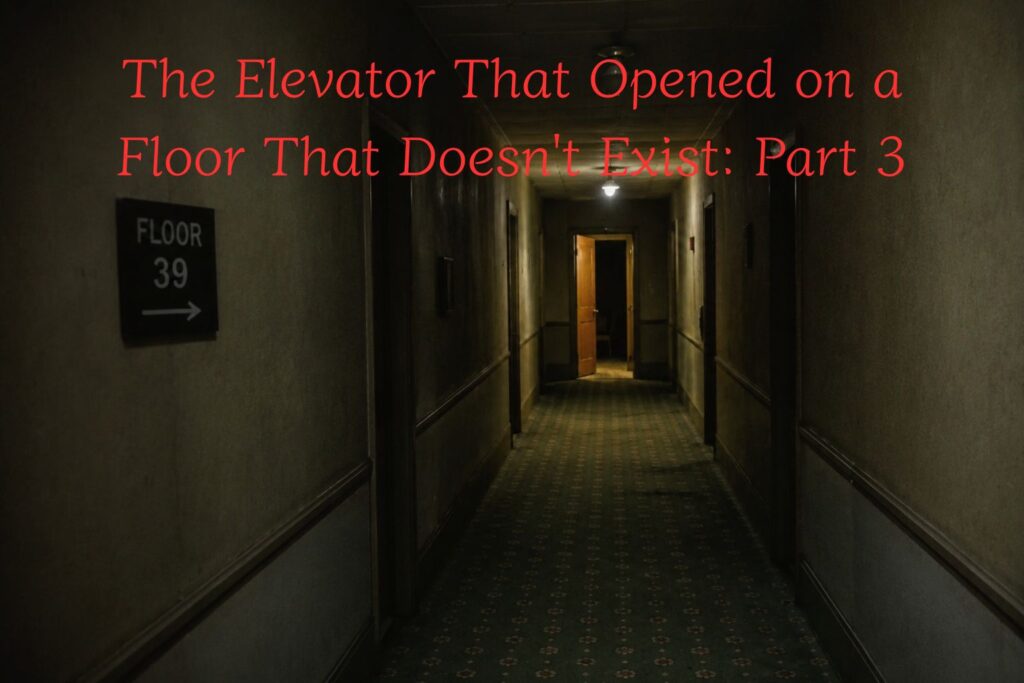
The Elevator That Opened on a Floor That Doesn’t Exist
Part 3: The Man Who Took My Name
The gunshot exploded inside the narrow passage.
For a moment, I felt nothing.
No pain.
No impact.
Only heat against my face and the violent ringing inside my ears.
Then something heavy struck the wall beside me.
Metal pipes shook.
A shower of rust and dust fell from above.
I dropped to the floor.
The darkness became complete.
I couldn’t see the older Daniel.
I couldn’t see the gun.
I couldn’t even see my own hands.
I crawled backward, one palm sliding across cold concrete, the other pressed against my chest.
No blood.
At least, none that I could feel.
“Daniel?”
The older man didn’t answer.
Somewhere ahead, I heard a low mechanical hum.
Then a wet dragging sound.
I froze.
A flicker of emergency light appeared behind me.
Not from a bulb.
From the cracks between the metal shelves blocking the passage entrance.
Shadows moved on the other side.
Several of them.
The employees had entered the archive room.
Their voices returned.
Softly this time.
Almost respectfully.
“Supervisor.”
“Supervisor Carter.”
“Your replacement has arrived.”
“Please complete the transfer.”
I heard the older Daniel breathing.
Fast.
Uneven.
He was still alive.
“Get up,” he whispered.
I stayed on the floor.
“You shot at me.”
“I shot behind you.”
“What?”
“Get up now.”
A shape moved in the darkness near my shoulder.
I turned.
Two pale hands extended from a gap between the pipes.
Long fingers reached toward my neck.
I scrambled forward.
The older Daniel fired again.
The muzzle flash illuminated the passage for half a second.
In that brief burst of light, I saw what had been behind me.
A man was halfway through the concrete wall.
Not through an opening.
Through the wall itself.
His torso had emerged from the stone as though the surface were liquid.
He wore an old security uniform.
His face was smooth.
No eyes.
No nose.
Only a narrow mouth stretching from one cheek to the other.
The second bullet struck his chest.
There was no blood.
The body jerked backward and disappeared into the wall.
The concrete hardened immediately.
The older Daniel grabbed me by the jacket.
“Move.”
We ran.
The passage turned sharply to the left.
Then right.
Then downward.
The floor sloped beneath us, though I was certain we were still somewhere above the thirty-seventh floor.
The voices followed inside the pipes.
“Unauthorized departure.”
“Return to your assigned office.”
“Attendance is mandatory.”
The older Daniel reached a steel ladder descending into darkness.
He climbed down first.
I followed.
The ladder seemed endless.
After perhaps twenty feet, my shoes touched solid ground.
A dim red bulb glowed overhead.
We stood inside a utility room filled with electrical panels and old machinery.
The air smelled of oil and burnt wires.
The older man leaned against the wall.
Blood ran down the side of his neck.
A bullet had grazed him.
“You’re hurt,” I said.
“It doesn’t matter.”
“You nearly killed me.”
“If I wanted you dead, you’d be dead.”
“I’m not convinced.”
“You saw what was behind you.”
“I also saw your badge.”
He looked down at the metal plate pinned to his jacket.
“Floor Supervisor.”
He said nothing.
“You said you were trapped here.”
“I am.”
“Supervisors usually work for the place they supervise.”
His jaw tightened.
“I worked for them once.”
“How convenient.”
“You think I wanted this?”
“I think you’ve been lying since the moment you appeared.”
He raised his eyes toward me.
“I haven’t lied.”
“You said you were me.”
“I am.”
“You said I’d become you.”
“You will.”
“And now the voices say I’m your replacement.”
He looked away.
“That part is also true.”
I backed toward the door.
“Then stay away from me.”
“You won’t survive ten minutes alone.”
“I was doing better before you arrived.”
“No, you weren’t. The floor was studying you.”
“Studying me?”
“Learning what you trust. What you fear. Which voices will make you open a door.”
He nodded toward the passage above us.
“It already knows about Rachel.”
“You knew about her too.”
“Because I remember this night.”
“Then tell me what happens next.”
His expression changed.
For the first time, he looked uncertain.
“I don’t know.”
“You claim you’ve lived this before.”
“I remember entering the floor.”
“I remember the office.”
“I remember the photograph.”
“I remember meeting an older version of myself.”
My stomach tightened.
“You met yourself too?”
“Yes.”
“What happened to him?”
The older Daniel looked at the revolver in his hand.
“I killed him.”
The utility room seemed to become colder.
I stared at him.
“You killed him?”
“He tried to force the transfer.”
“The same thing you’re trying to do to me?”
“No.”
“You pointed a gun at me.”
“To protect you.”
“You expect me to believe that?”
“No. I expect you to keep asking questions until there’s enough truth left to save you.”
I moved closer despite myself.
“What transfer?”
He removed the metal badge from his jacket.
I expected to see a pin.
There wasn’t one.
The plate appeared fused into the fabric.
When he pulled, the jacket stretched with it.
“It can’t be removed,” he said.
“What happens during the transfer?”
“The floor assigns you a role.”
“Why?”
“Because it needs people to continue operating.”
“This place isn’t an office.”
“No.”
“Then what is it?”
He glanced at the electrical panels.
Several small lights blinked in irregular patterns.
“I’ve had a hundred years to think about that.”
“And?”
“I believe Floor 39 is a machine.”
I almost laughed.
“A machine?”
“Not one built from steel and wires. Those are only parts of it.”
“What does it do?”
“It collects possibilities.”
“That means nothing.”
“It means every decision that could have been made still exists somewhere.”
He pointed upward.
“Every office you saw belongs to a version of this building that existed, might exist, or nearly existed.”
“The photograph from 1978?”
“One version of the building opened that year.”
“The picture of me and Rachel?”
“One version of us had that life.”
“And this floor brings those versions together?”
“Not exactly.”
He paused.
“It brings the remains.”
I felt a chill.
“The remains of what?”
“Timelines that ended.”
The electrical lights blinked faster.
The older Daniel lowered his voice.
“When a possibility collapses, most of it disappears. But certain places hold on to what was lost.”
“Why this building?”
“Because of what they built under it.”
“Who?”
“The Hawthornes.”
I remembered the photograph in the hallway.
“The original owners?”
“They didn’t build the tower as an office building. The offices came later.”
“What was it supposed to be?”
“A door.”
The red bulb above us flickered.
The utility room door rattled.
Once.
The older Daniel raised the revolver.
“They found us.”
“Who are they?”
“The ones who have worked here too long.”
The rattling stopped.
A voice came through the door.
A woman’s voice.
Calm.
Professional.
“Mr. Carter?”
The older Daniel’s face hardened.
“Don’t answer.”
“Mr. Carter, this is Human Resources.”
I looked at him.
He shook his head.
The voice continued.
“We understand that your onboarding experience has been distressing.”
I almost laughed from fear.
“Onboarding?”
“We would like to reassure you that your position has been selected according to your qualifications.”
The door handle turned.
It was locked.
“Please open the door so we can complete your orientation.”
The older Daniel moved toward the electrical panels.
“What are you doing?”
“Buying us time.”
He opened one and reached inside.
Thick bundles of cables filled the compartment.
Some were modern.
Others were wrapped in cloth.
A few looked almost organic.
Pale cords pulsed gently among the wires.
“Those are moving,” I whispered.
“I know.”
He grabbed two cables and pulled them apart.
The room went black.
The woman outside stopped speaking.
Then the entire building screamed.
There was no other word for it.
The sound came through the walls, floor, pipes, and ceiling at once.
A deep metallic cry filled with countless human voices.
The room shook.
The red bulb burst.
Emergency sirens began somewhere beyond the door.
The older Daniel turned on a small flashlight.
“We have less than five minutes.”
“For what?”
“To reach the records room.”
“What records?”
“Yours.”
A maintenance hatch stood behind one of the machines.
The older Daniel forced it open.
Beyond it was another corridor.
Unlike the old offices above, this level looked modern.
White walls.
Gray carpet.
Fluorescent lights.
Security cameras.
It resembled the real Hawthorne Building.
For several seconds, relief passed through me.
Then I noticed the windows.
There shouldn’t have been windows inside the center of the building.
Yet a long row of them lined the corridor.
Through each window was a different office.
In the first, daylight filled my workplace on the twenty-ninth floor.
My coworkers sat at their desks.
Rachel stood beside my cubicle, speaking to someone.
I stopped.
“That’s downstairs.”
“No,” the older Daniel said.
“It looks like downstairs.”
I approached the glass.
Rachel was crying.
A police officer stood beside her.
My chair was empty.
On the desk was a printed photograph of me.
It was the missing-person investigation.
The next morning.
I knocked on the glass.
“Rachel!”
She didn’t react.
I hit it harder.
“Rachel!”
Nothing.
The older Daniel pulled me away.
“They can’t hear you.”
“What is that?”
“A possible tomorrow.”
“Possible?”
“It hasn’t happened yet.”
I looked through the window again.
A detective placed something into an evidence bag.
My phone charger.
Rachel covered her mouth.
“Can I stop it?”
“That’s why we’re moving.”
The second window showed my apartment.
My mother sat on the sofa beside my sister.
Both were crying.
The television displayed my employee photograph beneath a news headline.
LOCAL MAN DISAPPEARS FROM DOWNTOWN OFFICE TOWER
The third showed the building lobby.
Police officers reviewed elevator footage.
On the security screen, I entered Elevator B.
The doors closed.
Seconds later, they opened in the lobby.
The cabin was empty.
I watched the footage repeat.
I stepped into the elevator.
Then vanished.
No flash.
No cut.
One moment I was there.
The next I wasn’t.
“This is what happened to you?” I asked.
The older Daniel nodded.
“And you’ve been here ever since?”
“Yes.”
“Then how are there two of us?”
He continued walking.
“Because I’m not from your future.”
I stopped.
“You said—”
“I said I was you.”
“You let me believe you were older.”
“I am older.”
“But not from my future?”
He turned toward me.
“I entered this floor in 1997.”
The corridor seemed to tilt beneath my feet.
“That’s impossible.”
“I was thirty-four.”
“The same age as you are now.”
“I worked on the twenty-ninth floor.”
“The same desk.”
“The same job.”
He looked toward the windows.
“Different company name. Different coworkers. Different life.”
“But your name—”
“Daniel James Carter.”
“My parents gave me the same name.”
“I went to Northwestern.”
“So did I.”
“I received the same award.”
“But my Rachel was named Laura.”
I stared at him.
“The floor doesn’t collect random people,” he said.
“It collects versions of the same people.”
“Why?”
“Because repetition creates stability.”
“You’re another version of me.”
“Yes.”
“How many are there?”
He didn’t answer.
“How many?”
“More than I can count.”
A light switched on behind the fourth window.
Inside was a small room.
A man sat facing away from us.
He wore my jacket.
My hairstyle.
My exact body.
The date displayed on a digital clock was November 14, 2025.
11:52 p.m.
He turned.
It was me.
Not older.
Not different.
Me.
He stood and approached the glass.
We faced each other.
Same face.
Same clothes.
Same fear.
I raised my hand.
He copied me.
Then his expression changed.
He smiled.
I wasn’t smiling.
The other Daniel placed one finger against his lips.
Behind him, a dark shape rose from the floor.
The older Daniel grabbed my shoulder.
“Don’t look.”
The window went black.
“What was that?”
“A version that didn’t find the office.”
“What happened to him?”
“He became useful.”
The glass cracked from the inside.
We ran.
The records room was hidden behind an unmarked steel door.
The older Daniel entered a code into a keypad.
The employee number the voices had called through the pipes.
The lock clicked.
Inside, rows of filing cabinets extended farther than the flashlight could reach.
Thousands of drawers.
Each labeled with names and dates.
The air was dry and cold.
“This is where they keep assignments,” he said.
“Assignments?”
“Every person brought here is given a purpose.”
He walked between the cabinets.
I followed, reading labels.
Some names appeared once.
Others appeared dozens of times.
REBECCA HOLT — 1964
REBECCA HOLT — 1981
REBECCA HOLT — 2009
REBECCA HOLT — 2038
Different versions.
Different years.
The older Daniel stopped at a cabinet marked:
CARTER, DANIEL J.
It contained hundreds of drawers.
My name repeated again and again.
Each followed by a date.
Some years hadn’t happened yet.
He opened the drawer marked 2025.
Inside was a thin folder.
My employee photograph was attached to the front.
Below it were several typed lines.
ARRIVAL STATUS: CONFIRMED
COMPATIBILITY: 98.7%
PROPOSED POSITION: FLOOR SUPERVISOR
TRANSFER CANDIDATE: CARTER-1997
I looked at the older Daniel.
“You are replacing yourself with me.”
“No.”
“It says transfer candidate.”
“I brought you here to destroy the file.”
“Why didn’t you destroy it before?”
“Because only the assigned candidate can open it.”
I pulled the folder from the drawer.
Inside were photographs.
Dozens.
Images of me from moments that no camera had recorded.
Me sleeping in my apartment.
Me eating lunch alone.
Me arguing with my father two years before he died.
Me sitting beside Rachel during a company conference.
Someone had been watching my entire life.
At the bottom was a psychological profile.
Fears.
Regrets.
Relationships.
Weaknesses.
One section was titled:
PRIMARY EMOTIONAL LEVER: RACHEL MORGAN
I felt anger replace fear.
“They chose her because they knew I’d follow her voice.”
“Yes.”
I turned another page.
SUPERVISOR TRANSFER REQUIREMENTS
- Candidate must enter voluntarily.
- Candidate must encounter assigned predecessor.
- Candidate must accept employee identification.
- Candidate must remain on Floor 39 until 12:39 a.m.
I checked my phone.
12:21 a.m.
Eighteen minutes.
“What happens at 12:39?”
“The transfer becomes permanent.”
“And you?”
“I’m released.”
“Back downstairs?”
The older Daniel didn’t answer.
“Released where?”
“I don’t know.”
“You were willing to trap me so you could leave.”
“At first.”
I stepped away from him.
“At first?”
“When I saw your file, I intended to complete the transfer.”
He spoke without defending himself.
“I had spent more than a century in this place. I had forgotten sunlight. Food. Sleep. I had forgotten what it felt like to stand in a room without hearing the building think.”
“So you called me.”
“Yes.”
“You led me to the office.”
“Yes.”
“You were going to replace yourself with me.”
“Yes.”
My hands tightened around the folder.
“What changed?”
“You did.”
“That’s not an answer.”
“You asked the same questions I asked in 1997.”
“You looked at the same photographs.”
“You refused the same lies.”
He stared at me.
“And I realized the version of me who trapped me had probably felt the same way.”
The words hung between us.
“How long has this been happening?”
“I don’t know.”
“Each Daniel replaces another?”
“Yes.”
“Then the one you killed—”
“Was Daniel Carter from 1978.”
“And he had replaced someone before him.”
“Yes.”
A chain.
Maybe decades old.
Maybe centuries.
Different versions of the same man sacrificing one another for freedom.
I looked at the transfer page.
“How do we stop it?”
“Destroy the file before 12:39.”
I tore the first page.
It didn’t rip.
The paper bent, then returned to its original shape.
I tried again.
Nothing.
“Fire?”
“Doesn’t burn.”
“Water?”
“Doesn’t damage it.”
“Then how?”
He pointed to a black symbol printed on the final page.
A circle intersected by three vertical lines.
“The original archive has a deletion terminal.”
“Where?”
“Below us.”
“How far below?”
He looked toward the ceiling as another alarm began to pulse.
“Farther than this building should go.”
A bell rang.
One clear metallic chime.
Every drawer in the records room opened simultaneously.
Paper filled the air.
Thousands of folders burst outward.
Photographs, reports, and identity cards spun around us like a storm.
The steel door slammed shut.
The lights turned on.
At the far end of the room stood a woman in a gray suit.
She was perhaps fifty.
Her hair was tied neatly behind her head.
A small gold badge rested on her chest.
EVELYN SHAW
DIRECTOR OF HUMAN RESOURCES
She smiled.
“Mr. Carter.”
The older Daniel aimed the revolver.
Evelyn didn’t react.
“Which one?” I asked.
Her smile widened.
“Both, temporarily.”
The older Daniel fired.
The bullet stopped in the air inches from her face.
It remained suspended.
She glanced at it with mild disappointment.
“Violence against management is a violation of company policy.”
The bullet turned around.
It shot backward.
The older Daniel fell.
Blood spread across his shoulder.
I ran toward him.
Evelyn raised one hand.
The filing cabinets moved.
Rows of metal drawers slid together, creating a wall between us.
I could hear the older Daniel on the other side.
“Run!”
Evelyn walked toward me.
Her heels made no sound.
“You’ve had a difficult first evening.”
“Stay away from me.”
“We understand that change can be uncomfortable.”
“I don’t work here.”
Her expression softened with false sympathy.
“Everyone works here eventually.”
I backed between the cabinets.
“You kidnapped me.”
“No.”
“You entered voluntarily.”
“An elevator brought me.”
“And you chose to step out.”
“The elevator doors closed.”
“You chose to walk away from them.”
“You manipulated me.”
“All employers influence candidate behavior.”
She held out her hand.
A metal badge rested in her palm.
DANIEL CARTER
FLOOR SUPERVISOR
The badge looked identical to the one fused to the older Daniel’s jacket.
“Accept your identification.”
“No.”
“Your predecessor has completed ninety-six years of satisfactory service.”
“You told me it had been more than a century,” I shouted toward the cabinets.
His voice answered weakly.
“Time moves differently.”
Evelyn continued.
“He has earned retirement.”
“And what do I earn?”
“A position.”
“I already have a job.”
“You have a temporary contract, moderate debt, limited advancement prospects, and no meaningful personal attachments.”
The words hit harder than I expected.
“You don’t know anything about me.”
“We know everything about you.”
Behind her, photographs rose into the air.
My childhood.
My graduation.
My father’s funeral.
Rachel smiling at me across a restaurant table during a team dinner.
“You seek significance,” Evelyn said.
“You fear that your life will pass without consequence.”
She stepped closer.
“Floor 39 offers permanence.”
“I don’t want permanence.”
“Most people say that before they understand death.”
The badge gleamed in her hand.
“Take it.”
The room changed.
The filing cabinets disappeared.
I stood in sunlight.
Warmth touched my face.
I was outside the Hawthorne Building.
Traffic moved through downtown Chicago.
People walked past me.
My phone showed full signal.
The time was 11:58 p.m.
Rachel stood near the entrance.
“Daniel?”
She ran toward me and wrapped her arms around my neck.
“You’re okay.”
I couldn’t speak.
Her hair smelled like rain.
Behind her, police vehicles surrounded the building.
“I thought you were gone,” she said.
I held her.
Everything felt real.
The cold air.
The wet pavement.
Her heartbeat.
Then she stepped back.
“You just need to sign one thing.”
My stomach turned.
She held the metal badge.
“Take it.”
I pulled away.
Her face remained smiling, but her eyes became still.
“This isn’t real.”
“Daniel—”
“This isn’t Rachel.”
The street froze.
Cars stopped in place.
Raindrops hung in the air.
Pedestrians became motionless.
Rachel’s smile stretched wider.
“You could make it real.”
The city peeled away like wallpaper.
I stood in the records room again.
Evelyn remained in front of me.
The badge rested on her palm.
“You have sixteen minutes,” she said.
Then she disappeared.
The filing cabinets returned to their original positions.
The older Daniel lay on the floor, bleeding heavily.
I knelt beside him.
“You need help.”
“I need to get you downstairs.”
He pressed one hand against his shoulder.
“Can you walk?”
“Yes.”
He couldn’t.
I pulled his arm around my neck and helped him stand.
The transfer folder remained clutched in my other hand.
Somewhere above us, a public-address system came alive.
Evelyn’s voice filled the building.
“Attention, employees.”
“Candidate Carter has declined voluntary orientation.”
“Mandatory processing will begin at 12:39 a.m.”
Every cabinet drawer slammed shut.
“Security personnel are authorized to use corrective measures.”
From outside the records room came the sound of hundreds of footsteps.
The older Daniel pointed toward the back wall.
“There.”
A narrow service elevator stood behind the final row of cabinets.
Its doors were rusted.
Above them, a display showed no number.
Only an arrow pointing downward.
I pressed the button.
The doors opened.
Inside was a cage barely large enough for two people.
No control panel.
Only a lever.
The older Daniel leaned against the wall.
“Once we start descending, don’t stop the elevator.”
“Why?”
“Because there are levels between floors.”
“What levels?”
“The ones that notice movement.”
That was all he said.
I pulled the lever.
The cage dropped.
We descended through darkness.
There were no cables above us.
No shaft walls beside us.
Only open black space beyond the metal bars.
The flashlight illuminated nothing.
I felt motion but saw no evidence of it.
No passing floors.
No machinery.
No wind.
The older Daniel sat against the cage wall, his face pale.
“How deep does it go?”
“No one knows.”
“You’ve been there?”
“Once.”
“To delete your own file?”
“To kill the Daniel before me.”
I looked at the revolver.
“Why did you kill him?”
“He told me the deletion terminal was a lie.”
“Was it?”
“I don’t know.”
“You’ve had a century and never checked?”
“I couldn’t return.”
“Why?”
He looked downward.
“Because something followed me back.”
A sound rose from beneath the cage.
A faint scratching.
Like fingernails moving across metal.
The older Daniel closed his eyes.
“Don’t look down.”
I gripped the folder.
The scratching grew louder.
Something climbed the underside of the cage.
The floor vibrated.
A hand wrapped around one of the lower bars.
Then another.
Pale fingers pulled a figure upward from the darkness.
I saw my own face.
The other Daniel from behind the window.
He clung to the outside of the cage.
His smile was too wide.
“Don’t trust him,” he said.
The older Daniel aimed the revolver.
The creature moved faster.
It reached through the bars and grabbed his wounded shoulder.
He screamed.
I kicked its hand away.
It turned toward me.
Its face changed.
Rachel.
Then my mother.
Then me again.
“You left us,” it said.
I stomped on its fingers.
The creature fell, but its arm stretched impossibly long, still attached to the cage.
The older Daniel fired.
The bullet tore through its wrist.
The arm vanished into the darkness.
The scratching stopped.
For several seconds, neither of us spoke.
Then a soft ding sounded.
The cage stopped.
The doors opened.
Outside was the lobby of the Hawthorne Building.
The real lobby.
Modern marble floors.
Glass entrance doors.
Security desk.
Streetlights visible outside.
I stared.
“We made it.”
The older Daniel didn’t move.
“No.”
“This is the lobby.”
“No, it isn’t.”
Behind the security desk sat a guard.
I recognized him.
Marcus Hill.
He worked weekday nights.
He looked up from his monitor.
“Mr. Carter?”
Relief nearly broke me.
“Marcus.”
I stepped out of the cage.
The older Daniel grabbed my sleeve.
“Don’t.”
Marcus stood.
“You all right? We’ve been looking for you.”
The street outside looked real.
Cars passed.
Rain struck the glass.
My phone regained signal.
Dozens of missed calls appeared.
Rachel.
My mother.
Unknown numbers.
“It’s real,” I said.
The older Daniel stared at Marcus.
“Ask him the date.”
“What?”
“Ask.”
I turned toward the guard.
“What date is it?”
Marcus looked confused.
“November fourteenth.”
“What year?”
His expression became blank.
“What year, Marcus?”
The lights dimmed.
Marcus’s mouth opened.
A rotary telephone rang inside his chest.
One ring.
Two.
Three.
His uniform split down the middle.
Behind it was no body.
Only darkness filled with hundreds of ringing telephones.
The lobby windows turned black.
The street disappeared.
The marble floor became old green carpet.
We were back on Floor 39.
The service elevator doors closed behind us.
The display above them lit up.
12:31 A.M.
Eight minutes remained.
Every office door in the corridor opened.
The employees stepped out.
Hundreds of them.
Men and women from different decades.
Some had faces.
Some didn’t.
Some wore versions of my face.
At the end of the hallway stood Evelyn.
She held the badge.
“Final orientation,” she announced.
The older Daniel placed the revolver in my hand.
“There are six bullets left.”
“There were six bullets when we started.”
He looked at the weapon.
“Then stop wasting them.”
The employees began walking toward us.
“Where’s the deletion terminal?”
He pointed at the elevator doors behind us.
“Below this level.”
“The elevator’s gone.”
“There’s another way.”
“Where?”
He looked toward the nearest office.
A brass sign on the door read:
EXECUTIVE STAIRWELL
The employees moved closer.
The older Daniel stepped in front of me.
“You have the file.”
“What are you doing?”
“Giving you time.”
“You’re coming with me.”
“I can’t.”
“Yes, you can.”
“No.”
He pulled open his jacket.
The supervisor badge had spread.
Thin black lines extended from it across his chest and neck like veins.
His skin around the metal was turning gray.
“The floor is calling me back.”
I grabbed his arm.
“You said we could stop this.”
“You can.”
“We can.”
He smiled weakly.
“That’s what I said to the version before me.”
Behind us, Evelyn raised one hand.
The employees stopped.
“Supervisor Carter,” she said.
“Complete your final duty.”
The older Daniel looked at me.
“Whatever happens downstairs, don’t believe anything that knows your name.”
He pushed me toward the stairwell.
Then he turned and fired into the ceiling.
The lights exploded.
Darkness swallowed the hallway.
The employees screamed.
I ran.
Behind me, gunshots echoed.
One.
Two.
Three.
I reached the stairwell door and pulled it open.
A spiral staircase descended into red light.
I looked back once.
The older Daniel stood alone in the corridor.
Employees surrounded him.
Evelyn watched from the far end.
He raised the revolver toward his own supervisor badge.
Our eyes met.
He fired.
The explosion threw me through the doorway.
The stairwell door slammed shut.
Silence followed.
My phone showed:
12:34 a.m.
Five minutes remained.
I still had the folder.
I still had the badge Evelyn had offered me.
I didn’t remember taking it.
Yet it was now inside my jacket pocket.
Below me, from somewhere deep in the stairwell, Rachel called my name.
This time she wasn’t crying.
She sounded angry.
“Daniel.”
I looked down.
Hundreds of steps disappeared into the red glow.
“Bring me the file.”
A second voice joined hers.
My own.
“Before they learn which one of us is real.”