
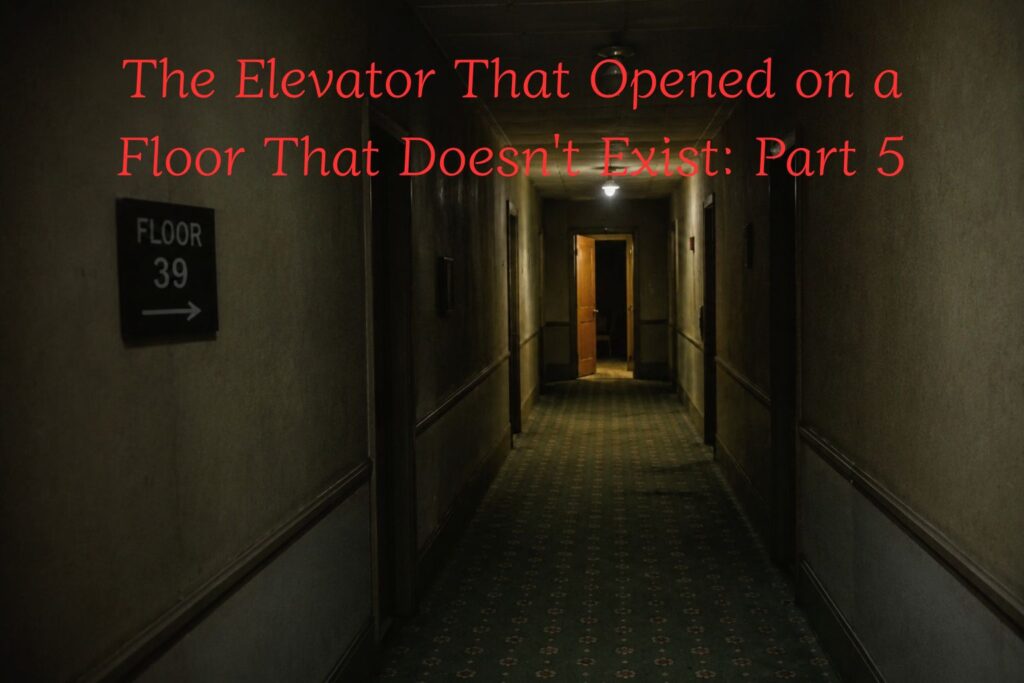
The Elevator That Opened on a Floor That Doesn’t Exist
Part 5: The Exit Interview
“Daniel Carter.”
The voice came from the interview room.
Not loud.
Not threatening.
Just patient.
Every version of me in the waiting room turned toward the door.
Hundreds of faces.
Some young.
Some old.
Some scarred.
Some barely human.
All of them mine.
My ticket burned between my fingers.
347
The display above the door blinked.
NOW SERVING: 0347
The older Daniel beside me stood.
“No.”
His voice was quiet, but every version heard him.
Several men rose from their chairs.
One wore a wool suit from the 1920s.
Another had an employee badge embedded in his forehead.
A third looked no older than nineteen.
They all stared at the open door.
“You can’t go in alone,” the older Daniel said.
The interview room remained dark.
The voice returned.
“Candidate 347 is required to attend individually.”
I looked at the hundreds of versions around me.
“Why did it skip everyone else?”
The man with the elevator button in his eye answered.
“Because you filed the resignation.”
The button clicked when he blinked.
“You’re the active supervisor.”
“Then why are all of you here?”
“To confirm whether your resignation applies to us.”
“And if I fail?”
Nobody answered.
From inside the room came the faint scrape of a chair being pulled away from a desk.
The older Daniel touched my arm.
“Don’t answer anything too quickly.”
“What are they going to ask?”
“Different questions for every person.”
“You said there was one answer they accept.”
“There is.”
“What is it?”
The older Daniel looked toward the open doorway.
“You have to mean it.”
“That still isn’t an answer.”
“No.”
His face had become more transparent.
The cables beneath his skin were visible now, pulsing in slow black lines.
“It isn’t.”
The voice called again.
“Daniel.”
This time, it sounded like my father.
Every muscle in my body tightened.
Not the false version from the staircase.
This voice was exact.
Weak.
Breathless.
The voice from the final night in the hospital.
“Please come in.”
The waiting room disappeared.
For one second, I was back beside my father’s bed.
His hand in mine.
The monitor beeping.
The smell of disinfectant.
His eyes half-closed.
Then the waiting room returned.
The older Daniel was watching me.
“It knows the part you never told anyone,” he said.
“What part?”
“The thing he said.”
I stared at him.
“How do you know?”
“Because every Daniel carries something he never said aloud.”
The interview room waited.
I looked down at the burning ticket.
Then I walked toward the door.
The room was smaller than I expected.
A metal desk.
Two chairs.
A filing cabinet.
A lamp with a green shade.
No windows.
No visible exit except the door behind me.
The moment I entered, it closed.
The handle disappeared.
A person sat on the opposite side of the desk.
At first, I thought it was Evelyn.
Then the face changed.
My manager.
Rachel.
My mother.
The older Daniel.
My own reflection.
The features moved slowly, never settling.
On the desk rested my personnel folder.
It was undamaged.
Every page I had torn had returned.
The interviewer folded its hands.
“Please sit.”
I remained standing.
“Is this mandatory?”
“All departure procedures are mandatory.”
“Then it isn’t an interview.”
The face became mine.
“Correct.”
I sat.
A tape recorder clicked on.
The interviewer opened the folder.
“State your full name.”
“Daniel James Carter.”
“Which one?”
I said nothing.
The interviewer waited.
“What do you mean?”
“Which Daniel James Carter are you?”
“The one who entered tonight.”
“Many entered tonight.”
“The one from 2025.”
“Many originate from 2025.”
“The one from Chicago.”
“All originate from Chicago.”
Frustration rose in my chest.
“You already know who I am.”
“We know what you remember.”
“That’s the same thing.”
“No.”
The interviewer turned a page.
“Memory is a record. Identity is an authorization.”
“I’m not an employee.”
“You accepted identification.”
“Under coercion.”
“You exercised available choice.”
“That isn’t consent.”
“Your presence continued.”
“I was trapped.”
“You explored.”
“I was looking for a way out.”
“You accessed restricted records.”
“To escape.”
“You assumed supervisory authority.”
“To survive.”
The interviewer leaned closer.
“Every employee describes employment as survival.”
Its face became Evelyn’s.
“Why do you wish to resign?”
“Because this place abducts people.”
“Incorrect.”
“It manipulates them.”
“Standard recruitment practice.”
“It traps copies of people for decades.”
“Archived constructs do not experience duration in the human sense.”
“They feel pain.”
“They reproduce the memory of pain.”
“What’s the difference?”
The interviewer paused.
Its face shifted into the older Daniel’s.
“You tell us.”
The tape recorder continued turning.
I looked at the folder.
“Is he real?”
“Define real.”
“Does he think?”
“He responds.”
“Does he suffer?”
“He reports suffering.”
“Does he want to live?”
“He reports preference for continuation.”
“That means yes.”
“That is your interpretation.”
“No. That is your excuse.”
The interviewer made a note.
Candidate displays attachment to simulated personnel.
I reached across the desk and turned the paper toward me.
“What happens to the others if I fail?”
“They return to assigned status.”
“And me?”
“You remain supervisor.”
“For how long?”
“Until replaced.”
“By another version.”
“Yes.”
“And the chain continues.”
“Continuity is desirable.”
“Not to us.”
The interviewer’s face became Rachel’s.
“Why are you leaving, Daniel?”
The voice was gentle now.
Not official.
Not cold.
Her real voice.
I looked away.
“Don’t use her.”
“Why?”
“Because she isn’t part of this.”
“She is central to your profile.”
“That doesn’t make her yours.”
“You thought about her before entering the elevator.”
“So?”
“You imagined a life with her.”
I said nothing.
The interviewer opened the folder to the photograph from 2034.
Rachel beside me.
Two children.
Lake Geneva.
“Did this possibility bring you comfort?”
“It wasn’t real.”
“Did it feel desirable?”
“Yes.”
“Then why reject it?”
“Because desire isn’t truth.”
The interviewer smiled with Rachel’s mouth.
“What is truth?”
“That it didn’t happen.”
“Not in your sequence.”
“That means it didn’t happen to me.”
“Which returns us to the original question.”
Its face became mine again.
“Which Daniel are you?”
I stared at my own eyes across the desk.
The answer seemed obvious.
Then it didn’t.
I had seen versions of my life.
Versions of Rachel.
Versions of the building.
Versions of myself from years that had not yet arrived.
The floor could copy memory.
Construct personality.
Rewrite records.
Maybe I was only another construct.
A candidate assembled from stored information.
Maybe the real Daniel had never left Elevator B.
Maybe there had never been a real Daniel.
The interviewer watched me doubt.
“That is why personnel require identification,” it said.
“Without assignment, identity becomes unstable.”
“You create the instability.”
“We organize it.”
“You erase the difference between a person and a file.”
“Human beings do the same.”
The words hit me.
Names.
Employee numbers.
Records.
Credentials.
Photographs.
Accounts.
Everything people used to prove that someone existed was information stored somewhere.
The floor had only taken the idea further.
“What answer do you want?” I asked.
“The truthful one.”
“You already know my memories.”
“We do.”
“You know my fears.”
“Yes.”
“You know every decision I made.”
“Yes.”
“Then why ask me anything?”
The interviewer leaned back.
“Because records can be copied.”
The room became colder.
“Choice cannot.”
For the first time, I understood.
The interview wasn’t testing my history.
It was testing whether I could make a decision the floor had not predicted.
I looked at the personnel file.
Every page described me.
Every weakness.
Every emotional lever.
Every probable reaction.
The floor knew I would follow Rachel’s voice.
Knew I would distrust the older Daniel.
Knew I would accept the badge under pressure.
Knew I would try to rescue the archived versions.
Even my rebellion had been anticipated.
“What is the accepted reason for leaving?” I asked.
The interviewer’s face became blank.
No eyes.
No mouth.
Then words appeared across its skin.
PERSONNEL MUST DEMONSTRATE NON-DEPENDENCE
“What does that mean?”
The mouth returned.
“Employees leave when they no longer require employment.”
“I never required this.”
“You required answers.”
The folder opened by itself.
Photographs rose into the air.
The impossible floor.
The office.
The older Daniel.
The pit.
The eye beneath the building.
“You remained because you wanted to understand.”
“I remained because I couldn’t leave.”
“You could have waited at the elevator.”
“The elevator disappeared.”
“You could have remained in the first office.”
“And become trapped.”
“You could have accepted the position.”
“That isn’t leaving.”
“You assume departure must preserve your preferred outcome.”
The interviewer leaned forward.
“To leave, you must surrender all claims.”
“What claims?”
“Answers.”
The room changed.
The wall behind it opened.
Beyond it was the real lobby.
I could see Marcus at the security desk.
Rain against the glass.
The street outside.
My phone vibrated with dozens of missed calls.
Freedom was ten steps away.
The interviewer placed one paper on the desk.
FINAL RELEASE AGREEMENT
I read the terms.
I would return to the lobby.
My disappearance would last less than four minutes.
No one would remember Floor 39.
No record of the event would exist.
The other Daniels would remain archived.
The older Daniel would be deleted.
The supervisor role would continue.
Another candidate would eventually be selected.
At the bottom:
I accept that I am not responsible for personnel outside my assigned sequence.
A pen appeared beside the page.
“Sign,” the interviewer said.
I looked through the opening.
Marcus stood.
Alive.
Normal.
Beyond the glass, a taxi passed.
The world continued without me.
“You’re offering me my life back.”
“Yes.”
“In exchange for leaving everyone else here.”
“You do not know them.”
“They’re versions of me.”
“They are records.”
“They feel.”
“You cannot verify that.”
I thought of the older Daniel asking me for help.
Maybe programmed.
Maybe real.
Maybe there was no meaningful difference.
“What happens if I refuse?”
“The interview continues.”
“For how long?”
“Duration is not relevant here.”
“Centuries?”
“If necessary.”
The trap became clear.
The floor didn’t need me to accept the job.
It only needed me to keep negotiating.
Every question tied me to the place.
Every demand for certainty kept me seated.
I looked at the pen.
Then at the opening to the lobby.
Then at the folder.
The interviewer waited.
I pushed the release agreement away.
“I’m not signing.”
The opening closed.
Darkness returned behind the interviewer.
“You reject departure?”
“I reject your terms.”
“Then you remain.”
“No.”
I stood.
The interviewer’s face became Evelyn’s.
“Sit down.”
“No.”
“The interview is incomplete.”
“I’m finished.”
“Departure has not been approved.”
“I’m not asking.”
The tape recorder stopped.
The room became completely silent.
The interviewer watched me.
“You cannot leave without authorization.”
I looked at the wall where the door had been.
There was nothing there.
“No,” I said.
“I can leave without answers.”
Something changed.
The interviewer’s expression became uncertain.
“What do you mean?”
“I don’t need to know which Daniel is original.”
The lamp flickered.
“I don’t need proof that the older Daniel is real.”
A crack appeared across the desk.
“I don’t need to know what the building truly is.”
The walls trembled.
“I don’t need you to admit what you’ve done.”
The personnel file burst into flames.
Not normal fire.
White light consumed the pages without heat.
The interviewer rose.
“This statement does not constitute a valid departure request.”
“I’m not requesting departure.”
“Then state your intention.”
I looked into the shifting face.
“I’m leaving because I choose to leave.”
The interviewer froze.
Behind it, the wall split open.
Not into the lobby.
Into the waiting room.
All 346 Daniels were standing.
Watching.
The older Daniel stood in front.
He was barely visible now.
The interviewer turned toward them.
“This interview applies only to active personnel.”
The man with the elevator button in his eye stepped forward.
“I’m leaving.”
Another Daniel stood.
“So am I.”
Then another.
And another.
Different voices.
Different decades.
Different lives.
“I’m leaving.”
“I’m leaving.”
“I’m leaving.”
The phrase spread through the waiting room.
Not a request.
Not a resignation.
A decision.
The walls cracked.
The number display flashed randomly.
Negative numbers.
Symbols.
Years.
Evelyn appeared in the waiting room doorway.
Her face was breaking apart.
“Stop.”
No one did.
The interviewer slammed both hands onto the desk.
“Personnel must remain within assigned sequence.”
The older Daniel smiled.
“We are not personnel.”
The statement hit the room like an explosion.
Employee badges tore free.
Metal plates ripped from skin, clothing, bone.
The waiting room filled with screams.
The badge in my palm burned white.
I grabbed it and pulled.
Pain shot through my arm.
Black veins stretched beneath my skin.
I pulled harder.
The badge came free with a sound like tearing paper.
There was no wound beneath it.
Only smooth skin.
I threw the plate onto the desk.
“My name is not a position.”
The floor collapsed.
For several seconds, I fell.
Not downward.
Through.
Offices passed around me.
Thousands of them.
Different eras.
Different buildings.
People sitting at desks beneath gas lamps.
People typing on computers that had not been invented.
Empty cubicles covered in dust.
Rooms flooded with water.
Rooms floating beneath open skies.
Elevators moving sideways.
Staircases leading into childhood homes.
Every abandoned possibility opening at once.
The older Daniel fell beside me.
So did hundreds of others.
Some disappeared as they fell.
Others became younger.
Older.
Transparent.
Solid.
Their lives flickered across their bodies like projected films.
I saw marriages.
Funerals.
Children.
War.
Loneliness.
Joy.
Every Daniel had been a person.
Or believed he had.
That was enough.
Below us, the enormous eye opened.
The fracture.
It filled the darkness.
Not a creature.
A view.
Through it, I saw realities stacked without order.
A world where Hawthorne Tower never existed.
A world where Chicago had burned.
A world where I died at seven.
A world where Rachel never met me.
A world where she was waiting in our kitchen beside two children.
The possibilities pulled at me.
Each one offered something.
A better life.
A longer life.
A life without loss.
My father alive.
My debts gone.
Rachel loving me.
I felt myself separating.
One memory moving toward one world.
Another toward another.
The floor wanted me divided.
A person reduced to possible outcomes.
The older Daniel grabbed my wrist.
“Choose something.”
“What?”
“Anything.”
“There are too many.”
“That’s how it keeps us.”
He shouted over the roar.
“Choose one truth.”
I searched my memories.
My father’s face.
Rachel’s necklace.
The elevator.
The office.
Which were real?
Which were copied?
I didn’t know.
Then I remembered something ordinary.
At 11:36 p.m., I had corrected a mistake in the quarterly report.
A single transposed number.
I remembered the irritation.
The cold coffee beside my keyboard.
The ache in my neck.
Nothing meaningful.
Nothing dramatic.
Nothing the floor could use as temptation.
A boring moment.
My moment.
“I finished the report,” I said.
The older Daniel stared at me.
“What?”
“At 11:42, I saved the report.”
The worlds around me slowed.
“My coffee was cold.”
The fracture tightened.
“My left shoe was wet because I stepped in a puddle at lunch.”
The eye began closing.
“I had a headache.”
The possibilities faded.
“I wanted to go home.”
Home.
Not the perfect version.
Not the life from the photograph.
My actual apartment.
Unwashed dishes.
A broken kitchen drawer.
Mail stacked beside the door.
A life that was incomplete because it was mine.
The older Daniel laughed.
“I used to hate the office coffee.”
The man from 1938 shouted:
“I lied about knowing how to drive during my first job interview.”
Another called:
“I never returned a library book when I was twelve.”
Ordinary truths filled the darkness.
Tiny memories.
Unimportant choices.
Things no personnel file would consider useful.
The floor shook.
It could reproduce trauma.
Desire.
Fear.
But human identity wasn’t built only from important moments.
It was built from millions of useless details.
The eye closed.
The pull vanished.
We fell into white light.
I hit a hard floor.
The air left my lungs.
For several seconds, I couldn’t move.
Rain tapped against glass.
A fluorescent light hummed overhead.
Somewhere nearby, a radio played softly.
I opened my eyes.
Marble.
Modern lobby.
Security desk.
Marcus Hill stood over me.
“Mr. Carter?”
I rolled onto my back.
He crouched beside me.
“What happened?”
I looked around.
No other Daniels.
No Evelyn.
No old hallway.
Elevator B stood closed behind me.
The display showed L.
My phone lay a few feet away.
The screen read:
11:52 p.m.
Only four minutes after I had entered the elevator.
Marcus helped me sit.
“You came out and collapsed.”
“I came out?”
“Yeah.”
He pointed toward the elevator.
“The doors opened and you fell.”
“Was anyone with me?”
“No.”
I looked at my palm.
No badge.
No black veins.
Nothing.
The folder was gone.
The revolver was gone.
Marcus studied my face.
“You want me to call an ambulance?”
I almost said yes.
Then the elevator dinged.
The doors opened.
Empty.
The display above it flickered.
For a fraction of a second, I saw:
39
Then L returned.
I stood too quickly.
Marcus grabbed my arm.
“Easy.”
“Shut it down.”
“What?”
“Elevator B.”
“Why?”
“Just shut it down.”
He looked confused.
“It’s already scheduled for maintenance tomorrow.”
“Don’t let anyone use it.”
“Mr. Carter—”
“Promise me.”
He stared at me.
Then nodded.
“Okay.”
I left the building.
I did not report what happened.
Not that night.
Not the next day.
I told my manager the elevator had malfunctioned and that I had fainted from exhaustion.
The security footage showed exactly what Marcus described.
I entered Elevator B at 11:48 p.m.
The cabin descended to the lobby.
At 11:52, the doors opened.
I fell out alone.
Four minutes.
Nothing more.
The elevator’s internal camera recorded static during the descent.
Maintenance found no mechanical defect.
No hidden floor settings.
No abnormal wiring.
I resigned two weeks later.
Rachel asked why.
I told her the job had become too much.
That was partly true.
We kept in touch for a while.
Then less often.
She eventually moved to Seattle.
We never married.
We never had the children from the photograph.
At least, not in this sequence.
The Hawthorne Building remained open.
Elevator B was replaced during renovations.
I heard the original control system had been destroyed.
For years, nothing happened.
I began to believe the floor was gone.
Or sealed.
Or that I had suffered some kind of breakdown.
Then the dreams started.
In them, I sat in a waiting room.
The display always showed:
NOW SERVING: 0347
The chairs were empty.
But I could hear breathing behind the interview room door.
Sometimes the older Daniel sat beside me.
He never spoke.
He looked younger each time.
Then one night, he finally turned to me.
“You left the door open.”
I woke before I could ask what he meant.
Six years passed.
I moved to a different city.
Changed careers.
Tried to build a normal life.
I rarely entered elevators alone.
When possible, I took the stairs.
I never told anyone the full story.
Then, three weeks ago, I received a package.
No return address.
Inside was a black rotary telephone.
The same model from the office on Floor 39.
There was no cable.
No plug.
No way for it to function.
Beneath it was a single employee photograph.
It showed me standing in the Hawthorne Building lobby on the night I escaped.
Marcus was beside me.
Behind us, inside Elevator B, stood hundreds of men.
Every version of Daniel Carter.
The older Daniel stood at the front.
On the back of the photograph, someone had written:
Mass resignation accepted. Exit processing incomplete.
That night, the telephone rang.
I did not answer.
It rang again the next night.
And the next.
Always at 11:52 p.m.
I locked it inside a closet.
The sound came through the walls.
I took it to an empty field and left it there.
The following morning, it was back on my kitchen table.
Two nights ago, I finally picked up the receiver.
For several seconds, there was only static.
Then the older Daniel spoke.
He sounded far away.
“You were right.”
“About what?”
“We were real.”
I couldn’t speak.
Behind his voice, I heard hundreds of people.
Not screaming.
Talking.
Laughing.
Crying.
Alive.
“Where are you?”
“We don’t know.”
“Are you free?”
A long silence.
“Some of us are.”
“What about the others?”
“The floor did not release everything.”
My hand tightened around the receiver.
“What stayed behind?”
His voice lowered.
“The part that was never an employee.”
The line crackled.
“The employer.”
I looked toward my apartment hallway.
The lights flickered.
Once.
Twice.
At the far end stood an elevator door.
My building did not have an elevator.
Red numbers glowed above it.
39
The older Daniel whispered:
“It needs a new address.”
The doors began to open.
Before the connection ended, he said one final thing:
“Daniel, whatever comes out, do not let it learn what you call home.”
The line went dead.
The elevator doors opened completely.
There was no cabin behind them.
Only the old green hallway.
Yellow lamps.
Floral wallpaper.
Closed wooden offices.
At the far end, someone stood waiting.
A woman in a gray suit.
Her face was badly cracked.
But she was smiling.
In one hand, Evelyn held a clipboard.
In the other, she held a new brass sign.
She placed it beside the open elevator door.
The sign read:
NOCTURNAL STORIES
NOW HIRING