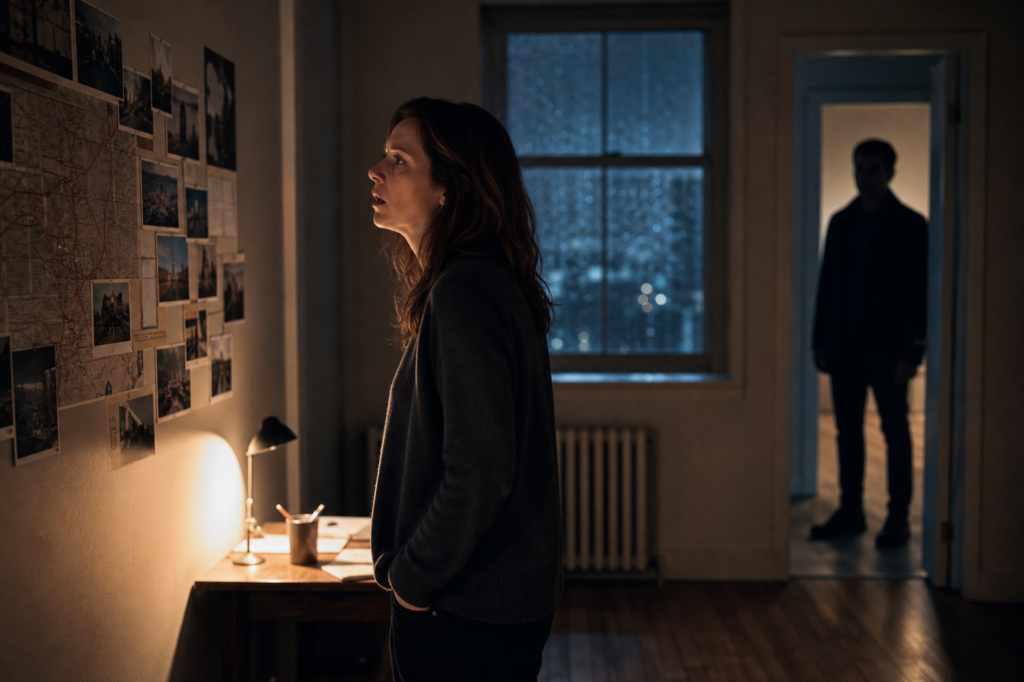
The secret apartment my husband kept from me had no bed, no dishes, and no clothes—only a wall covered with photographs of my life.
Some were recent: me carrying groceries, me leaving work, me sitting alone in our car outside the pharmacy. Others were old enough to make my knees weaken. There I was at nineteen, crossing my college campus in a red coat I had forgotten I owned.
My husband, Mark, and I did not meet until I was twenty-six.
I was still staring at the photographs when the lock turned behind me.
The Key That Did Not Belong to Our Home
Until that Thursday, I would have described our marriage as ordinary in the best possible way. Nine years together had replaced grand gestures with small, reliable kindnesses. Mark warmed my side of the bed during winter. I left the porch light on when his train ran late. We argued about cabinet doors, apologized badly, and knew exactly how the other person took coffee.
That was why the key bothered me.
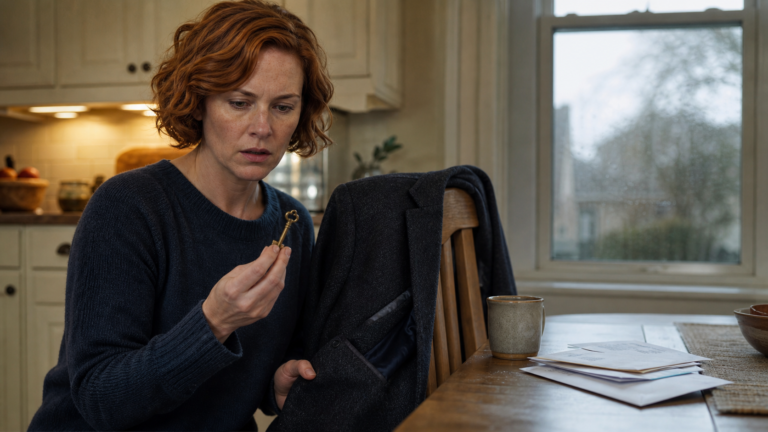
I found it in the pocket of his gray coat while searching for a receipt. It was attached to a white plastic tag stamped 3C. Our house had no numbered rooms. Mark’s office used electronic cards, and his parents lived in another state.
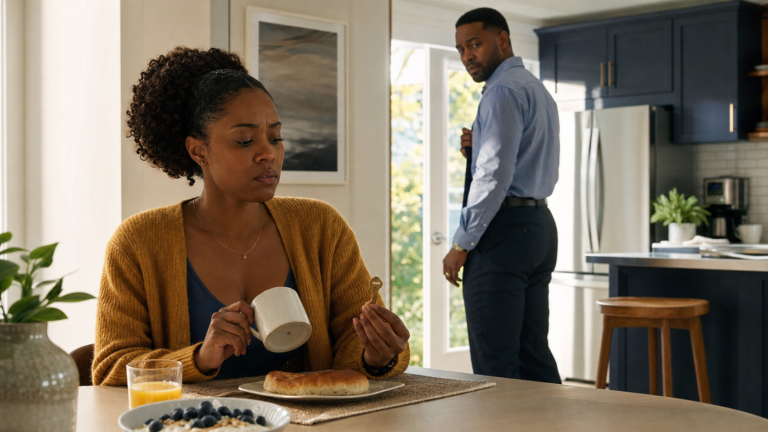
When I asked him about it, he barely looked up from chopping onions.
“Old storage unit,” he said. “Work documents.”
He answered too quickly. Mark was a terrible liar, not because he became nervous, but because he became efficient. Real answers wandered. His false ones arrived polished and complete.
I told myself not to turn one key into a crime. Then, two days later, our bank app showed a monthly payment to Bellweather Property Management. Nine hundred and forty dollars. The charge had appeared on the same date for fourteen months, hidden inside an account we used for home repairs.
I called the company and pretended I was confirming an appointment. The receptionist asked, “Is this about Apartment 3C on Mercer Street?”
I hung up without answering.
Every Thursday at Seven
Mark had started taking Thursday evening “client calls” the previous year. He would leave at six-thirty, return around nine, and smell faintly of dust and cold air. I had never questioned it. Trust is not blindness; it is the decision not to investigate every unlocked door.
That Thursday, I followed him.
He took the train downtown, walked four blocks in the rain, and entered a narrow brick building between a tailor and a closed bookstore. I waited across the street until the light on the third floor turned on.
For twenty minutes, I imagined the obvious. Another woman. A second life. Perhaps a child. Those possibilities hurt, but they were familiar shapes. People survived affairs. They divided furniture. They learned to sleep alone.
Mark left just before eight. He did not notice me beneath the awning.
I had copied the brass key at lunch.
Apartment 3C smelled like old paper and radiator heat. There was no living-room furniture, only a folding table, two metal chairs, and cardboard boxes arranged by year. A lamp illuminated the far wall.
The first photograph I recognized showed me outside the library where I worked after college. I was laughing at something outside the frame.
The next showed me boarding a bus.
Then sleeping beside the window in my first apartment.
I stepped backward and hit the table. A folder fell open. Inside were printed schedules, copies of rental applications, old social-media posts, and pages of handwritten observations.
Tuesday: leaves class at 4:10.
Orders tea when anxious.
Calls mother every Sunday.
The notes began seven years before I met Mark.
The Man in the Doorway
The lock turned at 8:23.
Mark entered carrying a small archive box. His face changed when he saw me—not the fear of a husband caught cheating, but the exhausted recognition of someone watching an old disaster arrive exactly on schedule.
“Claire,” he said. “Put the folder down.”
“How long have you been watching me?”
“I haven’t.”
I pointed at a photograph taken outside my office three months earlier.
Mark set the box on the floor and remained near the door. “I can explain the room. I can’t explain it in a way that won’t change what you think of me.”
“That changed when I saw my bedroom window on your wall.”
He flinched. Then he removed a photograph from his wallet and placed it on the table.
Two teenage boys stood beside a lake. One was Mark. The other had the same eyes but longer hair and an uneven smile.
“My brother, Lucas,” he said. “He died thirteen years ago.”
I knew Mark had a brother who died in a car accident. I knew the subject made his mother leave dinner tables and his father become silent. I had never seen a photograph.
But I had seen Lucas.
The Summer I Tried to Forget
At nineteen, I spent a summer convinced that someone was following me.
Objects moved in my dorm room. A yellow flower appeared beneath my windshield wiper every Monday. Once, through the library window, I saw a young man watching me from the courtyard. Campus security found nothing. My friends suggested I was exhausted.
Then someone entered my apartment while I slept. Nothing was stolen. The intruder placed my red coat across the foot of my bed and left a cup of tea on the kitchen counter.
I moved home the next morning.
For years I felt embarrassed by how frightened I had been. I packed the memories away because no arrest, injury, or obvious ending gave me permission to call myself a victim.
Lucas was the man from the courtyard.
Mark said the apartment had belonged to him. After Lucas’s death, their parents locked it and stopped paying attention to what remained inside. The building changed owners twice. Fourteen months earlier, a property manager finally contacted Mark about clearing the abandoned contents.
“I found the photographs,” he said. “I found your name. Then I found the recent ones.”
“Recent?”
He opened the archive box. The top envelope was postmarked the previous year. Inside were new photographs of me, our house, and Mark leaving his office.
“Someone has been mailing them here every few months,” he said. “I rented the apartment so the address stayed active. I’ve been trying to learn who is sending them.”
His explanation should have comforted me. Instead, another question sharpened.
“Why didn’t you call the police?”
“I did. There was no threat, no return address, and no proof the photographer was the same person who knew Lucas. They took a report.”
“Why didn’t you tell me?”
Mark looked toward the wall. “Because of how we met.”
The Coffee Shop Was Not an Accident
Our story had always begun in a crowded coffee shop.
I spilled tea across Mark’s newspaper. He made a joke about saving the crossword. We talked until the staff stacked chairs around us. For years, the memory had felt like evidence that chance could be generous.
It was not chance.
After Lucas died, Mark found a small box in his car containing three photographs of me and a page with my workplace address. Mark was twenty-three, grieving and horrified. He drove to the library intending to warn me, but he saw me through the window and lost his courage.
He returned several times. He learned when I took lunch. He chose the coffee shop because I visited it on Fridays. He sat at the only table beside the counter and waited.
“You arranged our first meeting,” I said.
“Yes.”
“Did you spill my tea too?”
“No. That part was you.”
Under any other circumstances, I might have laughed. In Apartment 3C, it sounded cruel.
Mark said he planned to tell me about Lucas after our first conversation. Then after our third date. Then before he proposed. Every delay made the confession more dangerous, and every happy year gave him more to lose.
“I loved you,” he said. “I thought telling you would turn our entire life into an extension of what he did.”
“You made that decision for me.”
He did not argue.
The Photograph Behind the Map
I wanted to believe Mark had been a frightened young man whose cowardice grew around a genuine love. That explanation was painful, but human.
Then I noticed a corner of glossy paper behind the city map.
Mark moved when I reached for it.
That movement told me more than any confession.
I pulled the photograph free. It showed me at twenty-five, sitting on the steps outside my apartment with my college friend Tessa. The date printed on the back was eight months after Lucas died and eleven months before the coffee shop.
The handwriting beneath it was not Lucas’s. I knew because it matched the labels on the boxes.
It was Mark’s.
Friday. Tea shop at 12:40. Usually alone.
The room tilted.
“You said you came to warn me.”
“That’s why I came the first time.”
“And the next hundred times?”
He sat down as if his legs no longer held him. “I needed to understand why Lucas chose you. Then I saw you kept looking over your shoulder. I thought if I knew your routine, I could make sure nobody was there.”
“You protected me by doing exactly what he did.”
Mark covered his face.
That was the true secret of the apartment. It did not preserve one dead man’s obsession. It documented the moment Mark inherited it and renamed it concern.
The Person Sending the New Photographs
A floorboard creaked in the hallway.
A woman stood outside the open door. She was close to sixty, rain shining on her coat. I recognized Mark’s mother, Diane, though I had not seen her in months.
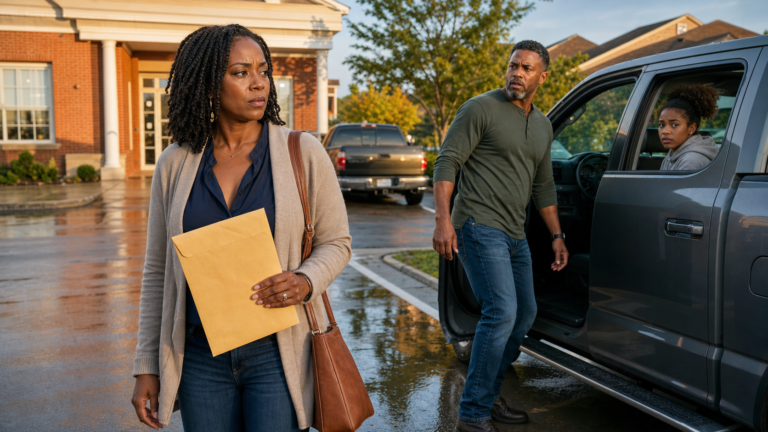
She held a large envelope.
“You told me she would never come here,” Diane said to Mark.
He did not answer.
Diane looked at me, then at the photograph in my hand. “I suppose that is over now.”
She had been sending the recent pictures.
After Lucas died, Diane discovered what he had done. She also found Mark’s early photographs and realized her surviving son was following the same path. She begged him to stop. When he married me, she convinced herself love had corrected what shame could not.
Last year, she saw Mark parked outside my office on a day he had told her he was out of town. She began photographing him watching me. She mailed the evidence to Apartment 3C because she wanted him to know someone could see him too.
“Why not tell me directly?” I asked.
Her answer was almost a whisper. “Because I had already protected one son by doubting a woman. I was terrified I would do it again.”
She gave me the envelope. Inside were photographs of Mark on seven different days, sitting in his car near my office, my gym, and the park where I walked on Sundays.
Some were taken while he was supposed to be at work.
What Love Cannot Excuse
Mark insisted he never intended to hurt me. I believe him.
That does not make what he did harmless.
He had confused knowing me with monitoring me, protection with control, and secrecy with mercy. He loved the person I was, but he also loved the private map of me he carried in his head. I could not tell where one ended and the other began.
I left Apartment 3C with Diane. That night I stayed with Tessa, who did not ask why I had waited so long to tell her about the summer at nineteen. She made the couch into a bed and put a chair beneath the front-door handle without making a performance of it.
The following week, I spoke with a lawyer and filed a police report. Mark gave the authorities every photograph and document. He started therapy and moved out when I asked. He did not send flowers, appear at my office, or demand forgiveness. For the first time, he let me decide where he was allowed to be.
We are separated now. I do not know whether our marriage will end or transform into something I cannot yet imagine. Nine years of kindness did not become fake when I learned how we met. But kindness cannot erase the fact that my choices were built on missing information.
I used to think betrayal required another lover. Sometimes it is quieter. Sometimes the third person in a marriage is the version of you that exists only in your partner’s private story—the one who never gets to say no because she never knows she is being watched.
The landlord emptied Apartment 3C after the investigation. The photographs are evidence now, not decoration.
I kept only one: the picture of me in the red coat, walking across campus. For years I saw a frightened girl whenever I remembered her.
Now I notice something else.
She is walking forward. She does not know the truth yet, but she is already carrying herself toward it.
Read more original emotional mysteries in our Relationship Stories collection, or discover how we create and review our stories on the About Nocturnal Stories page.
Fiction notice: This is an original fictional story created for entertainment. Names, characters, and events are invented.