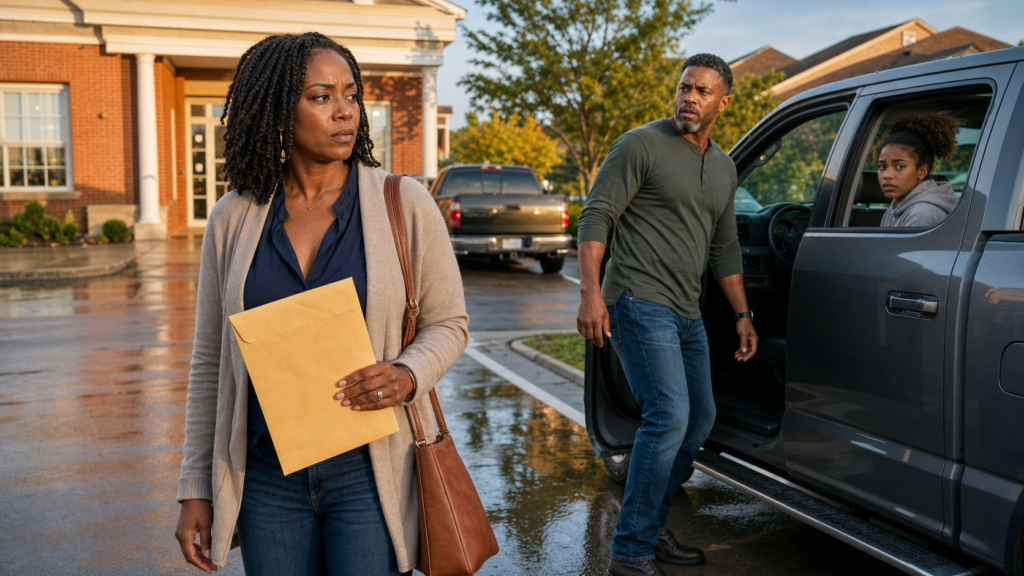
When I stepped out of Greenfield Community Bank, my husband was standing beside his truck as if he had been waiting for a confession.
Marcus had one hand on the open driver’s door. Our sixteen-year-old daughter, Imani, sat inside with her backpack on her lap. Neither of them was supposed to be there.
His eyes dropped to the thick yellow envelope pressed against my chest.
“Nia,” he said, crossing the wet parking lot. “Give me that.”
Not What is it? Not Why are you at the bank?
Give me that.
That was the moment I understood the envelope belonged to a secret my husband already knew.
The Signature That Looked Like Mine
Twenty minutes earlier, I had walked into the bank expecting to correct a simple mistake. A payment of $1,840 had disappeared from the savings account Marcus and I had spent eleven years building. That money was supposed to cover the first semester of Imani’s college tuition.
The branch manager, Mrs. Patel, invited me into her office and closed the glass door.
“Mrs. Brooks, the withdrawal wasn’t made from your savings account,” she said. “It was taken from the equity line attached to your home.”
I laughed because we did not have an equity line.
Then she turned her monitor toward me.
There it was: a loan for $86,000, opened seven months earlier. My name appeared beside Marcus’s. So did a digital copy of my signature.
It looked almost perfect. The long curve on the N. The small break in the final s. Whoever signed it had practiced.
“I never agreed to this,” I whispered.
Mrs. Patel’s face changed. She printed the application, transaction history, and the address receiving the transfers. She placed everything in the yellow envelope and gave me the number for the bank’s fraud department.
The money had not gone to another woman. It had gone to a company called Brooks Development Group.
Marcus had never mentioned that company.
A Lie in the Parking Lot
“Mom?” Imani called from the truck. “What’s happening?”
Marcus lowered his voice. “Not here.”
“Did you sign my name?” I asked.
His jaw tightened.
That was an answer.
I moved toward my car, but he stepped in front of me.
“I was going to fix it before you found out.”
“Fix eighty-six thousand dollars?”
Imani climbed out of the truck. “Dad, what did you do?”
Marcus looked at our daughter, then at the people leaving the bank. Shame finally pushed the anger out of his face.
“Your uncle needed help,” he said.
His younger brother, Terrence, had spent years introducing himself as an entrepreneur. Restaurants, delivery vans, rental houses—every new plan arrived with expensive shoes and disappeared with unpaid bills.
“You put our house behind one of Terrence’s businesses?” I asked.
“It wasn’t supposed to be his business. We were partners.”
The wet pavement reflected all three of us like a broken family photograph.
“Were?”
Marcus closed his eyes. “He’s gone.”
The House on Marlow Street
The address on the bank records led to a boarded duplex on Marlow Street. Marcus followed me there because I refused to go home without seeing what our money had purchased.
The front yard was waist-high with weeds. A city notice hung crookedly from the porch. Through a broken window, I could see stripped walls and exposed pipes.
Marcus stood beside me in silence.
“Tell me the whole thing,” I said.
He admitted that Terrence had promised to renovate the duplex and sell it within four months. Marcus believed one successful project could pay off our mortgage, fund Imani’s college, and allow him to leave the warehouse job that had worn down his back.
But Terrence had taken most of the loan money. The contractor had received only a deposit. Property taxes were overdue, and the city was preparing to condemn the building.
“Why my signature?”
“Because you would have said no.”
“That is not an explanation. That is the reason it was a crime.”
He flinched.
For years, Marcus had been the careful one. He compared grocery prices, changed our oil in the driveway, and refused vacations we could not pay for in cash. I had trusted his caution so completely that I never imagined checking behind it.
Then another car pulled up.
Terrence’s fiancée, Simone, stepped out holding a toddler. She looked exhausted.
“You’re Nia?” she asked. “I’ve been trying to find you.”
Marcus stared at her. “Where is my brother?”
Simone handed me a folder.
Inside were messages, wire receipts, and a copy of a plane ticket. Terrence had left for Atlanta three weeks earlier. He had not gone alone. He had taken Simone’s savings too, along with money borrowed from two church members and an elderly cousin.
But the worst document was a voice-message transcript.
Terrence had told Simone that if the project collapsed, Marcus would accept the blame because “he has a house, a wife, and too much pride to call the police.”
The Choice Marcus Feared
That evening, Marcus sat at our kitchen table while Imani stayed upstairs. The yellow envelope lay between us.
“If you report the signature,” he said, “I could lose my job. I could be charged.”
“If I don’t, we could lose the house.”
“I’ll work two jobs.”
“You still think this is only about money.”
I removed my wedding ring and placed it on the table—not because I had decided to end our marriage, but because I needed him to understand that marriage could not be used as protection from consequences.
“Tomorrow morning, I’m reporting the forgery,” I said. “You can tell the truth with me, or I can tell it without you.”
Marcus cried quietly. In twenty years, I had seen him cry at his father’s funeral and when Imani was born. This was different. This was a man finally meeting the damage he had kept calling a plan.
The next morning, he came with me.
What the Truth Cost Us
The investigation lasted five months. Marcus was suspended from his warehouse position, but his employer did not fire him after he cooperated fully. He gave investigators every message, bank record, and password he had used.
Terrence was arrested in Georgia after trying to open another loan under Simone’s name.
The bank confirmed that my signature had been forged. The equity loan was frozen, and after months of legal work, our home was released from the fraudulent debt. We still lost nearly twelve thousand dollars that Marcus had transferred from our legitimate savings before opening the loan.
We sold his truck. Marcus took weekend repair jobs. I postponed replacing our aging furnace and picked up summer classes at the community college where I worked.
But Imani’s tuition fund survived.
Our marriage did not return to normal, because normal had depended on trust I could no longer offer blindly. Marcus moved into the guest room. We began counseling. He gave me access to every account and stopped asking when I would forgive him.
Instead, he learned to answer harder questions.
Why had proving himself to his brother mattered more than protecting us? Why had he confused secrecy with leadership? Why did he believe a successful result would erase a dishonest beginning?
A year later, we stood outside the renovated duplex on Marlow Street. The city had sold it to a nonprofit that trained young adults in construction. Simone helped organize the program. Marcus volunteered there twice a month, never as the man in charge.
He looked at me and nodded toward my left hand. I had started wearing my ring again, but on a chain around my neck.
“Do you think it’ll ever go back?” he asked.
“No,” I said.
His face fell.
“But that doesn’t mean we can’t build something honest from what’s left.”
For the first time since the bank parking lot, Marcus did not promise to fix everything. He simply stood beside me and accepted that rebuilding would take longer than hiding ever had.
The Choice Behind the Envelope
This story uses an ordinary bank envelope to explore financial control inside a marriage. The tension does not come from money alone; it comes from one person believing he has the right to manage what the other person is permitted to know.
The ending focuses on documented facts, boundaries, and slow accountability instead of a dramatic act of revenge. That choice keeps the conflict grounded in the difficult decisions people face when trust and financial security collapse at the same time.
This is an original work of fiction. Names, characters, places, and events are invented.