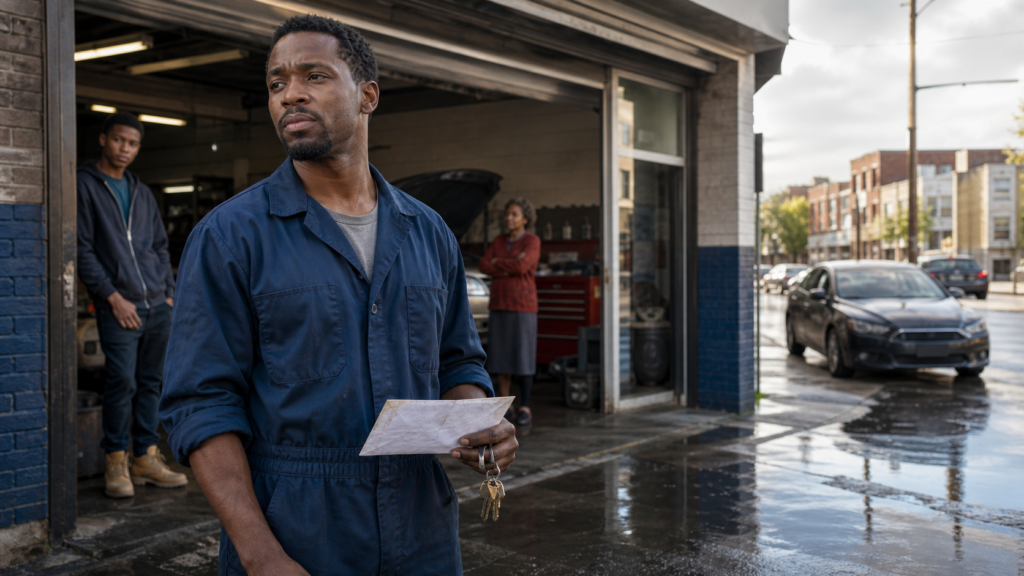
Darius Cole knew the paper on the garage door was bad news before he crossed the street. It was too white against the blue paint, too clean for a place where every surface carried grease. A city seal sat above three words printed in red: ORDER TO CLOSE.
For seven years, Cole Auto had been the one place in East Briar where Darius felt useful. He could hear a failing alternator before the dashboard light came on. He could coax another winter out of an old transmission. And when a customer could not afford the full bill, he quietly divided the work into what had to be done today and what could wait.
None of that mattered to the inspector. The building’s electrical panel was unsafe. Two permits had expired. Back taxes were overdue. Until Darius paid, repaired, and proved everything, the garage was closed.
His phone rang before he finished reading.
“Mr. Cole?” a woman said. “This is Northpoint Lending. Your truck payment is now thirty-one days late.”
Another call arrived while she was still speaking. His landlord wanted the rent by Friday. Then the school nurse texted: his fourteen-year-old son, Malik, had been suspended after punching another student.
Darius looked at the chained door and laughed once—not because anything was funny, but because the day had run out of places to hit him.
The Week Everything Fell
He found Malik sitting outside the principal’s office with a split lip and both hands tucked beneath his thighs.
“You know what this costs us?” Darius asked in the car. “I’m supposed to be at the garage fixing this.”
“The garage is closed,” Malik muttered.
Darius turned sharply. “Who told you?”
“Everybody knows.” Malik stared through the window. “His brother said you cheat people. Said Mom left because you’re a loser.”
The words struck harder than Darius expected. His wife, Nia, had not left because he was a loser. She had died two years earlier after a sudden illness, and grief had turned every simple task into something with twice the weight. But Darius had never told Malik how close the garage had come to failing during those hospital months. He had protected the boy from the numbers until the numbers reached the schoolyard.
At home, another envelope waited beneath the door. The bank had rejected his request for a small business loan. Insufficient revenue. Unresolved debt. High risk.
His mother, Evelyn, read the letter at the kitchen table while Darius searched the cupboards for dinner.
“I can ask the church,” she said.
“No.”
“Pride is expensive.”
“So is owing everybody.”
Evelyn folded the letter carefully. “Then stop trying to save the old version of your life. Build the next one.”
Darius wanted to tell her there was no next version. The garage needed nearly twelve thousand dollars. His truck might be repossessed. Three customers were demanding refunds for unfinished work, though their cars were trapped behind the city’s chain. Everywhere he turned, something else fell.
That night he opened a blank message to his former employer, a dealership across town. The manager had offered him work twice before. The salary would cover rent. The insurance would protect Malik. All Darius had to do was surrender the garage his father had started with a borrowed toolbox.
He typed, Is the position still available?
His thumb hovered over Send.
Then someone knocked.
A Repair Made on the Sidewalk
Mrs. Alvarez stood outside beside a dented minivan. She cleaned offices at night and raised two grandchildren. Darius had repaired that van so many times he knew which door refused to unlock in cold weather.
“It died at the light,” she said. “I know you’re closed, but the hospital called. My grandson’s surgery moved to tomorrow.”
Darius glanced at the dealership message. Then he carried his tools to the curb.
The fuel pump was failing, but a loose electrical connection was making it worse. He worked under the hood with a flashlight between his teeth while Malik watched from the porch. Forty minutes later, the engine started.
Mrs. Alvarez tried to give him sixty dollars.
“Keep it for gas,” Darius said.
“Then let me do something.”
“Tell people I’m not dead.”
She smiled. “That, I can do.”
The next morning, three cars waited outside his house.
Darius could not legally operate the garage, but he could perform limited mobile repairs. He checked the regulations twice, bought a temporary mobile-service permit with the last money in his account, and turned the back of his truck into a rolling toolbox. Malik built a simple booking page on his laptop. Evelyn answered calls and wrote appointments on the back of grocery receipts until they bought a proper notebook.
The money was small. The hours were brutal. Darius changed batteries in parking lots, replaced belts in driveways, and diagnosed engines while rain ran down his neck. Some days he earned enough to feel hopeful. Other days a canceled appointment meant choosing between fuel and groceries.
Then the truck disappeared.
He stepped outside at six one morning and found an empty space at the curb. The lender had repossessed it during the night.
Malik came up behind him. “What do we do now?”
Darius did not answer. Without the truck, there was no mobile business. Without the business, there was no money to reopen the garage. Without the garage, every sacrifice had only delayed the same ending.
He went inside, closed the bedroom door, and sat on the floor beside Nia’s old cedar chest. For the first time since her funeral, he said aloud, “I can’t carry this.”
He stayed there until the light changed on the wall.
The Job He Almost Took
That afternoon, Darius put on his only suit and rode two buses to the dealership. The manager, Greg Lawson, shook his hand warmly.
“You should have come months ago,” Greg said. “Best diagnostic mechanic I ever had.”
The offer was better than Darius remembered. Steady hours. Health insurance. A signing bonus large enough to recover the truck.
“One condition,” Greg added. “No side business. Customers belong to the dealership.”
Darius looked through the glass wall at twelve clean service bays, each brighter than his entire garage. Taking the job was not cowardice. It was responsible. It was what a father should do.
He reached for the pen.
His phone vibrated. Malik had sent a photo. Seven people stood outside Cole Auto holding handwritten signs: THIS GARAGE KEPT ME WORKING. DARIUS FIXED MY CAR WHEN I COULDN’T PAY. WE NEED COLE AUTO.
Below the photo, Malik wrote: I didn’t ask them to come.
Darius put down the pen.
“I need one day,” he told Greg.
Greg leaned back. “The offer expires tonight.”
“Then maybe it expires.”
What the Neighborhood Knew
By the time Darius reached the garage, the crowd had doubled. Mrs. Alvarez had posted his story in a neighborhood group. Former customers brought receipts, photographs, and memories. A delivery driver described how Darius once stayed until midnight to keep his van on the road. A nurse said he had repaired her brakes during the worst week of the pandemic and accepted payment three months later.
Darius hated standing in front of them. Need felt too much like exposure.
“I appreciate this,” he said, “but signs won’t fix the electrical panel.”
“No,” said a woman near the back. “An electrician will.”
Her name was Simone Reed. Darius had replaced her starter the previous winter. She ran a construction company and had brought two licensed electricians. They would donate the labor if Darius paid for materials.
A retired accountant offered to examine the taxes. A restaurant owner offered weekend work so Darius could earn cash after mobile appointments. Someone started a legitimate community fundraiser, but Darius insisted on a rule: every dollar would be recorded, and anyone who contributed could choose a future repair credit instead of a donation.
It still was not enough.
So Darius did the part no crowd could do for him. He called every creditor instead of avoiding them. He negotiated a payment plan with the city. He sold equipment he rarely used. He asked the lender for the exact reinstatement figure on the truck and did not argue when the number embarrassed him. He worked restaurant maintenance at night and rode with Simone’s crew before dawn.
Malik worked too. He photographed every repair, organized appointments, and built a page showing where the reopening money went.
One night, while they ate sandwiches on the garage steps, Malik said, “I’m sorry I punched him.”
“You should be.”
“But he lied about you.”
Darius looked at the chain across the door. “People will lie about you. If every lie can control your hands, they own your future.”
Malik nodded slowly. “Are we going to make it?”
“I don’t know.”
It was the first honest answer Darius had given him in months.
“But tomorrow,” Darius continued, “we’re getting up.”
The Second Notice
Six weeks after the closure, another white paper appeared on the garage door.
Darius saw it from across the street and stopped in the same place. His stomach tightened. They had repaired the wiring, cleared the permits, paid the first tax installment, and recovered the truck. But one failed inspection could erase all of it.
Malik reached the door first.
“Dad,” he said.
Darius could not read his face.
“Just tell me.”
Malik pulled the paper free and turned it around.
APPROVED FOR OCCUPANCY.
Darius read it twice. He did not shout. He pressed one hand against the door and lowered his head. Evelyn wrapped both arms around him. Behind them, neighbors began to clap—not the wild applause of a miracle, but the steady sound people make when they know exactly how much something cost.
The garage reopened on a Monday at seven in the morning.
Success did not arrive like a movie ending. The first week was slow. A supplier demanded cash. An air compressor failed. Darius still worked nights at the restaurant for another month. But the appointment page Malik built kept filling. Simone sent her company vehicles. The accountant taught Darius to read a cash-flow statement instead of merely checking whether money remained in the account.
Within a year, Cole Auto hired two apprentices from the neighborhood. Darius created an emergency repair fund financed by customers who chose to round up their bills. No one received free work without limits, and every arrangement was written down. Generosity, he had learned, needed structure if it was going to survive.
On the anniversary of the closure, Greg from the dealership visited the garage.
“You made the wrong decision,” Greg said, looking around at the busy bays.
Darius raised an eyebrow.
Greg smiled. “For anybody else, I mean.”
Darius watched Malik at the front desk explaining an estimate to a customer. On the wall behind him hung both city notices in matching frames: the order to close and the approval to reopen.
“I almost quit,” Darius said.
“But you didn’t.”
“That isn’t the whole story.” Darius wiped his hands on a cloth. “I did quit—about twenty times in my head. Then morning came, and there was still one useful thing I could do.”
Outside, the garage door stood open to the daylight. Cars waited along the curb. Bills still arrived. Problems still knew his address.
But so did opportunity.
This is an original work of fiction. Names, characters, places, and events are invented.