This is a fictional story. Names, characters, places, and events are invented.
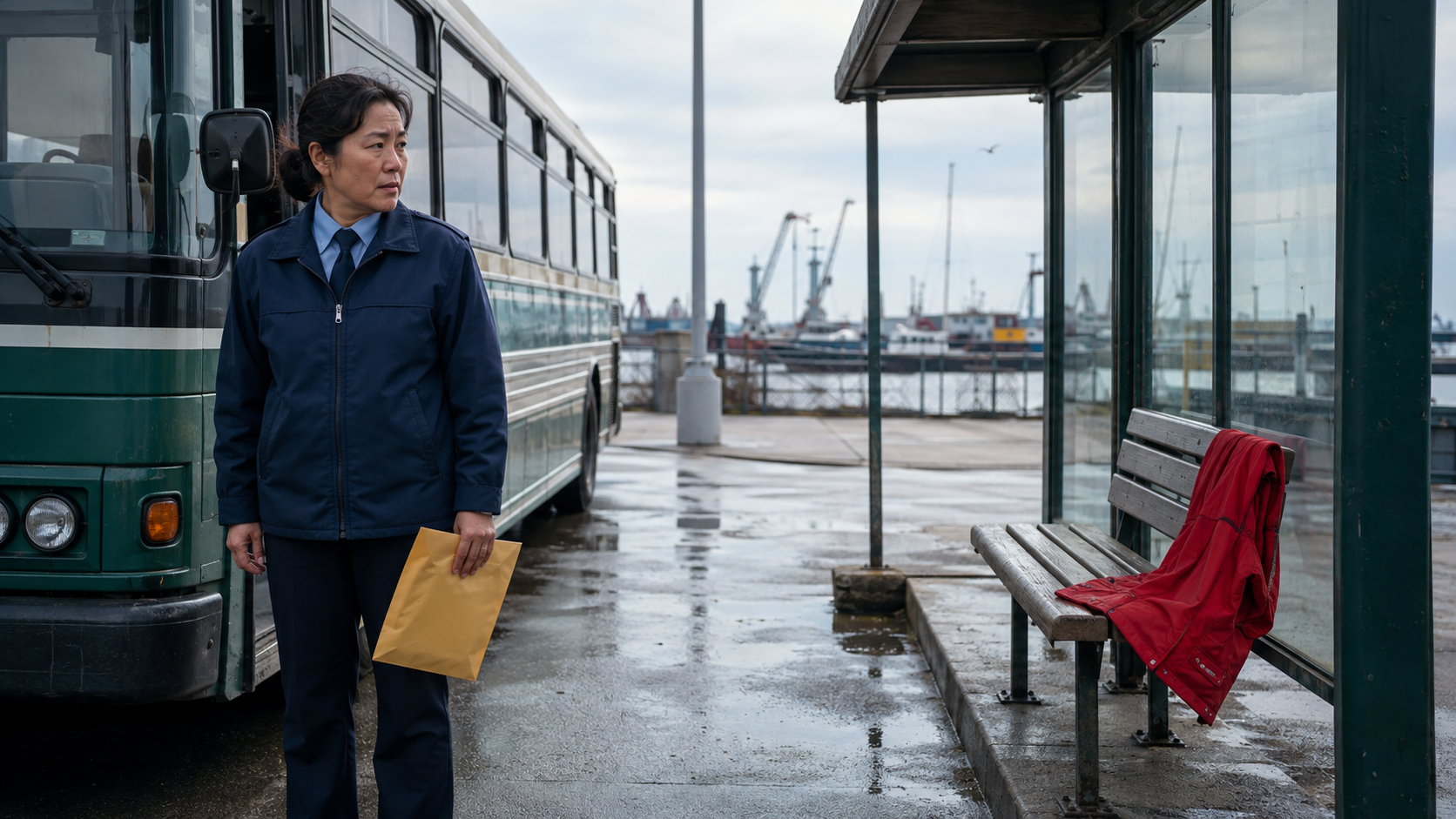
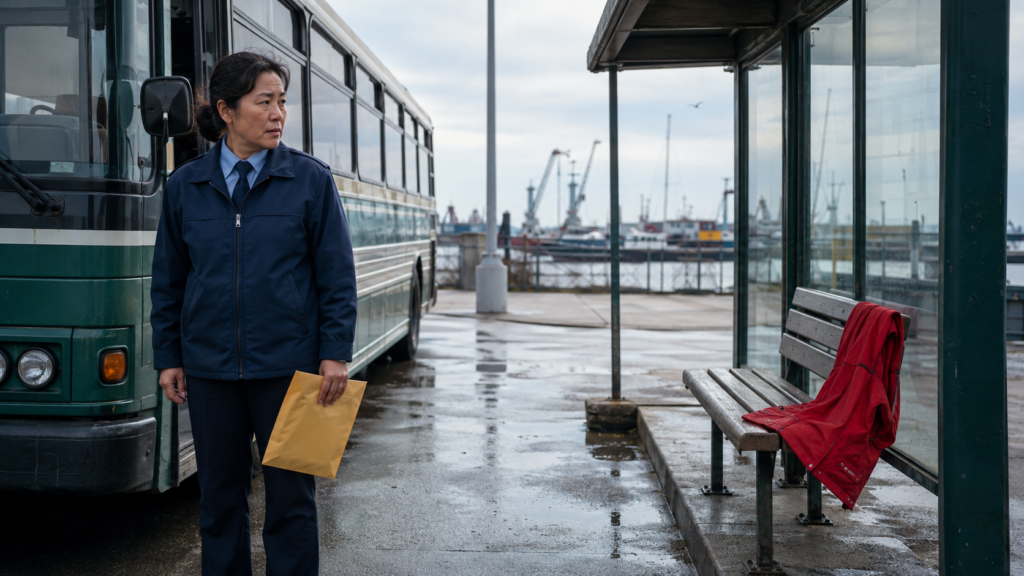
At 4:07 every afternoon, the red coat was waiting at Harbor Stop.
Not a child wearing it. Just the coat.
It hung over the back of the bench as neatly as if invisible shoulders were still inside it, its sleeves moving whenever wind came off the water. At 4:12, when Mina Park completed the loop and passed the stop again, the coat would be gone.
For eleven days, the same thing happened.
Mina had driven Route 18 through Bellweather, Washington, for twenty-three years. She knew which passengers carried exact change, which streets flooded first, and which high school students pretended not to see one another after a breakup. She noticed small changes because small changes were often the beginning of trouble.
On the twelfth day, rain polished the road and blurred the harbor cranes into gray shapes. The coat was there at 4:07. At 4:12, it was still there.
And someone had placed a yellow envelope beneath it.
The Envelope on Seat Seven
Mina pulled the bus to the curb, set the brake, and opened the doors.
“Two minutes,” she told her six passengers. “Mechanical check.”
“That coat is not mechanical,” said Mr. Alvarez from the front seat.
He was seventy-four and had spent thirty years repairing fishing boats. Retirement had made him observant and shamelessly curious.
“Then consider this preventive maintenance,” Mina said.
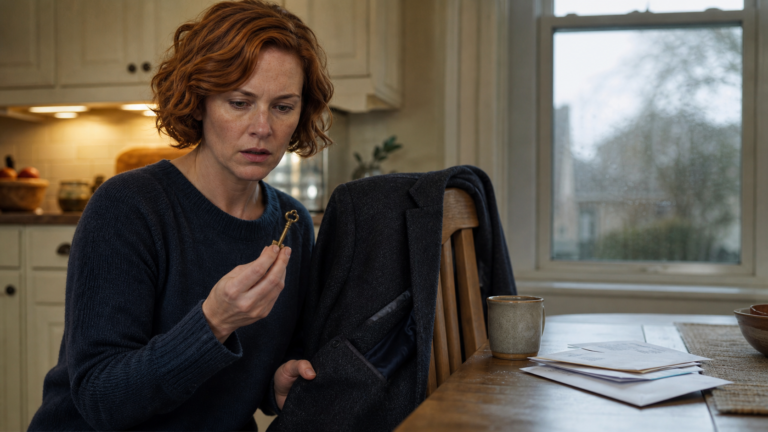
She stepped into the rain. The envelope was dry, protected beneath the coat. On the front, written in green marker, were five words.
FOR THE DRIVER OF EIGHTEEN.
Inside were seven used bus transfers, a brass apartment key, and a note.
If the coat is still here after the second bus, something went wrong. Please find Nia. Do not call Daniel Cross.
Mina read the last sentence twice.
Daniel Cross was not a stranger. His face appeared on campaign signs around town. He was a city councilman, a former police officer, and the man who had shaken Mina’s hand at the transit awards dinner six months earlier.
Mr. Alvarez stood under the bus doorway.
“You look like you found a snake.”
“I found instructions,” Mina replied.
“Those can be worse.”
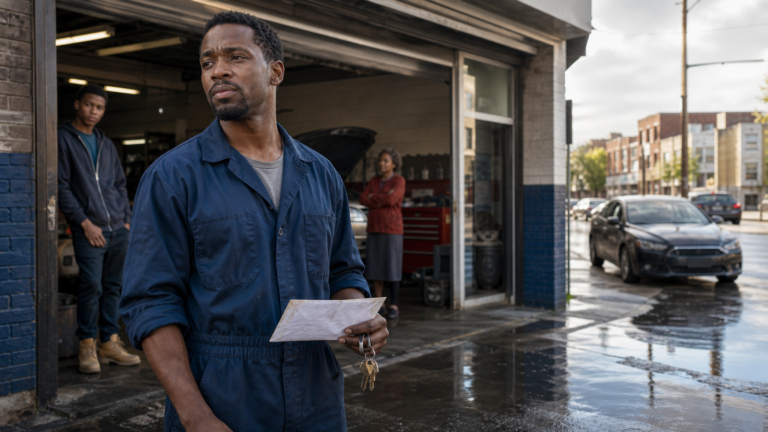
The first transfer was stamped three weeks earlier. The seventh was stamped that morning. Every ticket came from the same stop near Bellweather Middle School.
Mina remembered the girl.
Nia Bell, twelve years old, narrow braids decorated with blue beads. She usually boarded with an older woman named Evelyn. They sat behind Mina and played a quiet game in which one described a person on the sidewalk and the other invented a secret life for them.
The last time Mina saw them, Nia had not played. She had watched the rear window until the bus turned away from the school.
“Luis,” Mina said into the radio, “I need another driver to take my passengers at Pier Avenue.”
The dispatcher answered immediately. “Are you sick?”
“No.”
“Is the bus damaged?”
“No.”
A pause followed. “Then tell me what is happening.”
Mina looked at the note again.
“I think one of our young passengers asked me for help.”
A Route Hidden Inside the Route
Twenty minutes later, Mina sat in the transit office with Luis Ortega and Mr. Alvarez, who had refused to leave.
Luis spread the transfers across his desk. “They are not random,” he said. “Look at the punched corners.”
Each transfer had a different corner removed. Left, right, both, then none. Mina arranged them by date. The missing corners formed a pattern matching turns on the old Route 18 map.
“Left at Cedar,” Mina said. “Right at Franklin. Straight past the library.”
“A route inside your route,” Mr. Alvarez murmured.
It ended at a condemned apartment building near the shipyard.
Luis reached for his phone. “We call the police.”
“The note says not to call Cross.”
“It does not say not to call the police.”
“He worked there for sixteen years. We do not know who still owes him favors.”
Luis stared at her. “Mina, you drive a bus. I dispatch buses. We are not detectives.”
“Correct,” she said. “But Nia did not leave this for a detective. She left it for the person she knew would pass that bench twice.”
Mr. Alvarez tapped the brass key against the desk. “And she trusted that person to notice.”
Mina called one person before leaving: Simone Reed, a family advocate whose card was pinned beside the transit office first-aid cabinet. Simone listened without interrupting.
“Do not enter the building,” she said. “Send me the address. I will contact a unit outside Cross’s old district and meet you there.”
Mina agreed.
Then she drove straight to the building.
The Woman Behind the Blue Door
The apartment key opened the exterior door. Mina told herself she was only stepping inside to get out of the rain.
She climbed to the second floor, where a blue door stood slightly open.
“Nia?” she called.
A woman answered from the darkness. “Who are you?”
“Mina Park. Route 18.”
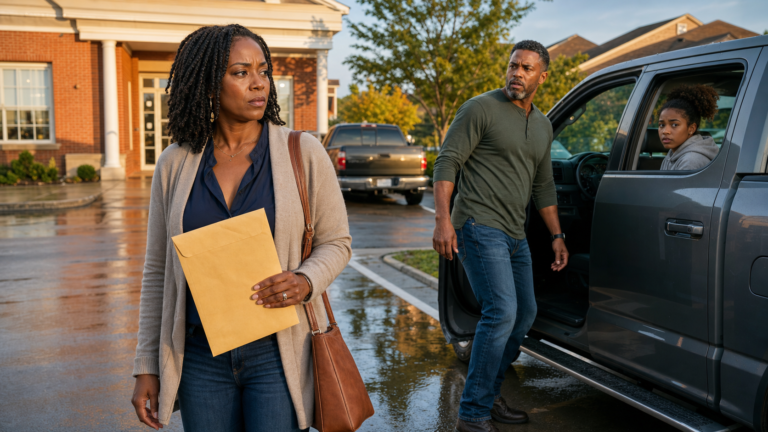
The door opened wider. Evelyn Bell stood barefoot, with a swollen lip and a kitchen towel wrapped around one hand.
“You saw the coat,” she said.
“Where is Nia?”
Evelyn looked past Mina toward the stairs. “Daniel took her from school.”
“Why would Councilman Cross take your granddaughter?”
Evelyn’s expression hardened. “Because he is not just a councilman. He is her father.”
The story came out in short, painful pieces.
Nia’s mother, Alana, had married Daniel when Nia was six. In public he was generous, polished, and endlessly patient. At home, he monitored every phone call, every receipt, and every mile on Alana’s car. When Alana tried to leave, Daniel used old colleagues to find her within hours.
Two months earlier, Alana had disappeared.
Daniel told everyone she had abandoned the family. Evelyn believed him until Nia found a second phone hidden inside the lining of her mother’s sewing basket. It contained photographs of injuries, messages from Daniel, and a voice recording in which Alana described a shelter across the state.
“She is alive?” Mina asked.
“We think so,” Evelyn said. “Nia and I made a plan. The red coat meant she got home safely. I removed it after the second bus. Today Daniel collected her before I arrived.”
“Why the transfers?”
Evelyn gave a tired smile. “Nia designed that. She said phones can be tracked, but nobody tracks old bus tickets.”
Headlights swept across the cracked hallway window.
Evelyn grabbed Mina’s sleeve. “That is his car.”
The Bus in the Alley
Daniel Cross climbed the stairs slowly, as though arriving at a meeting he already controlled.
He wore a charcoal raincoat. Nia stood in front of him, one of his hands resting on her shoulder.
“Ms. Park,” he said. “This is a family matter.”
Nia’s eyes moved to Mina, then to the apartment key in her hand.
“Did you read my note?” the girl asked.
Daniel’s fingers tightened.
“Enough,” he said.
Mina had imagined herself saying something brave. Instead, she felt every one of her fifty-two years in her knees.
Then the street outside filled with the sound of a bus horn.
Mr. Alvarez was sitting behind the wheel of Route 18 in the alley. Luis stood beside him, waving both arms. The bus blocked Daniel’s car completely.
“He cannot drive that,” Mina whispered.
“Apparently retirement rules are flexible,” Evelyn said.
Daniel pulled Nia toward the stairs, but passengers were now standing in the alley. Luis had brought the next Route 18 bus behind them, and nearly twenty people had stepped out. Phones were raised. Cameras were recording.
Daniel stopped.
His power had always depended on closed doors and private fear. Now there were witnesses at every exit.
Simone Reed arrived with two state investigators. She did not shout. She simply walked up the stairs, showed her identification, and held out her hand to Nia.
“You can come with me,” she said.
Nia looked at Daniel.
“He says nobody will believe us.”
Simone nodded toward the alley. “It looks like your bus driver brought twenty witnesses.”
Daniel released her.
What the Girl Had Really Hidden
Three days later, Alana Bell returned to Bellweather under protective supervision. The evidence on the hidden phone led investigators to reopen two complaints that had been quietly closed years before.
Daniel denied everything.
For the first time, denial was not enough.
Mina visited Nia and Alana at Evelyn’s apartment. On the kitchen table sat the yellow envelope, the transfers, and the brass key.
“There is one thing I do not understand,” Mina said. “Why did you write not to call Daniel? If he had already taken you, how did the note reach the stop?”
Nia glanced at her grandmother.
Evelyn looked equally confused. “I thought she gave it to you.”
Nia shook her head.
“Mom wrote the first note before she disappeared,” she said. “I found it with the phone. But the envelope was mine.”
She turned over the final transfer. In tiny green letters, another message had been written along the edge.
Ask the people on the bus to stay.
Mina understood then. Nia had never expected one heroic stranger to rescue her. She had built a plan around a crowd of ordinary people who rode the same streets every day.
“You knew Mr. Alvarez would follow me,” Mina said.
Nia smiled for the first time. “He follows everybody.”
From the living room, Mr. Alvarez called, “I heard that.”
Everyone laughed, even Evelyn.
The following Monday, Mina reached Harbor Stop at 4:07. The bench was empty. No coat. No envelope.
At 4:12, she passed again.
Nia was standing beside the shelter in a bright green jacket. Alana held her hand. Evelyn stood behind them.
Mina opened the doors.
“Where to?” she asked.
Nia climbed aboard and placed exact change in the box.
“Anywhere this route actually goes,” she said.
The doors closed, the harbor disappeared behind them, and Route 18 continued through the afternoon light.