
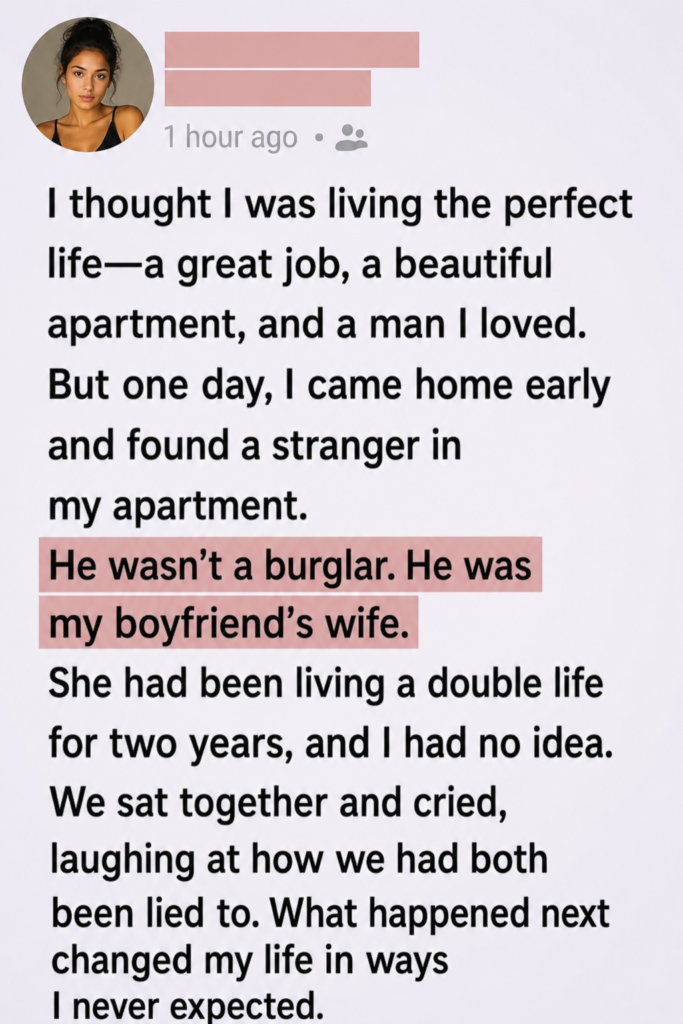
I thought I was living the kind of life people quietly envy.
I had a stable job, a clean apartment in a good neighborhood, enough money to travel once or twice a year, and a man I believed I would eventually marry.
His name was Marcus.
We had been together for almost three years.
He was charming without being loud, attentive without seeming controlling, and confident in a way that made everyone around him feel safe. When we first met, he told me he worked in logistics and traveled often because his company managed contracts across several states.
At the time, his schedule seemed impressive.
Later, I would understand that it had simply made lying easier.
Marcus never fully moved into my apartment, but he spent most nights there. He kept clothes in my closet, toiletries in my bathroom, and a charger beside my bed. He had a key. He contributed to groceries, fixed things when they broke, and knew exactly how I liked my coffee.
We had routines.
On Fridays, we ordered takeout.
On Sunday mornings, we went for long walks unless he was away for work.
Every few months, he disappeared for several days on a “site visit,” but he always called at night. Sometimes the calls were short. Sometimes he said he was exhausted. I never considered that unusual.
I trusted him.
That is the part I still struggle to explain.
People often ask whether there were signs.
Of course there were.
There are always signs once you already know the truth.
At the time, each one had a reasonable explanation.
He rarely posted pictures of us online because he said he was private.
He did not like being tagged.
He avoided meeting some of my coworkers because he said networking exhausted him.
He had two phones, but one was supposedly for work.
He sometimes turned his screen over when messages arrived, but he said clients contacted him at all hours.
His apartment was in another city, almost two hours away. I had only been there twice.
He said he kept it because it was close to his company’s main office and saved him from commuting.
The place always looked temporary.
There were no photographs.
Very little decoration.
Almost no food.
At the time, I thought he was simply practical.
I did not realize I was visiting a carefully maintained stage.
The day everything changed was a Wednesday in March.
I was supposed to remain at work until six, but our internet went down after lunch and management told us to finish the day from home.
I texted Marcus to tell him.
He did not reply.
That was normal. He was supposed to be in another state for a three-day work trip.
I stopped at a grocery store on the way home and bought pasta, wine, and a few things for breakfast.
When I reached my building, I noticed a dark blue car parked near the entrance.
I had seen it before, but I could not remember where.
The elevator was out, so I climbed four flights carrying two bags.
When I reached my door, it was slightly open.
Not wide open.
Just enough that the latch had not caught.
I froze.
My first thought was that someone had broken in.
I quietly placed the grocery bags on the floor and pulled out my phone.
Then I heard movement inside.
A cabinet closing.
Footsteps.
Someone was in my apartment.
I should have called the police immediately.
Instead, I pushed the door open and shouted, “Who’s there?”
A woman appeared from the hallway.
She looked as shocked as I felt.
She was around my age, maybe a little older. She had shoulder-length brown hair, a gray coat, and a large handbag clutched against her body.
For several seconds, neither of us moved.
Then she said, “Who are you?”
I almost laughed.
It sounded absurd.
“This is my apartment,” I said.
Her face changed.
Not fear exactly.
Recognition.
Then something close to horror.
She looked around the room as though seeing it differently.
“Your apartment?”
“Yes.”
She stared at me.
Then she whispered, “Where is Marcus?”
My whole body went cold.
“How do you know Marcus?”
She did not answer immediately.
Instead, she reached into her bag and pulled out her phone.
She opened a photo.
It showed Marcus standing beside her in front of a Christmas tree.
His arm was around her waist.
Two children stood in front of them.
A boy and a girl.
Both looked like him.
The woman held the phone out toward me.
“He’s my husband,” she said.
I remember the room becoming strangely quiet.
The traffic outside disappeared.
The refrigerator stopped humming.
Even my own breathing seemed far away.
I stared at the photo.
Then I looked at her.
“No.”
It was the only word I could say.
She swallowed.
“We’ve been married eleven years.”
I shook my head.
“No.”
“We have two children.”
“No.”
“He told me this apartment belonged to a colleague who moved overseas.”
I felt sick.
I sat down because my knees stopped supporting me.
The woman remained standing near the hallway.
She looked angry, but not at me.
Not yet.
I asked her name.
“Rachel.”
She asked mine.
“Naomi.”
Then she asked the question I had been dreading.
“How long?”
I could not speak.
She repeated it.
“How long have you been with him?”
“Almost three years.”
Her eyes filled with tears.
She turned away.
For a moment, I thought she might scream.
Instead, she laughed once.
It was not a happy sound.
“Three years,” she said.
Then she sat in the chair across from me.
We remained there in silence.
I kept staring at the family photo on her phone.
Marcus looked exactly like himself.
Same smile.
Same watch.
Same relaxed posture.
Nothing in the image looked false.
That was what made it unbearable.
He had not created an entirely different personality for her.
He had simply divided his real life into separate rooms.
Rachel was the first to speak.
“He told me he was staying here because of work.”
I looked at her.
“When?”
“Sometimes. Usually two or three nights a week.”
Those were the nights he stayed with me.
I asked where she lived.
She named the city where Marcus supposedly kept his work apartment.
My stomach tightened.
“That’s where his apartment is.”
She shook her head.
“That’s our house.”
I stared at her.
“No, he has an apartment there.”
“He rented a small place near the highway last year. He said it was for employees who worked late.”
The temporary apartment.
The empty cupboards.
The careful absence of photographs.
It had been another stage.
Rachel asked why she had come to my apartment.
She explained that Marcus had left one of his phones at home that morning.
The device had been locked, but a message appeared on the screen.
It was from my building manager.
The message said a package for “Naomi” had been left downstairs and Marcus could collect it with his key.
Rachel had never heard my name before.
She searched the address.
Then she drove there.
She used Marcus’s key.
She expected to find evidence of another woman.
She did not expect the other woman to come home.
I began crying.
Not dramatically.
The tears simply would not stop.
Rachel watched me for a while.
Then she asked, “Did you know?”
“No.”
“Did you ever suspect?”
I wanted to say no again.
But that would have been a lie.
“I thought he might be hiding something,” I said. “But not this.”
She looked down at her hands.
“He told me he was depressed. He said work was destroying him.”
The cruelty of it became clearer with every sentence.
He had used work to explain his absence to both of us.
He had used exhaustion to avoid questions.
He had used privacy to keep us from existing publicly.
Rachel asked whether he had spoken about marriage.
I nodded.
“He said next year.”
She closed her eyes.
“He told me we should renew our vows next year.”
We both laughed then.
Not because anything was funny.
Sometimes the body reacts to pain by choosing the wrong sound.
Rachel asked to see my phone.
I hesitated.
Then I opened our messages.
There were thousands.
Good morning texts.
Photographs.
Arguments.
Apologies.
Plans.
Three years of a relationship that had felt completely real.
Rachel scrolled slowly.
She stopped at a photograph of Marcus cooking in my kitchen.
“That shirt,” she said.
“What?”
“I bought him that shirt.”
I covered my face.
She continued.
One message said:
“I wish I could wake up next to you every day.”
The date was the day after his daughter’s birthday.
Another said:
“You’re the only person who really understands me.”
He had sent it from a family vacation.
Rachel opened her own messages.
The same week, he had written to her:
“I miss home. I hate being away from you and the kids.”
He had not even needed to create new words.
He simply sent each of us what we wanted to hear.
At some point, I asked whether she hated me.
She took a long time to answer.
“I wanted to,” she said.
“Do you?”
“No. I don’t think you knew enough for me to hate you.”
That sentence nearly broke me.
Because she was comforting me inside my own apartment after discovering that I had unknowingly participated in the destruction of her marriage.
I asked whether she wanted me to leave when Marcus returned.
She shook her head.
“No. I want you here.”
We both knew he would deny everything if he had the opportunity.
So we made a plan.
Rachel placed her phone on the table and started recording.
I texted Marcus.
“Are you coming back tonight?”
He replied almost immediately.
“I might be able to surprise you.”
I looked at Rachel.
She stared at the message.
Then her phone rang.
Marcus.
She answered normally.
“Hi.”
We could hear his voice faintly.
He asked where she was.
She said she was shopping.
He told her he would remain out of town until Friday.
Then he said he loved her.
Rachel looked directly at me while he said it.
“I love you too,” she replied.
After the call ended, she placed the phone down carefully.
I asked whether she was okay.
“No,” she said. “But I will be.”
Marcus arrived at my apartment shortly after eight.
He carried flowers and a bottle of wine.
I heard his key turn in the lock.
Rachel and I were sitting side by side on the sofa.
The door opened.
Marcus stepped inside.
He saw me first.
He smiled.
Then he saw Rachel.
The flowers slipped from his hand.
For several seconds, no one spoke.
His face changed in stages.
Surprise.
Fear.
Calculation.
Then anger.
Not shame.
Anger.
“What are you doing here?” he asked Rachel.
She stood.
“I could ask you the same thing.”
He looked at me.
“Naomi, let me explain.”
Rachel laughed bitterly.
“Which one of us are you explaining to?”
He walked toward the kitchen, then stopped.
I could see him trying to choose a story.
He told Rachel that I was an old friend who had become emotionally unstable.
He told me that Rachel and he were separated but had not told the children.
Rachel opened her phone and played the recording of their call from an hour earlier.
His face went pale.
Then he said the most revealing thing of all.
“This is not what it looks like.”
I stood.
“What does it look like, Marcus?”
He looked at me as though I had betrayed him.
That expression stayed with me longer than anything else.
He had lied to both of us for years, but in that moment, he genuinely seemed offended that we had compared notes.
Rachel asked him to hand over his house keys.
He refused.
She told him she had already called her brother, who was waiting outside.
That was not true.
But Marcus believed her.
He placed the keys on the table.
Then he turned to me.
“I can fix this.”
I stared at him.
“No, you can’t.”
He said he loved me.
Rachel closed her eyes.
He immediately changed his approach.
He said he had been trapped in an unhappy marriage.
Rachel asked why he had planned a vow renewal.
He said it was for the children.
I asked why he had planned to marry me.
He said he had meant it.
Every answer created another lie.
Eventually, Rachel told him to leave.
He looked at both of us.
Then he picked up the wine, but left the flowers on the floor.
That detail still makes me angry.
Even while his life collapsed, he did not want to waste a bottle he had paid for.
After he left, Rachel and I remained together for several hours.
We ordered food but barely ate.
She called her sister.
I called my best friend.
Neither of us knew what to do next.
Rachel decided she would not return home that night.
I told her she could stay with me.
It sounds unbelievable when I say it now.
But there was no one else who understood exactly what had happened.
We were strangers connected by the same betrayal.
She slept in my bedroom.
I slept on the sofa.
The next morning, we drank coffee in silence.
Then Rachel showed me more of her life.
Photographs of the children.
School events.
Birthdays.
Family vacations.
Marcus had been present in all of them.
Not always happily.
But present enough to maintain the image of a devoted husband.
I showed her my own photographs.
Weekend trips.
Concerts.
Dinner with friends.
He was present there too.
The timeline was almost impressive.
He had attended his son’s school play on a Thursday, then driven to my apartment and spent the night.
He had celebrated my birthday on Saturday, then returned home Sunday morning claiming his flight had landed early.
He had kept separate calendars.
Separate clothing.
Separate stories.
We found one hotel receipt that appeared in neither of our timelines.
That was when we realized there might have been other women.
Rachel hired a lawyer.
Within a week, she filed for separation.
Marcus moved into the small apartment near the highway.
He called me constantly at first.
I blocked him.
Then he emailed.
He said Rachel had always been cold.
He said he had fallen in love with me accidentally.
He said he had planned to leave but needed time.
He said the children were the only reason he stayed.
Then Rachel forwarded me an email he had sent her.
In it, he claimed I had seduced him during a weak period.
He said I had pressured him.
He said he had never truly loved me.
That was the moment I stopped mourning the relationship.
Until then, part of me still missed the man I thought he was.
But there had never been one man.
There had only been whichever version was useful at the time.
The divorce became ugly.
Marcus argued over money.
He denied assets.
He blamed stress.
He attended counseling briefly and told everyone he was trying to change.
Rachel later learned he had started seeing someone new before the divorce was finalized.
She was twenty-nine and worked at one of his company’s offices.
Apparently, he told her he was separated.
Maybe this time it was partly true.
Rachel and I stayed in contact.
At first, we spoke almost every day.
We exchanged information for the lawyer.
Receipts.
Photographs.
Dates.
Messages.
Then our conversations became less practical.
We talked about work.
Family.
Sleep.
Fear.
She told me she had not worked full-time since her youngest child was born and was terrified about supporting herself.
I helped her update her résumé.
She helped me repaint my apartment after I could no longer stand looking at the walls Marcus had chosen.
We did not become best friends immediately.
There was too much pain between us for that.
Sometimes she became distant.
Sometimes I felt guilty simply being around her.
There were moments when I wondered whether my face reminded her of everything she had lost.
One afternoon, almost six months after we met, she said something I had been afraid to ask.
“I know you didn’t know,” she said. “But sometimes I still look at you and imagine him here with you while I was waiting at home.”
I nodded.
“I understand.”
“No, I don’t think you do.”
She was right.
I understood the facts.
I did not understand her exact pain.
I told her she did not owe me friendship.
She cried.
“I know. That’s what makes this harder.”
We did not speak for nearly two months after that.
Then she called me.
Her daughter had been taken to the emergency room with appendicitis.
Marcus was unreachable.
Rachel was alone and panicking.
I drove to the hospital.
I sat with her for five hours.
Her daughter had surgery and recovered.
Afterward, Rachel hugged me in the parking lot.
That was the moment our relationship changed.
Not because the past disappeared.
It did not.
But because trust began somewhere new.
Two years after the divorce, Rachel found a job at a medical billing company.
She moved into a smaller house near the children’s school.
Marcus saw the children according to a schedule, though he often canceled.
I moved to another neighborhood and changed jobs.
The apartment had become too connected to him.
We both rebuilt slowly.
There was nothing dramatic about it.
No sudden transformation.
No perfect revenge.
Real recovery is usually boring.
It looks like therapy appointments.
New passwords.
Paperwork.
Insomnia.
Budget spreadsheets.
Learning to eat alone.
Explaining the truth to family members.
Deleting old photographs one by one.
Sometimes it looks like laughing for the first time and then feeling guilty for laughing.
Three years after that Wednesday, Rachel invited me to her birthday dinner.
Her sister was there.
A few coworkers.
Her children.
At one point, her son asked how we had met.
Rachel and I looked at each other.
Then she said, “Through someone we both used to know.”
The adults laughed.
The children did not understand.
That was fine.
Marcus eventually married the woman from his office.
It lasted less than two years.
Rachel told me when she heard.
Neither of us felt satisfied.
By then, he had become less important.
That surprised me most.
For a long time, I thought closure would come from seeing him suffer.
It did not.
Closure came when an entire week passed without either of us mentioning him.
Then a month.
Then several months.
People sometimes ask whether Rachel and I are still friends.
We are.
Not in the simple way most friendships begin.
We did not meet at school, work, or through shared interests.
We met inside a lie.
But we built something honest afterward.
There are still boundaries.
We do not discuss every detail of the relationship.
We do not compare who suffered more.
We do not pretend what happened was secretly a blessing.
It was not.
It damaged both of us.
It affected her children.
It changed how we trust people.
But it also taught me something I wish I had understood earlier.
People do not always deceive us by acting suspiciously.
Sometimes they deceive us by acting ordinary.
They remember birthdays.
They buy groceries.
They complain about traffic.
They kiss you goodbye.
They build routines so familiar that questioning them feels irrational.
That is why betrayal can exist so close to normal life.
I spent years asking myself how I could have been so foolish.
Therapy helped me replace that question.
The better question was not, “How could I have failed to see?”
It was, “What will I do now that I know?”
I no longer investigate every person I date.
I do not demand passwords.
I do not assume every late reply is a lie.
But I pay attention to consistency.
I no longer confuse secrecy with privacy.
I no longer ignore discomfort simply because the alternative is inconvenient.
Most importantly, I trust myself enough to ask questions.
The stranger I found in my apartment was not a burglar.
She did not come to steal my life.
She came carrying the truth about it.
At first, I thought Marcus had destroyed both of us.
But that was not entirely true.
He damaged us.
Then we chose what happened next.
And what happened next was not the ending he expected.
It was the beginning of a life where neither of us needed his version of reality anymore.