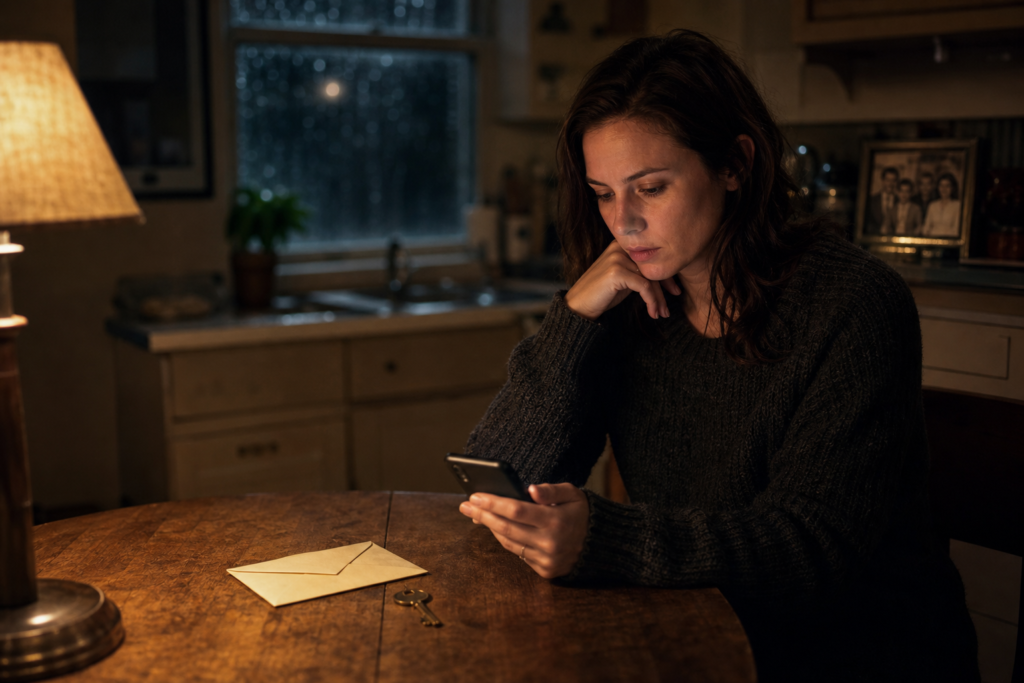
The voice message my mother left reached me at 2:17 in the morning, six months after we buried her—and it began with a warning meant for someone else.
I did not answer. I watched the name Mom glow on the screen until the call stopped, telling myself it was a delayed notification, a recycled number, anything ordinary. Then a voice message appeared.
For eleven seconds there was only the scrape of a chair and my mother breathing. Her voice came next, low and hurried.
“Daniel, if Emma finds the brass key, tell her I lied about the night her father left. And please—don’t let her open the blue box alone.”
The recording ended with the soft click of a cupboard door.
I played it four times. My mother had been dead since January. Daniel was her younger brother, and he had not spoken to our family in almost twenty years. The brass key was sitting in my kitchen, inside an envelope I had found that afternoon while emptying the last drawer of her sewing cabinet.
The Key in the Sewing Drawer
My mother, Helen, had labelled everything. Winter sheets. Tax papers. Emma’s school drawings. Even the loose buttons in her sewing room were separated by color. But the cream envelope had no label, only my first name written in the shaky hand she developed near the end.
Inside was a small brass key and a receipt for a storage unit on the edge of town. Unit 214. Paid through the end of the year.
I had nearly thrown the receipt away. Grief turns objects into traps. A grocery list becomes the last list. A half-used bottle of perfume becomes the last morning your mother stood in front of a mirror. I was tired of being ambushed by ordinary things.
But the message changed the key from clutter into a question.
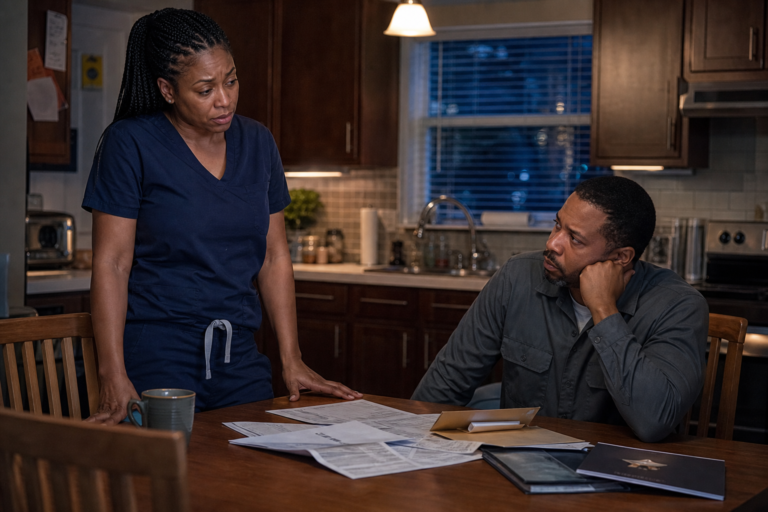
My husband, Noah, woke when he heard me pacing. I let him listen. He checked the date on the recording, then the details on the phone bill. The message had not been sent that night. It had been scheduled months earlier through a voice-reminder service my mother used when chemotherapy made her forget appointments.
“She wanted you to hear it now,” he said.
“Then why is she talking to Daniel?”
Noah looked at the key in my palm. “Maybe she knew you’d be the one holding the phone.”
The Story I Had Believed
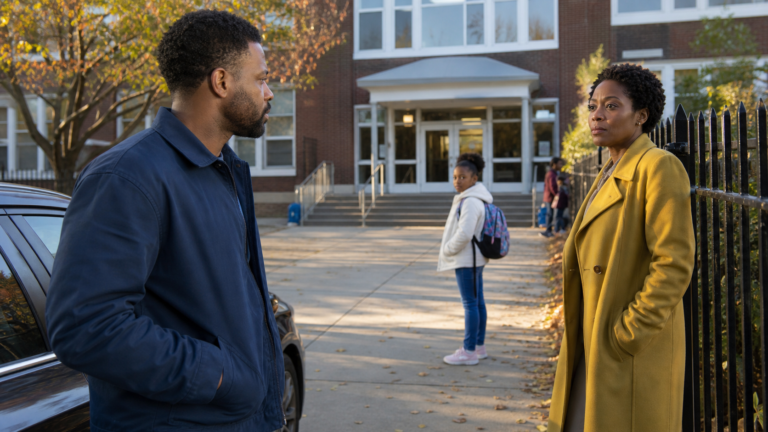
I was nine when my father disappeared. The official family version was painfully simple: he emptied the savings account, drove away before sunrise, and never looked back.
My mother never insulted him. That restraint made the story feel more convincing. Whenever I asked whether he loved me, she would fold a dish towel into a smaller and smaller square and say, “Some people love you and still choose themselves.”
Uncle Daniel challenged that story once. I remember voices behind the kitchen door, a glass breaking, and Daniel shouting, “You can’t build her whole life on this lie.” My mother told him to leave. He did.
After that, his birthday cards stopped coming. When I asked why, she said he had sided with my father.
By sunrise, I had called the only number I could find for him. It was disconnected. I sent an email to an address that looked ten years old, then drove to the storage facility alone despite Noah asking me to wait.
The manager led me down a corridor that smelled of dust and wet concrete. Unit 214 was smaller than a bedroom. Inside stood a wooden chair, three sealed cartons, and a blue metal box on a folding table.
I almost laughed. My mother had turned a family secret into a stage set.
The brass key fit.
What My Mother Kept
The first thing inside was not a confession. It was a stack of unopened letters addressed to me.
They began the month after my father left.
Dear Em, I saw a girl at the station wearing one red sock and one yellow sock. You would have approved.
Dear Em, I am working nights now. I count the weeks by Fridays because Friday was pancake night.
Dear Emma, your mother says you need space. I will give you space, but I will not stop writing.
There were seventy-three letters. The last had been mailed on my eighteenth birthday.
I sat on the concrete floor and read until the words blurred. My father had not forgotten my school play, my broken wrist, or the ridiculous green bicycle I loved. Someone had told him everything. Someone had also returned every letter before I could see it.
Beneath them was a ledger in my mother’s handwriting. Monthly deposits. Rent. School fees. Dentist. The money did not come from her salary. Each line was marked with the same initials: R.M.—my father, Robert Miller.
He had paid for the life I believed he had abandoned.
The final object was a tiny cassette recorder and five tapes. On the first, my mother’s younger voice filled the storage unit.
“Robert, say it clearly. I need to know you understand.”
My father answered, “I understand. Emma stays with you. Daniel stays out of prison. And you never tell her what happened.”
I stopped the tape.
My hands were shaking so badly that I dropped it twice before getting it back into the case.
The Man at the Door
Someone knocked on the metal frame behind me.
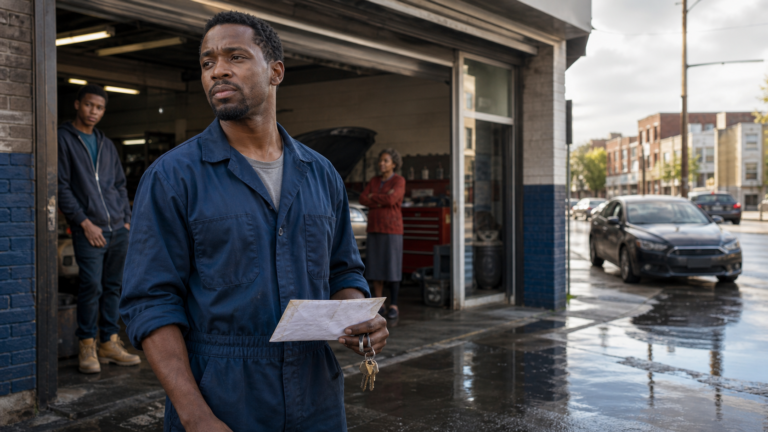
The man standing there was thinner and older than the uncle in my memories, but he still tilted his head before speaking.
“You sent an email,” Daniel said.
I stood up too quickly. “Did my father take the blame for you?”
Daniel looked at the open box and closed his eyes. “That is what Helen wanted everyone to believe.”
He sat on the wooden chair. He did not ask me to forgive him or my mother. He only asked which tape I had heard.
“The first.”
“Then you heard the bargain, not the reason.”
He pointed to the third tape.
On it, three people argued in my parents’ kitchen. I recognized my mother and father. Daniel’s voice was younger, frightened. They kept mentioning an accident, a bridge, and a man named Victor Hale.
Slowly, the pieces became clear.
Daniel had borrowed my father’s car after drinking. On the bridge, the car struck another vehicle and pushed it into the barrier. Victor survived, but his passenger was badly injured. Daniel panicked and ran. My father found the damaged car before the police did.
He agreed to say he had been driving—not to save Daniel, but because my mother begged him. Daniel had a new baby and a previous arrest. My father had no record and believed he would receive probation.
He was wrong. A witness reported seeing him leave town after the accident. The charge became more serious, and while he waited for trial, my mother changed the plan. She told him to disappear permanently.
“Why?” I asked.
Daniel did not answer. He rewound the tape and pressed play again.
My mother said, “If Robert stays, Emma will learn that Daniel was driving.”
My father replied, “She can survive knowing her uncle made a terrible mistake.”
There was a long silence.
Then my mother said, “Daniel isn’t her uncle.”
The Photograph That Changed Everything
I thought I had misunderstood. Daniel’s face told me I had not.
He took a photograph from the bottom of the box. My mother was nineteen, holding a newborn wrapped in a yellow blanket. Daniel stood beside her, not like a brother posing with his niece, but like a terrified young father.
“Robert met Helen when you were six months old,” Daniel said. “He married her, gave you his name, and loved you as his own. Helen and I were not related. She told people I was her half-brother because it was easier than explaining why your biological father kept appearing at family dinners.”
The story was ugly, but not in the way I expected. My mother and Daniel had been teenagers. Their families forced them apart. Years later, after Daniel returned, my mother let him be near me as an “uncle,” while Robert carried the burden of being my father in every way that mattered.
The accident threatened to expose all of it. My mother believed losing Robert was safer than letting me discover that the adults around me had rewritten my identity.
“He didn’t abandon you,” Daniel said. “He left because Helen promised it would be temporary. By the time he realized she meant forever, she had convinced him that coming back would destroy you.”
“And you let her?”
His eyes filled, but I felt no comfort in that. “I was a coward twice. Once on the bridge. Once in your kitchen.”
The Last Tape
I wanted to leave. Instead, I played the fifth tape.
My mother sounded older. Sick. There were long pauses between her breaths.
“Emma, if you are hearing this, Daniel came when I asked him. That means he has finally done one brave thing.”
Beside me, Daniel began to cry.
“I told myself I was protecting you,” she continued. “The truth is that I was protecting the version of me you loved. Robert wanted to come home. I stopped him. Daniel wanted to confess. I stopped him too. Every year the lie became heavier, and every year I made you carry it without telling you its name.”
She gave an address in another state.
“Robert still lives there. He thinks you chose not to answer his letters. Please do not punish him for my silence.”
The tape clicked off.
For several minutes, neither Daniel nor I spoke. Rain tapped the metal roof. Somewhere down the corridor, a door rolled shut.
I had imagined this moment as a choice between anger and forgiveness. It was neither. My mother had loved me fiercely and harmed me deeply. Robert had accepted an impossible bargain and then obeyed it for too long. Daniel had spent decades confusing regret with accountability.
They were not villains. That did not make them innocent.
The Call I Finally Made
I waited three days before dialing the number Daniel found for Robert.
A man answered on the fourth ring.
“Hello?”
I had prepared a speech. I forgot every word.
“This is Emma,” I said.
The silence on the line was so complete that I checked whether the call had ended.
Then he whispered, “Are you safe?”
It was such a father’s question that I began crying before I could stop myself.
We spoke for two hours. Not everything he said made me feel better. He admitted that shame had become an excuse. He could have challenged my mother, could have appeared at my graduation, could have risked my anger instead of accepting my absence. But he remembered the green bicycle. He remembered Friday pancakes. He still had copies of every letter.
I have not forgiven anyone completely. Perhaps forgiveness is not a door you walk through once. Perhaps it is a hallway, and some days you can only stand at the entrance.
Daniel turned himself in and gave a statement about the old accident. The legal consequences were smaller than the ones he had imagined for twenty years, though the personal ones were not. Robert and I now speak every Sunday. Sometimes the conversations are warm. Sometimes they are awkward. Both feel honest.
I kept the brass key, but not the blue box. I divided its contents among the three of us. The last tape stayed with me.
My mother’s message had sounded as if it was meant for Daniel. I understand now that it was the final move in a plan she had arranged for me to uncover. Even in confession, she could not say the truth directly.
But she did leave me one thing more valuable than the perfect memory of her:
She left me the chance to stop inheriting her silence.
Explore more original emotional mysteries in our Family Stories collection, or learn about our approach on the About Nocturnal Stories page.
Fiction notice: This is an original fictional story created for entertainment. Names, characters, and events are invented.