The bank called during my daughter’s graduation rehearsal.
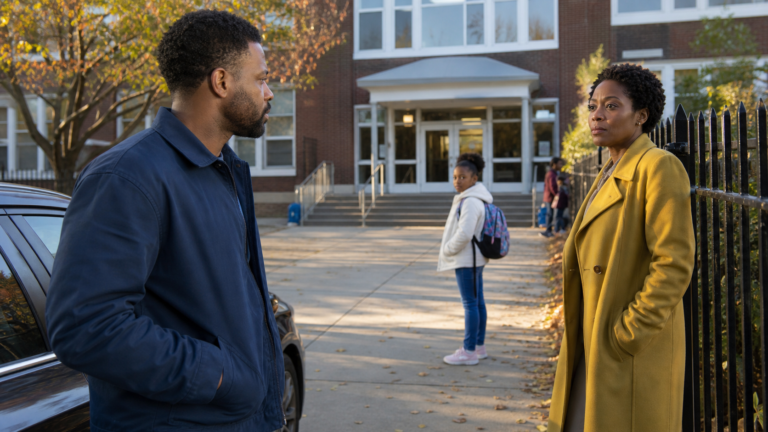
I was sitting in the third row of the school auditorium, still wearing navy scrubs from a twelve-hour shift, when an unfamiliar number flashed across my phone. Onstage, Maya balanced an imaginary diploma in one hand and tried not to laugh with her friends.
I almost ignored the call.
Then the voicemail appeared.
Mrs. Carter, this is our final attempt to discuss the delinquent balance on your mortgage before the account moves to legal review.
I listened twice.
We had never missed a mortgage payment.
At least, that was what my husband had told me.
The Folder Beneath the Cereal Boxes
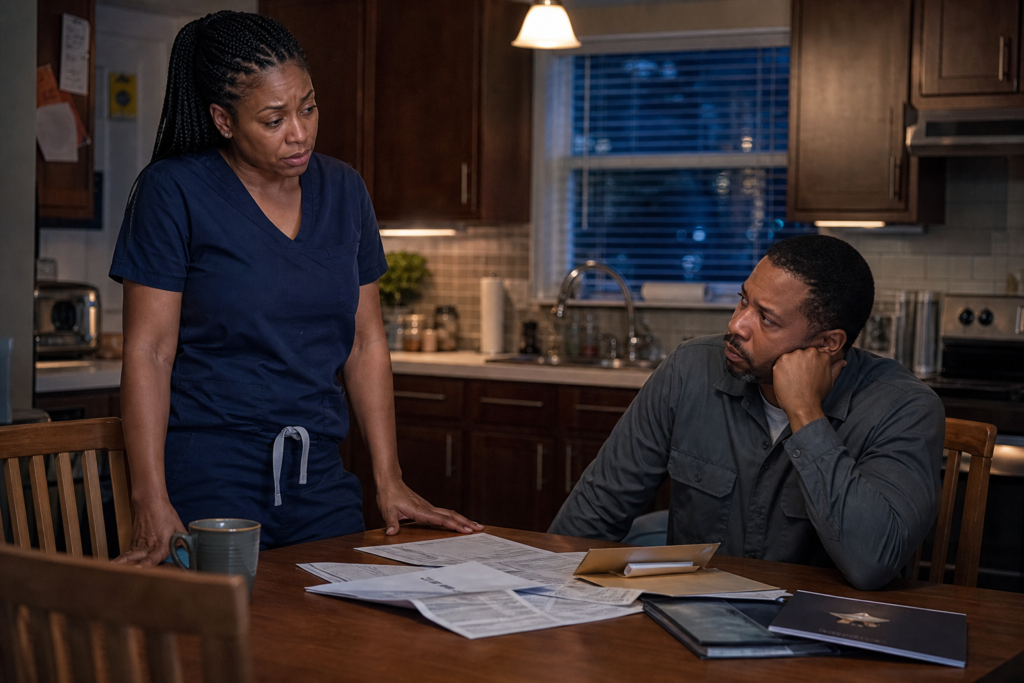
Andre was at the kitchen table when I came home. Bills covered the wood between us. He had made tea but had not touched it.
“How many payments?” I asked.
He looked at my face and understood that pretending would only make the room smaller.
“Four.”
“Four months?”
He nodded.
I put my hospital bag on the floor very carefully. Anger can make ordinary objects dangerous.
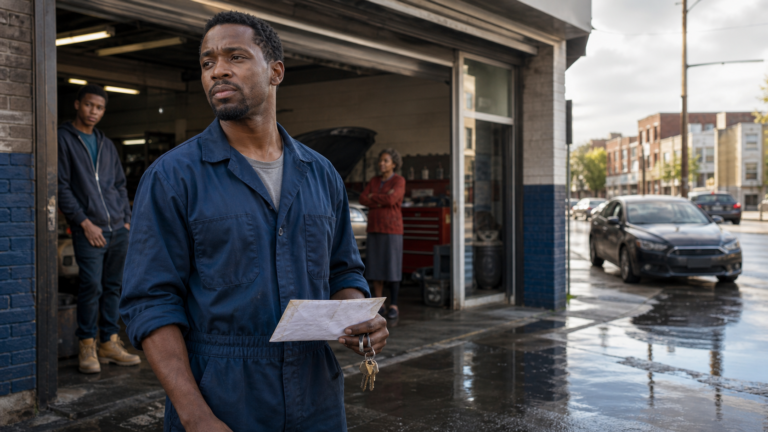
Andre and I had been married for nineteen years. He repaired commercial heating systems, the kind of work nobody noticed until a building became unbearable. I was an emergency-room nurse. We were not wealthy, but we had built a dependable life: a brick house outside Atlanta, two used cars, Friday takeout, and a college savings account we had fed twenty dollars at a time.
“Where did the money go?” I asked.
He opened a blue folder.
Inside were late notices, medical invoices, and statements from a small-business credit card I did not know existed.
“My contract with Mercer Plaza ended in January,” he said. “Then the school district reduced the maintenance work. I thought the spring jobs would cover everything.”
“You said business was slow.”
“It was worse than slow.”
“And you let me plan Maya’s graduation party while the bank prepared to take our house?”
He flinched.
“I kept thinking I could fix it before you had to know.”
That sentence hurt more than the number.
The Money We Had Promised Our Daughter
The mortgage was not the only secret.
Two weeks earlier, Andre had withdrawn six thousand dollars from Maya’s college account. He used part of it to pay the property tax and part to cover his mother’s home-care bill.
His mother, Evelyn, had early-stage dementia. She could still tell a perfect story from thirty years ago but sometimes left the stove burning and forgot which bus brought her home. Andre’s older brother lived in another state and sent advice more often than money.
“You took her college money,” I said.
“I borrowed it.”
“From an eighteen-year-old who doesn’t know she made the loan.”
“What was I supposed to do? Leave my mother alone?”
“You were supposed to tell me.”
He stood. “You were already picking up extra shifts.”
“That was my decision.”
“You came home with your feet swollen and fell asleep in the car twice. I wasn’t going to ask for more.”
“So you asked for everything without asking.”
We did not shout. Maya was upstairs. Quiet arguments can be worse because every word arrives intact.
Andre pushed the folder toward me. The total debt was larger than our yearly income after taxes.
For the first time in our marriage, I looked at him and could not tell whether I was seeing my partner or a stranger who had been managing my life from behind a closed door.
What Maya Heard From the Stairs
“How much did you take from my account?”
Maya’s voice came from the hallway.
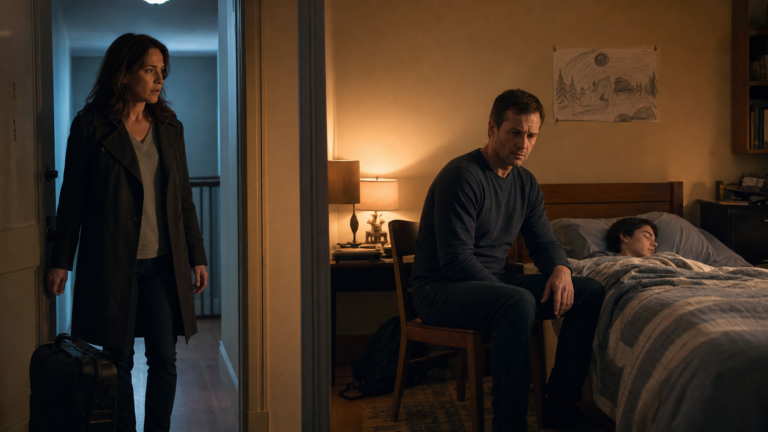
She stood on the bottom stair wearing her graduation T-shirt. Her face was still young enough to reveal every feeling before she could hide it.
Andre closed his eyes.
“Baby, we were going to tell you.”
“When? After I paid the enrollment deposit?”
I turned toward her. “Your deposit is safe.”
“That isn’t what I asked.”
She came to the table and read the withdrawal statement herself.
Maya had been accepted into a university three hours away. She wanted to study environmental engineering. For months, our refrigerator had held a photograph of the campus library. She had calculated meal plans, dorm costs, and the price of secondhand textbooks.
“Is there any money left?” she asked.
“Some,” Andre said.
“How much?”
He told her.
She looked at him for a long time, then went upstairs and closed her door.
No dramatic slam. Just a click.
Andre sat down as if his knees had stopped working.
The Meeting at the Bank
The next morning, we called the mortgage company together.
The woman on the phone did not sound cruel. That almost made it harder. She explained forbearance options, repayment plans, and documents we should have submitted months earlier. Because Andre had avoided the calls, some options had already expired.
Still, the house was not gone.
We had eleven days to submit a hardship package and enough money to stop the legal review.
At the branch meeting, I learned something humiliating and useful: financial disaster is rarely one dramatic mistake. It is a chain of small decisions made in private. A payment delayed for two weeks. A credit card used for payroll. A notice left unopened because Monday might bring better news.
Our counselor, Ms. Alvarez, made us list everything.
We owned two cars. One had three years of payments left. Andre’s business rented a storage unit full of equipment he rarely used. I paid for subscriptions I had forgotten. Evelyn qualified for assistance Andre had never applied for because he assumed the waiting list made it pointless.
“You do not need a miracle,” Ms. Alvarez said. “You need complete information and decisions you both understand.”
I glanced at Andre.
Trust had become a spreadsheet.
The Graduation Party We Could No Longer Afford
We canceled the restaurant room and held Maya’s party in our backyard.
I expected embarrassment. Instead, cousins brought folding chairs, neighbors carried trays, and my sister decorated the fence with photographs from kindergarten through senior year.
Maya smiled for guests but barely spoke to her father.
After everyone left, she found me wrapping leftovers.
“I can go to community college,” she said.
“You don’t have to make that decision tonight.”
“It would save money.”
“Your father’s mistake is not your bill.”
She leaned against the counter. “But the house is my house too.”
There it was—the sentence children say when adults have allowed them to carry adult fear.
I put down the foil.
“Listen to me. You can help us by knowing the truth, but you are not responsible for rescuing us. We will show you every real option. You will choose your school based on your future, not our shame.”
She nodded, but worry remained in her eyes.
I understood then that even if we saved the house, secrecy had already changed the way our daughter understood safety.
The Offer Andre Almost Refused
Andre sold the newer car and bought an old service van from a retiring technician. He closed the storage unit and moved the useful equipment into our garage.
Then my brother offered him a salaried maintenance position at a hospital complex.
Andre’s first response was no.
“I built my own company,” he said.
“And it is drowning us,” I replied.
He stared at the floor.
For him, the business was more than income. His father had worked under supervisors who called him “boy” well into his forties. Andre had promised himself that no one would control his paycheck or his dignity.
“Taking a job is not failure,” I said. “Hiding the numbers was.”
He accepted the position.
It paid less than his best business years and more than his recent months. Most importantly, it arrived on the same day every two weeks.
I reduced my overtime after nearly giving the wrong dosage during an exhausted night shift. That frightened me more than the mortgage notice. Saving our finances by risking a patient was not a plan.
What Happened to Maya’s College Plans
Maya compared the university’s revised aid offer with a local engineering transfer program. She chose one year at the community college, then a guaranteed transfer—not because we ordered her to, but because the numbers made sense to her.
She insisted on seeing the family budget once a month.
Andre deposited the first repayment into her account on a Friday morning. It was only two hundred dollars.
He printed the confirmation and placed it beside her breakfast.
“I’m sorry,” he said.
She did not hug him.
“Don’t apologize every month,” she replied. “Put the money back every month.”
He nodded.
It was not a cinematic reconciliation. It was better: a boundary, clearly spoken.
The House Was Never the Only Thing at Risk
We entered a repayment plan and kept the house.
That sentence makes the ending sound simpler than it was.
For nearly a year, we counted every grocery trip. Andre worked weekends. I learned to ask direct questions instead of assuming silence meant stability. We met with a marriage counselor twice a month, then once a month.
I did not forgive him the day the bank accepted our plan.
Forgiveness came in pieces.
It came when he handed me an unopened letter instead of hiding it. When he admitted a repair bill before trying to solve it alone. When he said, “I’m scared,” without turning fear into authority.
One evening, almost a year after the graduation rehearsal, we sat at the same kitchen table. Maya was away at a study group. Evelyn had moved into a supervised apartment near us and was safe.
Andre opened the banking app and turned the screen toward me.
“Mortgage paid,” he said.
“I know. I got the notification.”
He smiled. “I turned those on for both of us.”
The gesture was small. So had been the first missed payment.
That was what we finally understood: families are rarely broken or repaired in one enormous moment. They change through ordinary choices repeated until they become a life.
The bank’s number is still saved in my phone.
Not because I expect another final warning.
Because now, when something difficult calls, we answer it together.
Discover more emotional family dramas in our Family Stories collection.
The Pressure Behind the Phone Call
The graduation rehearsal places celebration beside financial fear. That contrast is intentional: family crises rarely wait for a convenient day, and parents often try to hide them so a child’s milestone will not be ruined.
The central question is not whether the family can find a sudden solution. It is whether they can stop protecting one another with partial truths and begin sharing responsibility. Answering the bank together becomes a small but meaningful change in how the family handles fear.
Fiction notice: This original story is a work of fiction. Names, characters, places, and events are invented.