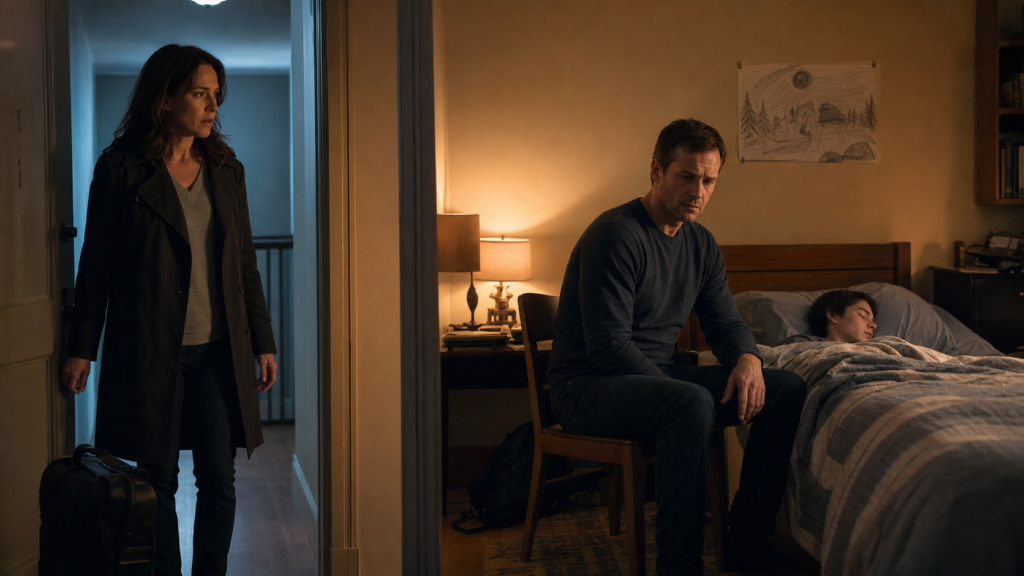
At 11:38 on a Thursday night, Claire Bennett came home three days early and found light leaking from beneath the one door her husband had promised never to open.
She stood in the hallway with one hand still wrapped around the handle of her suitcase. For sixteen years, that room had been a storage space. Before that, it had been a nursery for exactly nine days.
Claire had never entered it again.
Yet someone had painted the door blue.
From inside came the low murmur of a man’s voice, then the creak of a mattress. Claire released the suitcase. It landed softly on the runner, but the sound was enough.
The voice stopped.
“Mark?” she called.
No answer.
Claire had spent four months in Copenhagen supervising the restoration of a nineteenth-century concert hall. She had planned to surprise her husband with the early flight, a bottle of wine, and the news that she had refused a second overseas contract.
Now she noticed unfamiliar sneakers beside the stairs. A gray backpack rested beneath the coat rack. One of its straps had been repaired with red thread.
She walked toward the blue door.
“Mark, open it.”
The handle turned.
Her husband stepped into the hallway and pulled the door almost closed behind him. He wore the same navy sweater he had worn during their video call that morning, but his face looked older than it had on the screen.
“You weren’t supposed to be home until Sunday.”
“Who is in that room?”
Mark glanced behind him.
That small movement frightened her more than an answer would have.
Claire pushed past him.
The Boy in the Locked Room
The room no longer contained cardboard boxes or the covered rocking chair Claire had refused to throw away. There was a narrow bed, a wooden desk, two shelves of secondhand books, and a lamp shaped like a lighthouse.
A teenage boy lay asleep beneath a green blanket. He appeared to be sixteen or seventeen. Dark curls fell across his forehead, and one hand rested beside a half-finished sketch of a train station.
Claire stared at his face.
Something inside her recognized him before reason could object.
It was the shape of his mouth. The small crescent scar beneath his left eyebrow. The way the fingers of his sleeping hand folded inward.
Claire’s own hand did the same thing when she slept.
“Who is he?” she whispered.
Mark closed the door quietly and guided her into the kitchen.
She pulled away from him.
“If you tell me he’s your son, I swear—”
“He isn’t my son.”
“Then why is he sleeping in the room where our baby died?”
Mark pressed both hands against the counter. “Because the baby didn’t die there.”
The kitchen seemed to tilt.
Claire laughed once, sharply. “Don’t do that.”
“I need you to sit down.”
“Don’t tell me to sit down. Tell me who is in my house.”
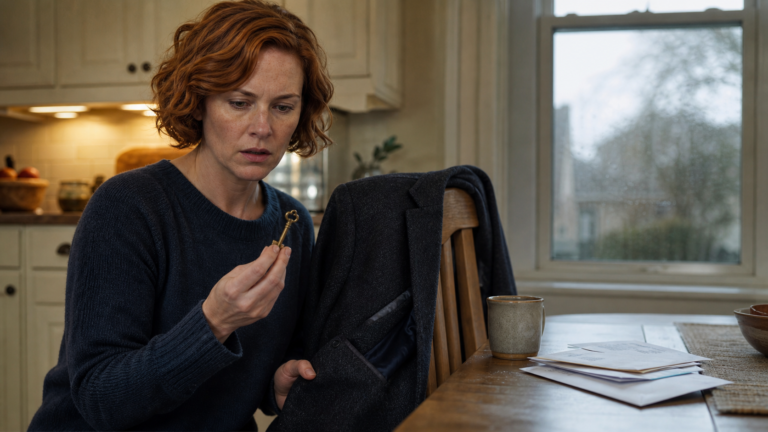
Mark opened a drawer and removed a brown envelope. Her mother’s handwriting crossed the front.
For Claire, when keeping the truth becomes crueler than telling it.
Claire had buried her mother eleven months earlier.
The Story Her Mother Gave Her
At twenty-one, Claire had given birth six weeks early after a difficult labor. She remembered waking in a private hospital room with her mother beside the bed and an empty plastic crib near the window.
Her mother told her the baby had lived for nine days.
Claire never saw his body. She was told an infection made viewing impossible. Her mother handled the paperwork, the cremation, and the tiny memorial service Claire had been too sedated to attend.
Mark had entered her life two years later. He knew the story, knew why she could not hear a music box without leaving the room, knew why they never tried to have another child.
“You know what happened,” Claire said. “You held me every year on his birthday.”
Mark slid the envelope toward her. “I knew what you were told.”
Inside was a letter, a hospital bracelet bearing the name Baby Bennett, and an unsigned adoption agreement.
Claire read the first paragraph three times.
Her mother had been afraid. Claire had no job, no partner, and months of physical recovery ahead of her. The baby’s father had disappeared. A couple from another county had been waiting years to adopt.
So her mother made a decision she had no right to make.
The child was placed with Thomas and Irene Vale. Claire was told he was dead. The Vales were told his mother had voluntarily surrendered him.
“No,” Claire said.
She tore the next page while unfolding it.
The boy’s name was Eli.
Sixteen years later, Irene Vale had died from cancer. Thomas, overwhelmed by debt and grief, found the original documents. He contacted Claire’s mother. She refused to reveal Claire’s address, but shortly before her own death, guilt changed her mind.
She wrote Mark’s name and phone number on the final page.
Claire looked toward the hallway.
“That boy is my son?”
Mark’s eyes filled, but he did not look away. “The DNA results came back six days ago.”
Claire slapped the envelope against his chest.
“Six days? How long has he been here?”
“Three weeks.”
“You let me call you from another country every night while my son was living in this house?”
“He asked me not to tell you until the test came back.”
“And you listened to him instead of your wife?”
“He had just lost the only mother he remembered. His father had checked himself into a treatment program. Eli arrived with a letter saying the woman he had been told was dead might still be alive. I wasn’t going to turn his life into another emergency just to make myself feel honest.”
Claire looked at the blue door.
“You put him in that room.”
“He chose it.”
“He knew what it was?”
“He knew it was supposed to have been his.”
What Eli Had Been Told
The boy appeared in the kitchen doorway before either adult noticed him. He held the green blanket around his shoulders.
“I can leave,” he said.
Claire turned.
Awake, he looked even more familiar. Not like a perfect copy, but like a sentence written in handwriting she had seen all her life.
She wanted to cross the room. She wanted to touch his face, to apologize, to ask sixteen years of questions at once.
Instead she heard herself say, “Did you know I was coming home?”
Eli shook his head.
“Did Mark tell you I abandoned you?”
“No.”
“What did my mother tell your parents?”
“That you chose them.”
Those four words struck with astonishing precision.
Eli tightened the blanket around himself. “My mom—my adoptive mom—never lied about loving me. She said you gave me away because you wanted me to have a stable home. When she got sick, she helped me write letters to you. Your mother sent every one back unopened.”
He returned to the bedroom and came back carrying a shoebox.
Inside were eleven envelopes.
The earliest had been written in blue crayon.
Dear Claire, I am seven. I like trains and I can swim now.
At ten, he had sent a school photograph.
At thirteen, he wrote that he was not angry.
At fifteen, he stopped calling her Mom.
The final envelope had no stamp. On the front he had written only: Questions I may never ask.
Claire sat at the kitchen table because her knees would no longer hold her.
“I didn’t know,” she said.
Eli looked at Mark, not at her. “That’s what he said.”
“It’s true.”
“I believe you.”
Relief rose too quickly.
Then Eli added, “But believing you doesn’t make us a family.”
The Truth Mark Had Kept
Claire spent the rest of the night reading every letter. Mark made tea no one drank. Eli sat on the stairs, close enough to hear but far enough to leave.
Near dawn, Claire reached the bottom of the box and found a photograph that did not belong to Eli.
It showed Mark and her mother outside a cafe. The date printed on the back was almost four years old.
Claire held it up. “You met with her?”
Mark went still.
The second betrayal arrived quietly.
Four years earlier, her mother had suffered a minor stroke. Frightened she might die with the secret, she had confessed everything to Mark. She gave him the Vales’ last known address, then begged him to protect Claire from the truth.
Mark drove to the address.
The family had moved.
He returned home and said nothing.
“You knew for four years,” Claire said.
“I knew there might be a child somewhere. I didn’t know if the story was true.”
“You could have searched.”
“I was afraid finding him would destroy you.”
“So you decided for me. Just like she did.”
Mark lowered his head.
That was the moment Claire understood there would be no simple villain in the room. Her mother had acted out of fear and control. Mark had acted out of fear and love. Both had taken the same thing from her: the right to face her own life.
Eli listened from the stairs.
“Are you going to leave him?” he asked.
Claire looked at her husband. “I don’t know.”
It was the first honest answer anyone had given that night.
The Morning After
There was no embrace at sunrise. No sudden promise that lost years could be restored.
Claire called the airline and canceled the return flight. Then she contacted a family counselor and an attorney who specialized in adoption records. Mark moved into the guest room. Eli chose to remain in the blue bedroom until his father completed treatment.
For the first week, Claire and Eli spoke mostly through questions left on index cards beside the coffee maker.
What music do you hate?
Do you still draw trains?
What was Irene like when she laughed?
Some answers were easy. Others remained blank.
Claire never asked Eli to call her Mom. She learned about Irene instead—the woman who had stayed awake through fevers, packed school lunches, and kept every drawing. Loving the son she had lost meant respecting the mother he had lost too.
Three months later, Claire repainted the bedroom with Eli. He chose a warmer blue.
While moving the desk, they discovered a tiny brass star wedged behind the baseboard. Claire recognized it as part of the mobile that once hung above the empty crib.
She placed it in Eli’s palm.
“This was yours,” she said.
He studied it for a long time.
“Maybe,” he replied. “But you can keep it until we figure out what yours means.”
Claire closed her fingers around the star.
Mark stood in the doorway, waiting for permission to enter. Their marriage had not healed. Trust did not return simply because his reasons were understandable. But he had stopped using protection as another word for secrecy.
Eli nodded, and Mark came inside.
The three of them assembled a bookshelf badly. One shelf leaned. Two screws remained unused. Nobody pretended it was perfect.
That evening, Eli handed Claire the last sealed letter from the shoebox.
“I think you can read this one now.”
Inside was a single question he had written months before they met:
If you discovered I was alive, would you come looking for me?
Claire turned the page over and wrote beneath it.
I would have. I am sorry other people made sure neither of us could prove it.
She gave the letter back.
Eli read her answer, folded the paper carefully, and returned it to the box.
He did not call her Mom.
But before going upstairs, he paused beside her chair and said, “Good night, Claire. I’ll see you in the morning.”
After sixteen years of being told her child was gone, Claire finally understood that those six ordinary words were not a small beginning.
They were the beginning.
This is a work of fiction. Names, characters, places, and events are invented.