Series: The Bellwood Family Mystery · View all parts in reading order
Part 3 and the finale of an original fictional serial. Read Part 1 and Part 2 first.
Fiction notice: This is an original fictional story created for entertainment. The characters and events are not presented as real people or verified news.
The woman at the fence was waiting for us to notice her.
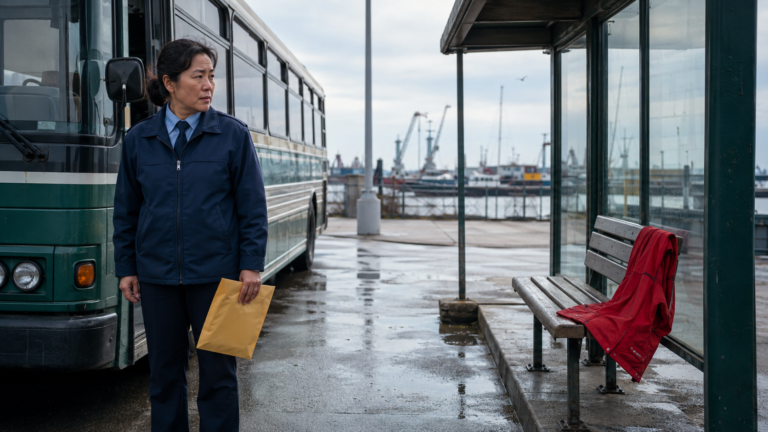
The figure did not move when I turned toward the window. A woman in a dark coat stood beneath the streetlamp, one hand lifted where I could see it. She held no weapon. She did not come closer.
Behind me, Lina pulled the curtain shut.
“Call the police,” she said.
Elias already had his phone out. Rose gathered the photographs from the table while I ran upstairs, woke Sophie and Noah, and took them into our bedroom away from the windows. I told them a car had broken down outside. Sophie knew I was lying, but she helped Noah build a blanket fort without asking questions.
When I returned, the woman had crossed from the fence to the back step.
She knocked three times.
“Daniel,” she called through the door. “My name is Miriam Bell. If you want your children safe, you need to let the police find me here—not on the road.”
The Woman Everyone Believed Was Dead
Rose made a sound like the air had been struck from her.
“Miriam?”
The woman outside leaned toward the glass. She was in her early fifties, with gray threaded through dark hair. The resemblance to Lina that Rose had seen was real, but not exact. It lived in the eyes and the shape of the mouth—the kind of resemblance that could belong to relatives or simply to two tired women under bad light.
“You told us she died in 2004,” Elias said.
Rose shook her head. “That is what Marianne told me.”
Sirens approached before we opened the door.
Two officers entered through the front while a third brought Miriam in from the garden. She surrendered her bag and allowed herself to be searched. Inside were three sealed folders, an old cassette recorder, and a photograph of a man leaving his car two streets from our house.
I recognized him from newspapers I had found during my search.
Dr. Marcus Dyer, the former director of Saint Matthew’s clinic.
He was eighty-one years old and supposedly living in a private care home fifty miles away.
“That is who was watching the house,” Miriam said. “I took the photograph from the garden. The message was mine too.”
Lina stared at her. “You wrote, ‘The children are next.’”
“I was trying to make you stop searching online before Dyer saw your names attached to the records. I had seconds, and I chose the worst possible words.” Miriam looked toward the ceiling where our children waited. “I am sorry.”
“Why should we believe anything you say?” I asked.
She placed both hands flat on the table.
“You should not. Not yet. But the police can verify every page I brought.”
What Saint Matthew’s Was Really Doing
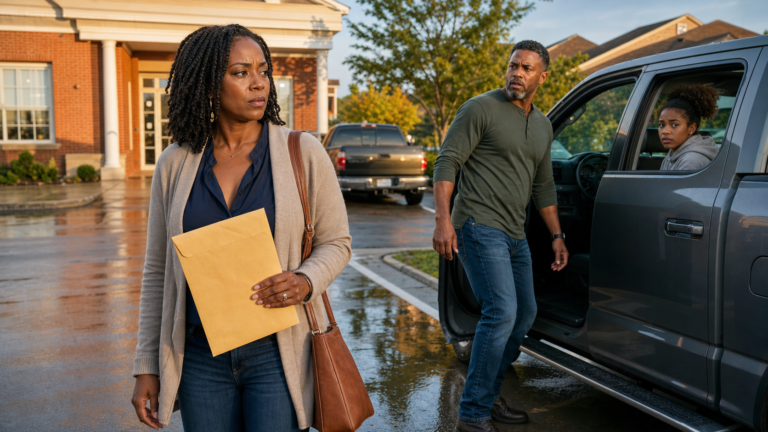
A detective named Lena Shaw arrived twenty minutes later. She had been assigned to Miriam’s missing-person case three months earlier, but until that night she had never heard of the Bell adoption files.
Miriam began at the beginning.
Saint Matthew’s had been a small charitable clinic with a maternity ward and a private adoption program. In the late 1980s, Dr. Dyer discovered how easily sealed records could hide missing signatures, invented dates, and unofficial payments.
“He told himself he was rescuing children,” Miriam said. “Sometimes he placed babies with safe families faster than the courts could act. Then wealthy couples began paying him. After that, it stopped being rescue.”
Dyer reused the identities of infants who had died before their records reached the county. He moved children between files, altered birth dates, and threatened anyone who asked questions. Some adoptive parents knew they were avoiding the law. Others believed every paper he gave them.
“D.M.,” I said, remembering the initials on the police report. “It never meant Daniel Mercer.”
“Dr. Marcus Dyer,” Miriam replied. “He enjoyed signing with initials that could point at somebody else.”
Rose sat beside her, pale and silent.
“You were Marianne’s daughter,” she said at last.
“Foster daughter,” Miriam corrected. “Marianne took me in when I was twelve. She was my mother in every way that mattered, but we did not share blood.”
That was the first knot to come loose.
Rose had called Miriam my sister because we had belonged to the same household. Years of rumor had turned that truth into biology.
“Then Marianne really was my birth mother?” I asked.
“Yes,” Miriam said. “You were her only biological child.”
Lina’s hand found mine beneath the table.
Relief came, but carefully. We had already learned not to trust relief that arrived before evidence.
Daniel and Grace
Miriam opened the first sealed folder.
Inside was the complete page from the photograph Rose had brought—the image of two infants labeled Daniel and Grace, March 1989.
“Grace was not your twin,” Miriam said. “She was born on the same day to a different mother. The clinic photographed newborns in pairs for its donor newsletter. Somebody later wrote the names on the back.”
Grace died three days later from a heart defect.
Two years afterward, Dyer reused her file for another little girl whose mother had died without completing any paperwork. He changed Grace’s birth date, combined pages from two records, and gave the child to the Vales under the name Lina.
Lina looked down at the partial certificate she had carried from her father’s box.
“Who was I?” she asked.
Miriam removed a hospital bracelet from a clear evidence sleeve.
Elena Hart.
“Your birth mother was Clara Hart, a nurse’s assistant at Saint Matthew’s,” Miriam said. “She died in a road accident when you were seven months old. There was no father listed. Dyer kept you at the clinic while he looked for a family willing to pay.”
“The Vales?”
“They paid administrative fees. I do not know whether they understood those fees were illegal.”
Lina held the bracelet but did not cry. Her grief was quieter than that—a rearranging of every story she had told herself about where she began.
“Why did my father keep the letters?”
“Because he eventually understood something was wrong,” Miriam said. “He began collecting proof. Dyer threatened to take you away if he went to the police.”
The Female Blood Card
Detective Shaw asked the question that still made no sense.
“Why was the blood card labeled Daniel female, and why did it match your missing-person profile?”
Miriam looked ashamed.
“Because I replaced it.”
In 1998, Helen Mercer had returned to Bellwood looking for the missing girl she believed might be connected to me. Dyer noticed and ordered the old evidence destroyed. Miriam, then twenty-three, broke into the clinic archive first.
“I took Daniel’s real card and left one of mine in its place,” she said. “I thought a female result would prove the archive unreliable and make Dyer abandon the search. I kept Daniel’s card with the original records.”
She opened the second folder.
Inside was a small evidence envelope marked with my birth name and a chain-of-custody form signed by a state investigator that morning.
“I disappeared three months ago because Dyer learned I still had this,” Miriam said. “I entered protective custody under another name. When the missing-person database flagged the sample your parents submitted, the laboratory contacted the detective handling my case.”
Detective Shaw nodded. “That part is true. We confirmed the match before coming here.”
The mystery of the blood card was not a family connection. It was a twenty-eight-year-old attempt to hide evidence.
The Test That Finally Mattered
There was only one answer Lina and I still needed, and no document could provide it.
Detective Shaw arranged direct DNA collection through the county forensic laboratory. A technician came to the house before sunrise, checked our identification, and sealed our samples in front of us.
Because the case involved possible record fraud and threats to children, the first comparison was expedited.
We waited thirty-six hours.
During that time, Lina and I barely slept. We made breakfast, walked the children to school with a police car at the corner, and answered each other’s questions without hiding behind kindness.
“If the result is bad,” Lina said the second night, “our children do not become mistakes.”
“Never.”
“And neither do the eleven years before we knew.”
“Never.”
She took my hand.
“But I am still angry that you investigated me before you trusted me.”
“You should be.”
“I need you to understand that relief will not erase that.”
“I do.”
It was not a dramatic reconciliation. It was better. It was the beginning of an honest one.
The laboratory called at 6:42 the following evening.
Daniel Mercer and Lina Vale shared no biological parent and had no close genetic relationship.
I read the sentence aloud twice.
Lina covered her face. Then she laughed and cried at the same time, and I held her while the fear that had lived between us finally lost its name.
The Last Files at the Clinic
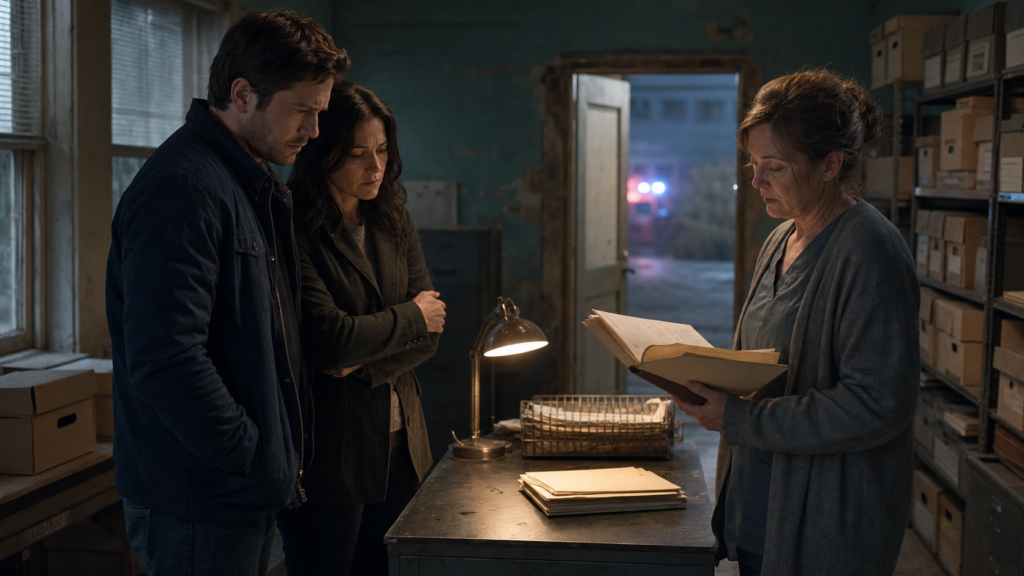
Miriam’s folders were enough to open an investigation, but not enough to identify every child whose records Dyer had changed. The complete ledger was still hidden beneath the abandoned clinic.
Dyer knew it too.
Police watching the building saw him enter through a maintenance door before dawn. He carried a fuel can and a box of matches.
He never reached the archive.
Detective Shaw arrested him in the basement corridor while another team recovered the ledger, payment books, and twenty-seven original birth files sealed inside a ventilation cavity.
When officers led him outside, Dyer did not look frightened. He looked offended.
“Those children had homes because of me,” he told the cameras.
Miriam stood behind the police line.
“They had names before you stole them,” she said.
He looked at her for a long moment, and for the first time, the old doctor had no answer.
What the Truth Changed
The legal case took months.
Some families learned that dates had been altered but their relationships were otherwise lawful. Others discovered siblings, living parents, or names they had never heard. Not everyone wanted contact. The investigators respected that.
Lina petitioned to correct her birth record. She kept the name Lina—not because Dyer had given it to her, but because she had lived in it, loved in it, and made it hers. She added Elena as a middle name for the child Clara Hart had once held.
My record was confirmed: Marianne Bell was my biological mother. Miriam had been my foster sister for only the first months of my life, before I was adopted. We did not pretend that this made us instantly close. We began with coffee, careful questions, and the freedom to stop whenever either of us needed space.
Helen came to our house and apologized to Lina.
“I thought silence was protection,” she said.
Lina answered, “Silence only protects the person who already knows the truth.”
Helen accepted that.
Rose gave the photographs to the investigation and kept one copy of the picture from the café—the one taken before a single question changed our lives.
The Envelope We Kept
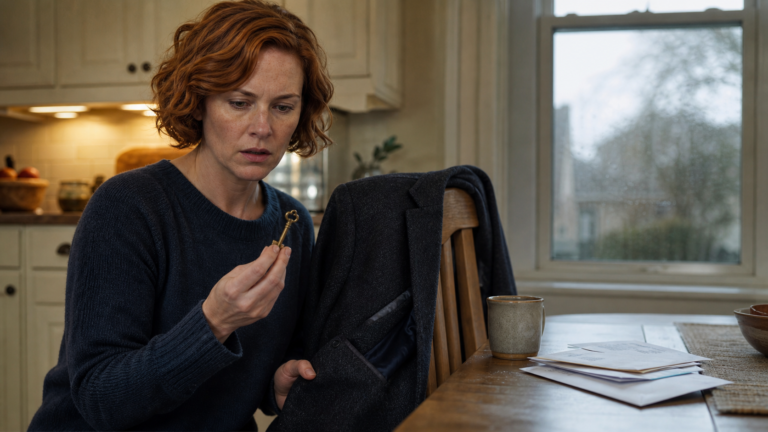
On our twelfth anniversary, Lina placed the old metal cashbox on the kitchen table.
Inside it, she arranged the documents that were true: Clara Hart’s photograph, the corrected certificate, the hospital bracelet, and a copy of the page that cleared our biological relationship.
She removed Dyer’s false letters and handed them to Detective Shaw for the trial.
“Do you want to lock the box?” I asked.
“No.”
She placed it on the shelf beneath our family albums.
“The children will ask one day,” she said. “When they do, we tell them the truth in words they can carry.”
I looked around the same kitchen where I had once watched her face for signs of a stranger. Sophie’s spelling test was attached to the refrigerator. Noah’s latest cardboard spaceship blocked the hallway. Nothing had returned to normal, because normal had been built partly from secrets.
What we had instead was better: a life whose difficult pages were no longer hidden.
“Do you ever think about the sentence that started all of this?” Lina asked.
I knew the one she meant.
My wife might be my sister.
“Sometimes.”
“And now?”
I took her hand.
“Now I think fear asked the wrong question.”
She waited.
“The real question was whether we could tell each other the truth when it hurt.”
Lina squeezed my fingers.
“We were late,” she said.
“But we got there.”
Upstairs, our children began arguing about whose turn it was to choose a bedtime story.
Lina smiled.
“Go referee.”
I stood, then looked back at the open cashbox.
For decades, people had changed names, moved dates, and buried evidence because they believed a family could be created or destroyed by paper.
They were wrong.
Paper could hide the beginning of a family.
Only truth could decide what happened next.
The End.
Explore more Family Stories and Mystery Stories.