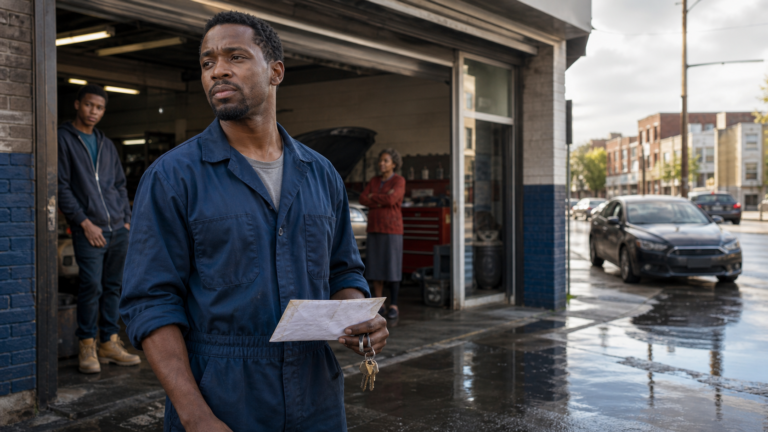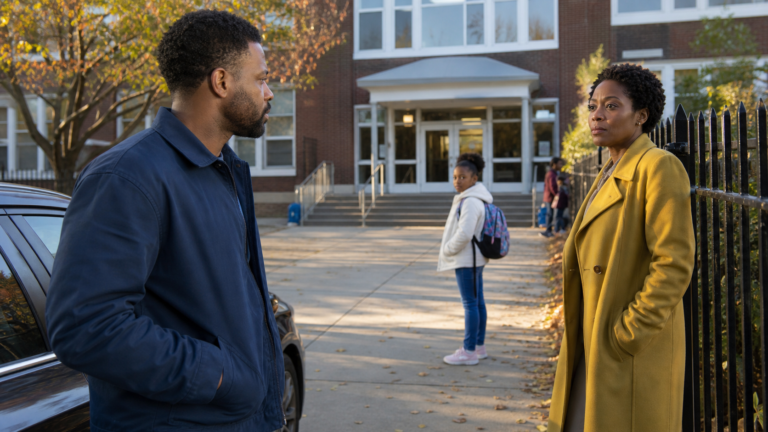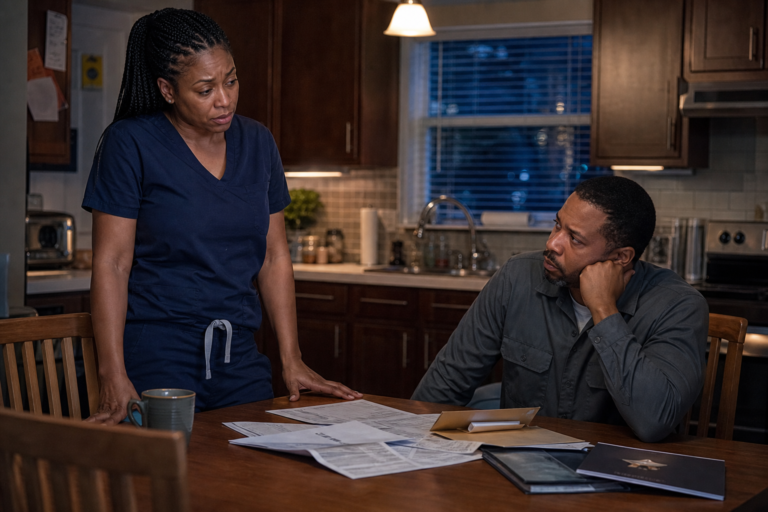

At 2:14 on a bright Tuesday afternoon, Daniel Reyes found an eight-year-old girl sitting alone at Platform Six with a ticket issued to a dead woman.
The station was full: coffee cups, rolling suitcases, children dragging tired parents toward the departure board. Nothing about the day looked like an emergency.
The girl wore a pink sweatshirt and held a paper ticket with both hands.
Daniel crouched several feet away. “Hi. I work here. Is someone traveling with you?”
“My mother.”
“Where is she?”
The girl pointed to the ticket. The passenger name was Mara Bell.
Daniel knew the name. Everyone in the city did. Mara Bell, a family-court lawyer, had died four days earlier in a highway accident.
“What’s your name?”
“Sophie.”
“Do you know a phone number?”
She nodded, then whispered, “But she said I must not call until three people come.”
Daniel looked up. Three adults were moving toward them from different sides of the concourse.
Daniel: The Employee Who Was Not Supposed to Decide
The first was a woman in a beige coat. She dropped her bag beside the bench and reached for Sophie.
“Thank God. Sophie, are you hurt?”
Daniel stepped between them. “Please don’t touch her yet. Who are you?”
“Claire Morgan. I’m her teacher.” She produced a school badge and photographs on her phone: Sophie at a science fair, Sophie holding a certificate, Sophie asleep during a class trip. “Mara asked me to take her if anything happened.”
“Do you have that in writing?”
Claire hesitated. “She was supposed to sign it Friday.”
The second person arrived before Daniel could answer. A young man in a denim jacket, breathing hard.
“Sophie!”
The girl stood. For half a second, relief crossed her face.
Then she sat down again.
“I’m Adrian Bell,” he told Daniel. “Mara’s brother. I’m family.” His phone showed years of messages, birthday videos, and a photo of Sophie on his shoulders. “Claire has no right to take her.”
“Neither do you,” Claire said. “Your sister stopped speaking to you last year.”
“Because you told her to.”
The third adult approached without running. She wore a red blazer and carried a thick folder.
“My name is Lena Ortiz, Child Protection Services. I have an emergency placement order.”
She handed Daniel documents stamped by the court. Unlike the teacher’s promise and the uncle’s photographs, Lena had the law.
“The child comes with me,” she said.
Sophie’s fingers closed around Daniel’s sleeve.
“Please,” she whispered. “Not yet.”
Claire: The Promise Nobody Witnessed
Claire had met Mara two years earlier at a parent conference. Sophie was falling asleep in class and hiding food in her backpack.
“We’re between apartments,” Mara had explained.
Claire later discovered that “between apartments” meant sleeping in a car while Mara fought a custody case she refused to discuss.
Three weeks before the accident, Mara appeared at Claire’s door after midnight.
“If something happens to me,” she said, “take Sophie somewhere public. Wait for my brother, a social worker, and you. Do not let any one person leave with her until all three have spoken.”
“That sounds insane.”
“It sounds insane because I can’t tell you everything.”
Claire wanted to call the police. Mara made her promise not to.
Now, at the station, Claire knelt beside Sophie.
“Did your mom leave you something?”
Sophie looked at Daniel, not Claire. “She told me only the station man can open it.”
From her backpack, she removed a sealed white envelope.
On the front: TO THE PERSON WHO HAS NO REASON TO LIE.
Daniel almost laughed. He had plenty of reasons to lie. He wanted no complaint, no lawsuit, no headline saying a station employee had interfered in a custody case.
Lena held out her hand. “That envelope may contain confidential information. Give it to me.”
Sophie pulled it back.
“My mother said the person with the papers would ask first.”
For the first time, Lena’s calm expression changed.
Adrian: The Family Member with a Missing Year
Adrian loved his sister. That was true.
He had also betrayed her. That was true too.
A year earlier, Mara had asked him for money and told him not to ask why. He refused. Two days later, he called Sophie’s biological father, Marcus, believing a child should not be sleeping in a car while her father lived in a large house.
Marcus used the call in court. Mara lost temporary custody for six weeks.
When Sophie returned, she no longer slept without a light on.
Mara never forgave Adrian.
At the station, he faced his niece. “I was wrong. I know that now.”
“Mom said you always know after,” Sophie replied.
The sentence hit harder than shouting.
Adrian looked at Lena’s folder. “Where will you take her?”
“To an approved temporary home.”
“Which one?”
“I can’t disclose that here.”
Claire folded her arms. “Is Marcus Bell connected to that home?”
Lena’s eyes moved toward the security cameras.
“We should continue this conversation privately.”
“No,” Daniel said. It surprised everyone, including him. “We stay where the cameras can see us.”
The Envelope
Daniel opened it.
Inside were three documents and a short letter.
The first document showed that Mara had filed an emergency complaint against a private foster-care contractor. The second listed payments from that contractor to a consulting company owned by the husband of Lena’s supervisor. The third was a placement order drafted two days before Mara’s death.
The approved temporary home belonged to Marcus Bell’s cousin.
Lena went pale. “I didn’t know about the payments.”
“But you knew the placement,” Claire said.
“I knew what the order said. My job is to follow it.”
Daniel read Mara’s letter aloud.
If you are hearing this, I failed to stay alive long enough to protect my daughter. Claire has love but no legal authority. Adrian has legal standing but has made choices that endangered Sophie. The social worker has legal authority but may be trapped inside a compromised system. None of them is entirely safe. None of them is entirely bad.
Do not choose the person who tells the best story. Choose the action that can be watched.
Under the letter was a phone number for a judge and a code: Platform Six.
Lena exhaled. “Judge Alvarez. She signed the order.”
“Then call her,” Daniel said.
“Court orders are not cancelled by phone calls.”
“I didn’t ask you to cancel it. I asked you to let her see what we see.”
Lena: The Law and the Person Carrying It
Lena had worked twelve years in child protection. She had removed children from rooms with no heat and returned them to parents who had earned another chance. She had learned that paperwork could save a life—and also hide the person destroying it.
Her supervisor had called that morning.
“Pick up Sophie Bell yourself. Do not involve local police unless necessary.”
At the time, it sounded like caution. Now it sounded like control.
“If I delay,” Lena said, “I could lose my license.”
Adrian answered, “If you don’t, she could lose more than that.”
“Easy for you. You don’t have to sign your name.”
Daniel placed the documents under the station camera. “Everyone signs. I’ll file an incident report. Claire signs as witness. Adrian signs. You write that the child remained in a public location while the judge was contacted.”
“And if the judge doesn’t answer?”
Sophie spoke quietly. “Mom said ask for the blue file.”
Lena stared at her. Then she called.
The judge answered on the fourth ring.
The Forty-Seven Minutes
For forty-seven minutes, nobody took Sophie anywhere.
Police arrived. A second child-protection supervisor arrived. Judge Alvarez joined by secure video and reviewed the documents. The original placement order was suspended pending investigation.
That did not solve the harder question: where would Sophie sleep?
Claire wanted to take her home. Adrian insisted family came first. Lena proposed a neutral emergency center.
They argued until Sophie climbed onto the bench and raised her voice.
“Stop choosing forever!”
The adults went silent.
“Mom said grown-ups make bad decisions when they think one decision has to fix everything.” Sophie looked at Claire. “Can I sleep at your house tonight?” Then at Adrian. “Can you come for breakfast?” Finally at Lena. “Can you check the house yourself?”
The judge agreed to a supervised, one-night emergency arrangement. Not custody. Not victory. One night that could be watched.
Claire took Sophie’s small hand. Adrian carried the backpack. Lena walked beside them, already writing her report.
Daniel remained at Platform Six, surrounded by people hurrying toward ordinary destinations.
What Happened After the Station
The investigation lasted seven months. Lena’s supervisor resigned. The contractor lost its license. Marcus was not charged with Mara’s death; the crash remained an accident. But the court reopened every decision connected to the private agency.
Adrian did not receive custody. Neither did Claire—not immediately.
They stopped treating Sophie like a prize. Claire became temporary guardian. Adrian attended every supervised visit and slowly rebuilt trust. Lena kept her license and later testified about the pressure inside her department.
Daniel received a written warning for delaying an authorized transfer.
He framed it.
A year later, Sophie returned to the station with three adults. She handed Daniel a ticket for Platform Six.
“Who’s traveling with you?” he asked.
She smiled. “All of them. But I decide where I sit.”
The train arrived in full daylight.
This original fictional story is published by Nocturnal Stories. Explore more family stories, visit our complete Stories archive, or read Voice Message My Mother Left.
Editor’s note: This is an original work of fiction about responsibility, family, and the dangerous distance between what is legal and what is right.