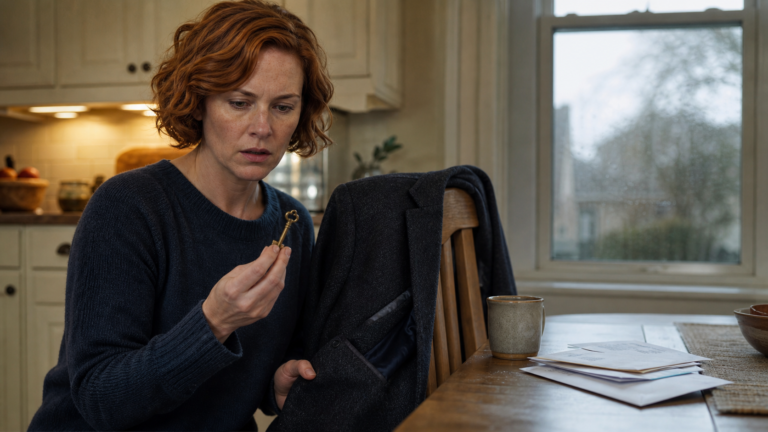
The photograph had been hidden inside my childhood bedroom wall for twenty-seven years. When my father saw it in my hand, he did not ask where I had found it. He only said, “Nora, please burn that before you read the back.”
I had come home to help him sell the house after my mother died. Six months had passed since the funeral, but her reading glasses still rested beside the lamp and a half-used bottle of vanilla remained in the kitchen cabinet. My father, Martin, moved around those objects as if disturbing them might cause a second death.
The real-estate agent said the upstairs wallpaper would frighten buyers. So on a cold Saturday in November, I stood in the room where I had once slept beneath glow-in-the-dark stars, pulling faded paper from the plaster.
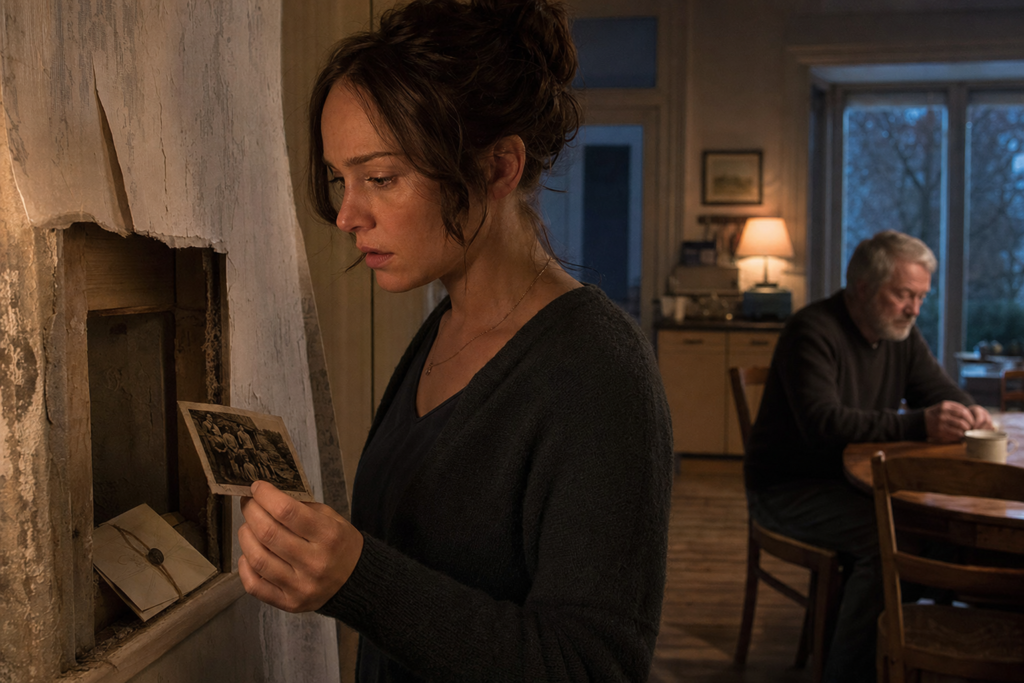
One strip came away with a thin piece of wallboard. Behind it was a narrow cavity. Inside, wrapped in a yellowed dish towel, I found a cream envelope and a photograph.
Three people stood outside a hospital in the picture. My mother, Elise, looked about thirty. My father stood beside her, younger and thinner than I had ever known him. Between them was another woman holding a newborn baby.
The woman had my eyes.
My father appeared in the doorway just as I turned the photograph over.
On the back, in my mother’s handwriting, were six words:
For Nora, when we are brave enough.
“Who is she?” I asked.
My father stared at the envelope. His face did not show surprise. It showed recognition.
“You need to give me that.”
“Who is she?”
He stepped into the room. “Nora, please burn it before you read the back.”
“I already did.”
For a moment, neither of us moved. Rain tapped against the window. Downstairs, the old refrigerator clicked on with the same mechanical hum I remembered from childhood.
Then my father sat on the bare floor.
The Woman in the Photograph
“Her name is Lena Vale,” he said. “She was your mother’s younger sister.”
I almost laughed. My mother had always told me she was an only child.
“That’s not possible.”
“It is.”
He spoke slowly, as if each sentence had to pass through a locked door. Lena was nineteen when she became pregnant. The baby’s father disappeared before the birth. My mother and father had been trying unsuccessfully to have a child for years. Their parents proposed what everyone called a temporary arrangement: Elise and Martin would care for the baby while Lena finished school and found stable work.
The baby was me.
“Temporary?” I repeated.
My father rubbed both hands over his face. “That was the word at first.”
Lena visited during my first year. She brought clothes, formula, and small toys she could barely afford. But my mother had already begun calling herself Mama. My father had added me to his health insurance. By the time Lena asked to take me home, I was fourteen months old.
“And you refused.”
“We were afraid.”
“That isn’t an answer.”
“It’s the only honest one I have.”
They went to court. Lena had no lawyer at first; my parents did. The judge focused on stability, housing, and the life I already knew. Eventually, Lena agreed to a closed adoption after being told she might otherwise lose contact without any written arrangement.
“Did she want me?” I asked.
My father looked directly at me. “Yes.”
The answer hurt more than abandonment would have. Abandonment was a clean story. This was a room full of adults making choices, then allowing a child to grow up inside the version that made them comfortable.
The Letter My Mother Hid
The envelope was addressed to me in my mother’s handwriting. Beneath my name she had written: On her eighteenth birthday.
“I was eighteen fourteen years ago,” I said.
My father closed his eyes.
I opened it.
The first page was from my mother. She had written it when I was sixteen, after a doctor told her the cancer might return. She explained that Lena was my biological mother. She admitted that love had made her protective, and fear had made her dishonest. She said there were letters from Lena in a safe-deposit box and promised I could choose whether to contact her when I turned eighteen.
The second page was in different handwriting.
Nora, I have started this letter so many times that I no longer know which beginning is fair to you. I did not leave because I did not love you. I signed because I was twenty, frightened, and surrounded by people who spoke as if wanting you and being able to raise you were the same question.
Lena did not ask me to call her “Mom.” She did not accuse Elise of stealing me. She wrote about the things she remembered: the small red mark behind my left knee, how I refused to sleep unless someone hummed near my crib, the knitted yellow cap she had kept after the adoption.
At the bottom, she had signed her full name and written the town where she was living at the time.
I looked at my father. “Why was this in the wall?”
His voice was barely audible. “Your mother changed her mind.”
“About telling me?”
“About waiting. A week before your eighteenth birthday, she put the letter on the kitchen table. She said the secret belonged to you now, not us.”
“But I never got it.”
“We argued. I told her you were applying to college and that this would turn your life upside down. She hid it somewhere and refused to tell me where. Then she became ill again.”
My mother had died believing the letter was still waiting for me. My father had spent fourteen years hoping it would remain inside the wall.
“You watched me give a speech at her funeral about how she never lied to me,” I said.
“She loved you.”
“That isn’t the same thing.”
“No,” he said. “It isn’t.”
Finding Lena
I left the house with the photograph and the letter. For two weeks, I did nothing. I went to work, answered emails, and woke each morning with the strange sensation that my face belonged to someone I had not met.
Then I searched Lena’s full name and the town from the letter. There were several women with that name. One was listed on the website of a public elementary school three hours away. Her staff photograph showed an older version of the woman behind the hospital: the same eyes, the same slight tilt of the mouth.
I sent a short email from my personal account.
My name is Nora Hale. I recently found a photograph taken outside St. Joseph’s Hospital in 1994. If I have the right person, I think you know who I am.
Her reply came forty-three minutes later.
I know exactly who you are. I have been waiting, but I never wanted to be the person who took your life apart.
We met the following Sunday in a quiet café halfway between our towns. I arrived early. Lena arrived earlier.
She did not rush toward me. She stood beside her chair and asked, “Would you prefer a handshake, a hug, or neither?”
“A hug,” I said, surprising myself.
It was not the magical recognition people describe in reunion stories. She smelled like coffee and rain. Her shoulder was bony beneath my hand. I did not suddenly remember her.
But when she pulled away, she touched the back of her own left knee and asked, “Is the birthmark still there?”
I began to cry.
We spoke for three hours. Lena showed me copies of letters she had sent every birthday until I turned twenty-one. Some had been returned unopened. Others, she said, received no response. She had eventually stopped because she did not know whether my silence was mine.
She had built a life. She had married, divorced, become a school counselor, and raised no other children. She did not present those facts as evidence that she deserved me. She simply answered what I asked.
Before we left, she placed a small box on the table. Inside was a knitted yellow baby cap.
“You don’t have to take it,” she said.
I took it.
What the Truth Changed
My father and I did not repair everything in one conversation. For months, we spoke only about the sale of the house. When he apologized, I told him I believed he was sorry and that forgiveness was not the same as immediate access to me.
I also refused to turn my mother into a villain. Elise had raised me through fevers, school plays, heartbreak, and every ordinary day that makes a parent. She had also helped create a lie and waited too long to correct it. Both things were true.
Lena and I meet once a month now. I still call her Lena. Sometimes our conversations are warm; sometimes they are awkward. We are not trying to recreate thirty-two missing years. We are trying to discover what can exist after them.
The house sold in March. Before handing over the keys, I returned to my old bedroom. The new wall was smooth and freshly painted, with no sign of the cavity.
My father stood in the doorway.
“Did you find her?” he asked.
“Yes.”
He nodded, looking at the floor. “Are you glad?”
I thought about the photograph, the unopened letters, the yellow cap, and the mother I had lost twice—once to death, and once to a truth she had been too afraid to give me in time.
“I’m glad I know,” I said. “That’s different.”
Then I closed the bedroom door. Not to hide what had happened, but because there was nothing left inside the wall that belonged to anyone else.
Explore more: Read more Family Stories, discover Mystery Stories, or browse all Stories.
Fiction notice: This is an original fictional story created for entertainment. The characters and events are not presented as real people or verified news.