Series: The Bellwood Family Mystery · View all parts in reading order
Part 2 of an ongoing fictional serial. Read Part 1 here.
Fiction notice: This is an original fictional story created for entertainment. The characters and events are not presented as real people or verified news.
“Tell me why you were searching for my birth records.”
Lina did not raise her voice. That made the question worse.
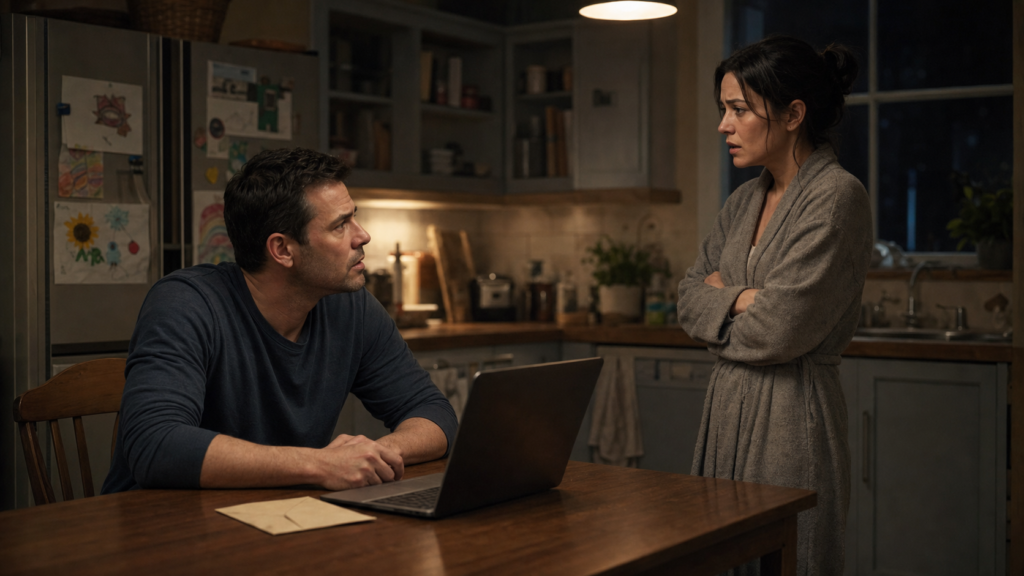
She stood across the kitchen table with her arms folded, watching me as if one wrong movement would confirm whatever she already feared. Between us, the laptop remained half closed. The faded clinic card glowed on the screen beneath it, and Elias’s message waited unanswered.
For eleven years, Lina had trusted me with the parts of herself she trusted nobody else to touch. Now I had exactly one chance not to turn that trust into another secret.
“Sit down,” I said.
“No.”
“Please.”
“Daniel, if this is about my adoption, I’m not sitting down until you tell me what you know.”
I opened the laptop.
The Truth I Could Barely Say
I began with the café. Elias. The photograph of her on my phone. His mother’s memory of a baby girl named Lina. I explained the shared date, the couple named Vale, and the clinic card carrying the same woman’s name as my own adoption file.
I tried to speak carefully, separating facts from guesses. But there was no careful way to say the sentence waiting at the center of everything.
“He thinks we may have had the same birth mother,” I said.
Lina stared at me.
For several seconds, the refrigerator hummed and the clock above the sink clicked forward. Somewhere upstairs, Noah coughed in his sleep.
Then Lina laughed once.
It was not amusement. It was the sound a person makes when reality has offered something too ugly to accept.
“That’s impossible.”
“It may be.”
“It is.”
“I know.”
“You know?” Her eyes sharpened. “You spent the evening looking at my face like I was a stranger.”
“I was frightened.”
“So was I. I thought you were searching because you found my biological family and didn’t want to tell me.”
“I should have told you immediately.”
“Yes.”
The word landed harder than shouting.
I turned the laptop toward her and showed her the clinic card. Lina leaned close but did not touch the screen. The mother’s name was visible beneath years of stains: Marianne Bell.
That was the name on my amended file.
Lina stepped back.
“My original birth certificate did not say Marianne Bell,” she whispered.
I looked up. “You’ve seen your original certificate?”
“Part of it.”
“You told me the file was sealed.”
“It was. But my father kept something.”
The Box Lina Never Opened
She left the kitchen without another word. I heard the attic ladder unfold in the hallway, followed by the slow scrape of a box being moved.
When she returned, dust marked the sleeve of her robe. She carried a small metal cashbox I had seen only once, after her adoptive father’s funeral. Lina had told me it contained tax papers and photographs she was not ready to sort.
She set it beside the laptop.
“Dad gave me the key the week before he died,” she said. “He told me there were things inside that belonged to my first life. I opened it once, saw the edge of a hospital form, and closed it again.”
“Why didn’t you tell me?”
She gave me a tired, furious look. “You don’t get to ask me that tonight.”
She was right.
The key was taped beneath the box. Inside were photographs, a baptism card, two letters tied with blue thread, and a brittle sheet folded into quarters.
Lina unfolded it carefully.
The top half of the document was missing. What remained showed a date of birth, October 17, 1991, and the surname Bell. The line for the mother’s first name had been covered by a correction strip so old it had turned yellow.
Under the strip, faint letters were still visible.
Not Marianne.
Miriam.
“That’s the name my mother mentioned,” I said.
“Your adoptive mother?”
I nodded. “When I asked if I had a sister, she said, ‘Who told you about Miriam?’”
Lina lowered herself into the chair.
“Maybe Miriam was our mother.”
“Or another child.”
“Or somebody who changed the records.”
She looked at the two unopened letters. Both were addressed to her adoptive father. The first had no return address. The second carried the stamp of Saint Matthew’s clinic.
“Open them,” I said.
“They’re mine.”
“I know.”
She held my gaze for a moment, then broke the blue thread.
A Warning from Twenty-Nine Years Ago
The first letter had been written in 1997, when Lina was six.
Her hands shook as she read aloud.
“Mr. Vale, you were told the child had no living relatives who could claim her. That information was not true. Someone has begun asking questions in Bellwood. If a woman named Helen Mercer contacts you, do not give her the child’s records. Do not return to Saint Matthew’s. The children are safer apart.”
Lina stopped.
Helen Mercer was my adoptive mother.
“Your mother knew my father,” she said.
“She told me she didn’t know where the girl went.”
“She lied.”
“Or somebody made sure she couldn’t find you.”
“Stop protecting her.”
“I’m not.”
“You always do that, Daniel. You build a reasonable explanation because the unreasonable one hurts too much.”
Before I could answer, headlights moved across the kitchen wall.
A car door closed outside.
Lina looked at the clock. “It’s two in the morning.”
My phone buzzed.
I’m outside. Mom insisted on coming.
Elias.
I had forgotten his promise to bring the envelope.
The Woman Who Remembered Too Much
Elias entered first, carrying a thick brown envelope. Behind him came a small woman in a navy coat, her silver hair pinned neatly at the back of her head.
Rose Ward had once patched my knees, served me peach pie, and scolded Elias and me for riding bicycles after dark. I had not seen her since childhood.
She looked at me with tearful recognition.
Then she saw Lina.
Rose gripped the doorframe.
“No,” she said.
Elias reached for her arm. “Mom?”
Rose did not take her eyes off Lina.
“You have her face.”
Lina went rigid. “Whose face?”
Rose entered the kitchen slowly. “Miriam’s.”
My stomach tightened.
“Was Miriam our mother?” I asked.
Rose looked from me to Lina, and her confusion deepened.
“Your mother?” she repeated. “Daniel, Miriam wasn’t your mother.”
She pulled out a chair but remained standing behind it, as if she needed the furniture to keep her upright.
“Miriam was your sister,” she said.
Nobody spoke.
I heard the sentence clearly, but my mind rejected its shape.
“That doesn’t make sense,” I said. “Miriam would have been a child.”
“She was fourteen when you were born.”
Rose opened the brown envelope and removed three photographs. In the first, a thin teenage girl stood outside Saint Matthew’s clinic, holding a baby. In the second, the same girl sat beside my biological mother, Marianne Bell.
The third photograph showed two infants in separate hospital bassinets.
On the back, someone had written: Daniel and Grace. March 1989.
“Grace?” Lina asked. “But I was born in 1991.”
Rose’s fingers tightened around the photograph.
“That is what your certificate says.”
She placed the image beside Lina’s partial birth record.
“The girl called Grace disappeared from the clinic after three days. Two years later, Mr. and Mrs. Vale arrived with a toddler they called Lina. Your father asked me whether the Bell family had ever had twins.”
“Why would he ask that?” I said.
Rose looked at Lina’s face again.
“Because the child he brought home looked exactly like the missing baby.”
The Second Letter
Lina reached for the unopened clinic letter from her father’s box.
This one was shorter.
“Mr. Vale, the identity assigned to your daughter must never be compared with the Mercer boy’s records. The dates will not match because they were changed deliberately. If either child submits DNA, the result will expose more than a family connection. It will reveal what happened at Saint Matthew’s.”
The letter ended with a single initial: H.
My hands went cold.
“Helen,” Lina said.
“We don’t know that.”
“Who else?”
Rose shook her head. “Helen did not write that letter.”
“How can you be sure?”
“Because she received one too.”
Rose took a final document from her envelope: a photocopy of a police report filed in 1998. Helen Mercer had reported repeated threats connected to two adoption files. The complaint had been closed after the clinic denied any record of the children.
At the bottom, a handwritten note read: Do not contact the Vale family again. D.M.
Those were my initials.
Daniel Mercer.
But in 1998, I had been nine years old.
The Call from My Mother
My phone rang.
Helen.
All four of us stared at the name on the screen.
I answered and put the call on speaker.
“Mom?”
“Is Rose Ward with you?” Helen asked.
Rose closed her eyes.
“How did you know?” I said.
“Because Elias called your father. Daniel, listen carefully. Do not upload your DNA anywhere. Do not send a sample to a commercial company, and do not let Lina do it either.”
Lina leaned toward the phone. “Why?”
Helen went silent.
“This is Lina,” she continued. “I found the letter you sent my father.”
“I never sent him a letter.”
“It was signed H.”
“That letter was not from me.” Helen’s voice became urgent. “The person who arranged your adoptions used our names, changed dates, and moved children between files. We tried to expose it. That is why we left Bellwood.”
“Then tell us the truth,” I said. “Are Lina and I related?”
My mother began to cry.
“I don’t know.”
“That isn’t good enough.”
“It is the only honest answer I have. Your file says Marianne was your mother. Another page says Miriam delivered you. A third says you were transferred from a county hospital that never existed.”
The room seemed to shrink around us.
“What about Grace?” Lina asked.
Helen stopped crying.
“Who told you that name?”
Rose placed the photograph of the bassinets beneath the phone.
“I did,” she said.
Helen whispered something I could not hear.
Then a man’s voice spoke in the background of her call.
My adoptive father.
“Tell him about the blood card.”
The Result We Were Not Supposed to Find
Helen explained that every newborn at Saint Matthew’s had a dried blood sample stored on a card. Years ago, she had taken copies of two cards before the clinic archives disappeared. One was labeled Daniel Bell. The other was labeled Grace Bell.
“Where are they?” I asked.
“Your father mailed them to an independent laboratory last week, after you said you wanted to learn more about your birth family.”
“Last week? Before I met Elias?”
“We were going to tell you when we had something certain.”
“And now?”
A notification chimed on Helen’s phone.
My father spoke again, farther away. “The laboratory just sent the preliminary comparison.”
Lina reached for my hand. Despite everything, I held hers.
Helen returned to the phone.
“The two samples are not siblings,” she said.
Air left my lungs.
Lina closed her eyes. For one second, relief crossed her face.
Then Helen continued.
“But Daniel, the blood on the card labeled with your name is female.”
I looked at the photograph of the two bassinets.
“That means the labels were switched,” Elias said.
“Maybe,” Helen replied. “But there is something else. The lab found a recent match in a missing-person database.”
“To whom?” I asked.
Helen hesitated.
“A woman who disappeared from Bellwood three months ago. Her name is Miriam Bell.”
Rose’s chair scraped backward.
“That’s impossible,” she said. “Miriam died in 2004.”
My phone vibrated with an incoming message from an unknown number.
It contained a photograph taken through our kitchen window.
All four of us were visible inside.
Beneath it were six words:
STOP LOOKING. THE CHILDREN ARE NEXT.
I turned toward the dark window.
Someone was standing beyond the garden fence.
What should Daniel and Lina do now? Call the police and risk exposing the children to whoever has watched the family for years—or leave the house immediately and confront Helen before any more records disappear?
Continue to Part 3: The Woman at the Fence Knew the Truth →
Continue with our Family Stories and Mystery Stories.