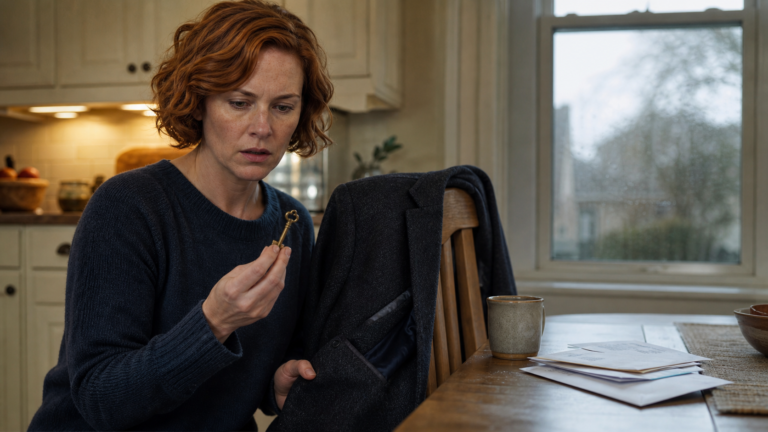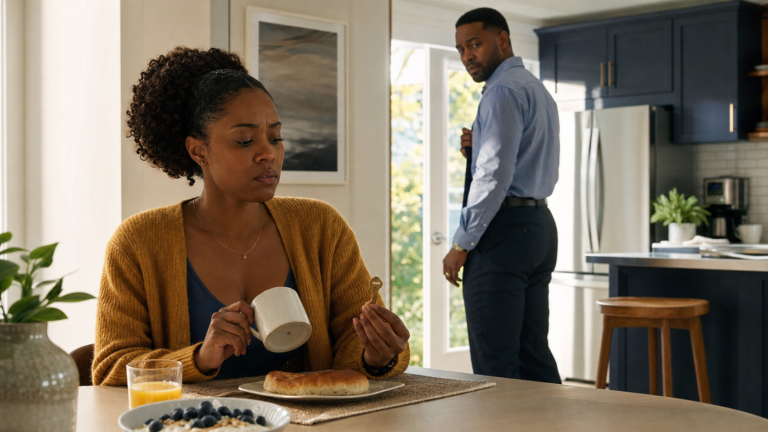
At 8:17 every Thursday night, my husband carried a second plate of dinner upstairs.
He never used a tray. He balanced the plate on his palm, covered it with one of our good linen napkins, and took the stairs instead of the elevator. The first time I asked where he was going, Daniel said the woman in 6B had injured her ankle and couldn’t cook.
“Mrs. Vale?” I asked. “I thought 6B was empty.”
He paused with his hand on the door.
“New tenant,” he said. “She keeps to herself.”
Then he smiled, kissed my forehead, and left before I could ask her first name.
The Thursday Routine
For six weeks, Thursday became the one night Daniel watched the clock.
At 7:45 he would help me clear the table. At 8:05 he would spoon a second portion onto a plate. At exactly 8:17, he would disappear upstairs and return twenty or thirty minutes later carrying the plate clean.
Everything else about our marriage remained ordinary. He still made coffee before I woke up. He still left notes in my lunch bag. He still called from the grocery store to ask which apples I liked, even though I had bought the same kind for nine years.
That was what made the secret unbearable. Cruel husbands are easy to suspect. Kind husbands teach you to doubt your own eyes.
On the seventh Thursday, I offered to bring the food myself.
Daniel’s fork stopped halfway to his mouth.
“Why?”
“Because you look tired.”
“I’m fine.”
“Then let me meet her.”
He put down his fork carefully. “Mara, she’s embarrassed about needing help. Please don’t turn this into something.”
I hadn’t accused him of anything. But he defended himself as if I had.
The Message on His Phone
That night, while Daniel was in the shower, his phone lit up on the nightstand.
6B: You promised this would be the last week.
A second message appeared before the screen went dark.
She deserves to know why you chose her.
I read those two sentences until the words stopped looking like English.
When Daniel came out of the bathroom, I was lying on my side with my eyes closed. He stood beside the bed for several seconds. I could hear water dripping from his hair onto the floor.
“Are you awake?” he whispered.
I kept breathing slowly.
He picked up the phone and went into the kitchen. The apartment was quiet enough for me to hear him say, “Not like this,” followed by, “You agreed to leave Mara out of it.”
That was the moment jealousy disappeared.
Jealousy would have been simpler.
I Followed Him Upstairs
The following Thursday, I pretended to have a migraine and went to bed early. At 8:16 I heard the cupboard open, a plate touch the counter, and the front door close.
I waited twelve seconds before following him.
Daniel was already inside 6B. The door had not fully latched. Warm yellow light cut across the hallway carpet.
I heard a woman say, “You built a marriage on the worst night of his life.”
Daniel answered so softly I had to move closer.
“I love her.”
“That isn’t an answer.”
“I love her more than anything.”
“Then tell her what you did to Evan.”
Evan.
I had not heard that name spoken in years.
Three months before I met Daniel, I had been engaged to a man named Evan Cole. Two weeks before our wedding, Evan vanished. He emptied his apartment, changed his number, and left one email telling me he had never loved me enough to stay.
I spent a year believing I had imagined our entire relationship.
Daniel knew all of that. He had been the patient friend who sat beside me when I couldn’t eat. The man who never rushed me. The man I eventually trusted because he seemed incapable of causing the kind of pain Evan had caused.
Inside 6B, a chair scraped against the floor.
“She thinks he abandoned her,” the woman said. “And you let her think it for nine years.”
I pushed the door open.
The Woman in 6B
Daniel turned so quickly the plate slipped from his hands. It struck the rug without breaking, spilling chicken and rice near his shoes.
The woman across from him was in her early sixties, with silver hair and a blue cardigan. She did not look surprised to see me.
“Mara,” Daniel said. His face had gone pale. “Please let me explain.”
“Who is she?”
The woman stood. “My name is Ruth Cole. Evan was my son.”
The room tilted.
I had met Evan’s mother only twice. Both times her hair had been dark, and grief had not yet carved deep lines around her mouth. But once she said her name, I saw him in her eyes.
“Evan told me his mother moved to Oregon,” I said.
“I did. I came back six months ago.” She looked at Daniel. “Because I found this.”
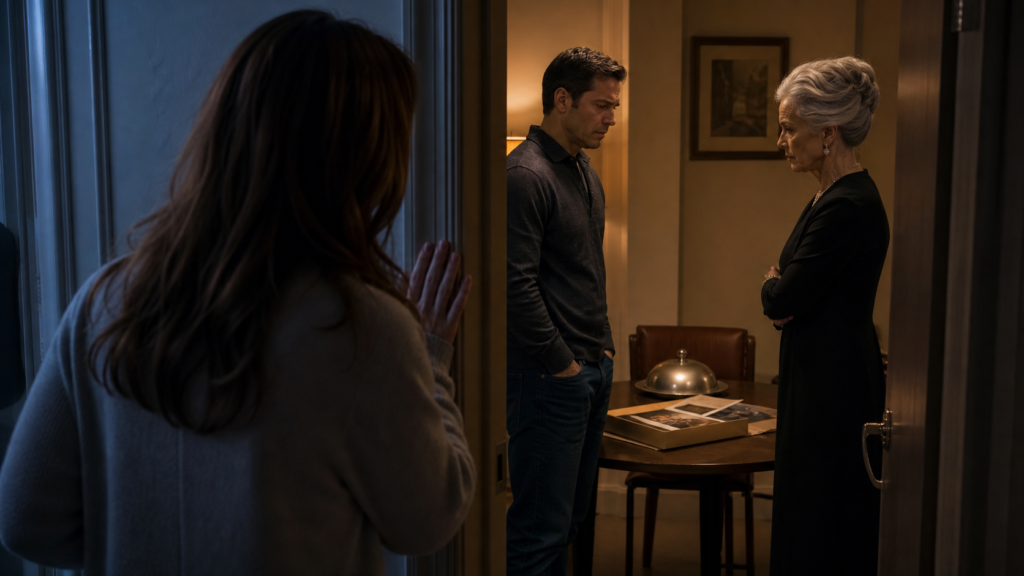
She lifted a thin cardboard folder from the table.
Daniel stepped toward me. “Mara, I was twenty-seven. I was angry and stupid. I thought I was protecting you.”
“Protecting me from what?”
No one answered.
So Ruth opened the folder.
The Letter That Never Reached Me
Inside were printed emails, phone records, and a letter with my old address written in Evan’s handwriting.
Ruth handed me the letter.
Evan had written it two days after he disappeared.
He said a man had contacted him with photographs showing me entering a hotel with a coworker. The photographs were convincing. The messages that followed appeared to come from my email account. They described an affair that had never happened.
Evan believed them.
He left because he thought I had been lying to him for months.
Three weeks later, he discovered the photographs had been altered. He tried to reach me, but my email rejected his messages and my number had been changed. Daniel had helped me change it after Evan vanished. Daniel had also convinced me to block every member of Evan’s family because, he said, “They’ll only reopen the wound.”
The letter ended with one sentence written twice:
I am coming back to fix this.
“He never came back,” I said.
Ruth’s voice softened. “He died in a car accident that night.”
I looked at Daniel.
He was crying now, but he did not deny anything.
Why Daniel Chose Me
Daniel and Evan had worked at the same architecture firm. They were not friends, but Daniel had noticed me at office events. He had asked Evan about me more than once. Evan joked that Daniel had a harmless crush.
It had not been harmless.
Daniel created the photographs. He sent the messages. He watched our engagement collapse from a distance, expecting Evan to leave for a few weeks—just long enough for Daniel to become the person who helped me recover.
Then Evan died.
“I was going to confess,” Daniel said. “After the funeral, I tried. But you were barely functioning. Then months passed, and we became close. I told myself the truth would only destroy you again.”
“So you married me.”
His mouth trembled. “I did love you.”
“Did?”
“Do. I love you.”
Ruth looked away.
I understood then why Daniel had brought her food. It was not kindness. It was payment made in portions small enough to call compassion. Each Thursday, he carried dinner upstairs hoping guilt could be fed until it stopped speaking.
The Choice He Had Already Made for Me
I walked back to our apartment alone.
Daniel followed five minutes later but did not come inside. He sat on the hallway floor outside our door until morning.
At 6:30, he slid an envelope underneath it. Inside was a confession signed with his full name, copies of every file Ruth had found, and the password to a cloud folder containing more evidence.
There was also a note.
I stole your choice once. I will not do it again. Whatever you decide, I will tell the truth publicly.
I wanted to hate him cleanly.
But nine years of marriage do not disappear when the truth arrives. They remain in the coffee cup he bought me in Lisbon, the dent in the hallway wall from moving our sofa, the birthday videos, the private jokes, and the quiet mornings when I had believed I was safe.
That was the cruelest part. The husband I loved was real. So was the man who had designed my grief.
The Following Thursday
One week later, at 8:17, I made two plates of dinner.
I carried one upstairs to Ruth.
Daniel was no longer living in our apartment. He had moved into a hotel and given his confession to Evan’s family and to an attorney. I had not promised divorce. I had not promised forgiveness. For the first time since I met him, the next decision belonged entirely to me.
Ruth opened the door and looked at the plate in my hands.
“You don’t owe me this,” she said.
“I know.”
We sat at her small table without speaking. Halfway through dinner, she brought out a box of photographs I had never seen—Evan as a child, Evan at university, Evan laughing beside a lake.
At the bottom was a photograph of Evan and me taken four months before our wedding.
On the back, he had written: Home is not a place. It is the person who knows the truth about you and stays.
I turned the photograph over and stared at our faces.
Then I realized something that frightened me more than Daniel’s confession.
I still did not know which truth would decide whether I stayed.
This is a work of fiction. Names, characters, places, and events are invented.