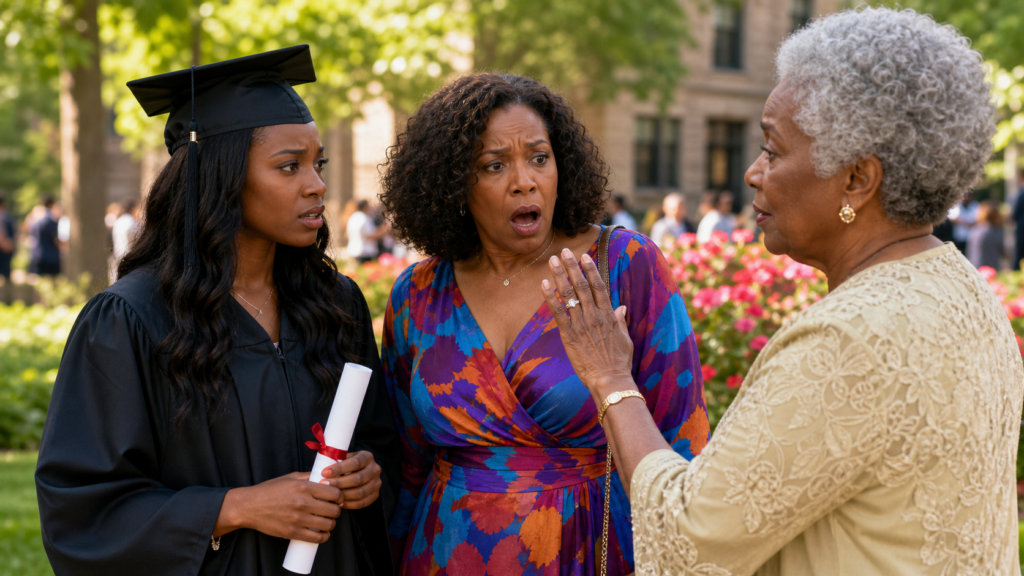
The woman wearing my mother’s ring appeared ten minutes after my daughter crossed the graduation stage.
I had been crying so hard that morning that my mascara had already surrendered. Nia stood between me and her father for photographs, laughing every time one of us tried to straighten her cap. Around us, families crowded the university lawn with balloons, bouquets, and the relieved noise of people who had survived something together.
Then an older woman stepped out from behind a row of red roses and said my name.
“Naomi?”
I turned. She was tall, silver-haired, and dressed in cream. Her voice was unfamiliar. The ring on her right hand was not.
Gold, oval-faced, with a tiny green stone surrounded by four engraved leaves. My mother had worn it every day of my childhood. I had watched her knead bread with it, point at my report cards with it, and tap it against the kitchen table whenever she was about to tell me something serious.
That ring had disappeared the night she died.
The Woman by the Roses
“Where did you get that?” I asked.
Nia followed my stare. “Mom, do you know her?”
The woman lowered her eyes to the ring. “I was hoping we could speak somewhere quieter.”
“You can speak here.” My voice came out sharper than I intended. “That belonged to my mother.”
She looked at me for a long moment. “It belonged to our mother.”
The celebration kept moving around us. A brass band began playing near the library. Someone shouted a graduate’s name. Nia’s father, Marcus, put a hand on my shoulder, but I could barely feel it.
“My mother had one daughter,” I said.
“She raised one daughter,” the woman replied.
Nia glanced from her to me. “What does that mean?”
The stranger opened a small leather handbag and removed an envelope yellowed at the corners. My name was written across the front in my mother’s handwriting.
I knew every curve of those letters. She had labeled my school lunches the same way.
“My name is Celeste Bennett,” the woman said. “And I have been trying to decide for twenty-seven years whether giving you this would heal something or break it.”
A Letter That Waited Too Long
We found an empty stone bench behind the music building. Nia sat beside me, still clutching her diploma. Marcus stood a few steps away, guarding our privacy without leaving us alone.
I opened the envelope with trembling fingers.
My mother’s letter was only four pages, but it divided my life into a before and an after.
She wrote that Celeste had been born when she was seventeen. My grandmother, terrified of scandal and poverty, arranged for relatives in another state to raise the baby. My mother was told never to contact her. Years later, after marrying my father and having me, she searched in secret.
She found Celeste when I was twelve.
That was the first wound.
The second was worse: they had met for years without telling me.
Every third Saturday, my mother claimed she was attending a church committee meeting. Instead, she took a bus across town to drink coffee with the daughter she had lost.
I remembered those Saturdays. I remembered waiting by the window for her return, resenting the church for borrowing her so often.
“She lied to me,” I whispered.
Celeste’s face tightened. “She was afraid your father would leave if he learned the truth. And she was afraid you would think you weren’t enough for her.”
“So she made the decision for me.”
“Yes,” Celeste said softly. “She did.”
There was no defense in her voice. That made it harder to hate her.
Nia leaned close enough that her graduation sleeve brushed my arm. “What else does the letter say?”
The last page explained the ring. When my mother became ill, she gave it to Celeste and asked her to return it to me only when the time felt right.
“This isn’t the right time,” I said. “This is my daughter’s graduation.”
Celeste looked toward Nia. “That’s exactly why I came.”
The Scholarship Nobody Named
Nia had nearly abandoned university during her second year. The pandemic had ended Marcus’s contract work, and my hospital bills consumed what little savings we had. Then the financial aid office called to say an anonymous donor had covered the balance.
We had called it a miracle.
Celeste reached into her handbag again and placed three receipts on the bench.
Nia read the first one, then the second. Her mouth slowly opened.
“You paid my tuition?”
“Your grandmother left me a small account,” Celeste said. “She asked me to use it for you.”
My grief shifted shape. For years I had believed my mother left me only questions and an empty jewelry box. Now I learned that she had been quietly carrying Nia toward this day through a daughter I did not know existed.
“Why stay anonymous?” Nia asked.
“Because your mother deserved to choose whether I belonged in her life.”
I stood so suddenly that the letter slipped from my lap.
“No. Don’t make this sound noble. You watched us struggle. You knew where I lived. You knew my child. And you stayed hidden.”
Celeste stood too. “I came to your house once.”
The air left my lungs.
“When?”
“The week after your mother’s funeral.”
I remembered that week as fragments: casseroles, sympathy cards, closed curtains. I also remembered a woman standing across the street in the rain. I had assumed she was waiting for a bus.
“You saw me,” Celeste said. “You looked straight at me. I took one step toward your door, and then your father came outside. He told me your mother was dead and that her secrets should be buried with her.”
My father had died six years later, still insisting that my mother had never hidden anything from him.
“He knew?”
Celeste nodded.
What My Daughter Chose
I wanted to leave. I wanted to protect the clean version of my childhood, even though it had already vanished. But Nia stood between us and did something I was not ready to do.
She held out her hand to Celeste.
“I’m Nia,” she said. “I’m your niece.”
Celeste stared at the offered hand. Then she took it, and both of them began to cry.
I felt betrayed by the simplicity of that gesture. How could my daughter accept in seconds what I could not absorb in a lifetime?
Nia turned to me. “Mom, I am not choosing her instead of you. I’m choosing not to lose another person because everyone was scared to speak.”
Her words landed harder than any accusation.
All morning I had been telling people how proud I was that Nia had become brave, thoughtful, and independent. Now she was using those qualities in a way that frightened me.
Celeste removed the ring.
“Your mother wanted you to have this.”
I did not take it.
“Not yet,” I said.
She closed her hand around it. “All right.”
For the first time since she approached us, she smiled. Not with relief, exactly, but with recognition. The smile was crooked on one side, just like my mother’s.
The Photograph
Before we left the lawn, the university photographer called for families to gather beneath the old oak tree.
Nia took her place in the middle. Marcus stood on one side. I stood on the other.
Celeste remained near the roses, preparing to walk away.
“Wait,” Nia called.
I looked at my daughter. She did not plead. She simply left a space beside me.
I could have closed it.
Instead, I lifted my hand.
Celeste crossed the grass slowly and stood at the edge of our family. She did not touch me. I did not ask for the ring. We were not sisters yet—not in the way the word is supposed to feel.
But when the photographer counted to three, I noticed our shoulders leaning in the same direction.
That evening, Nia placed the printed preview on my kitchen table. Four adults and one graduate smiled beneath the oak tree. Celeste looked like someone who had finally arrived after a very long journey. I looked like someone standing at the beginning of one.
On the back, Nia had written a single sentence:
A family can be true before it becomes easy.
Celeste and I are meeting for coffee next Saturday. I still have questions that may hurt us both, and forgiveness is not guaranteed. But this time, no one will be waiting across the street.
This is an original work of fiction. Names, characters, places, and events are invented.