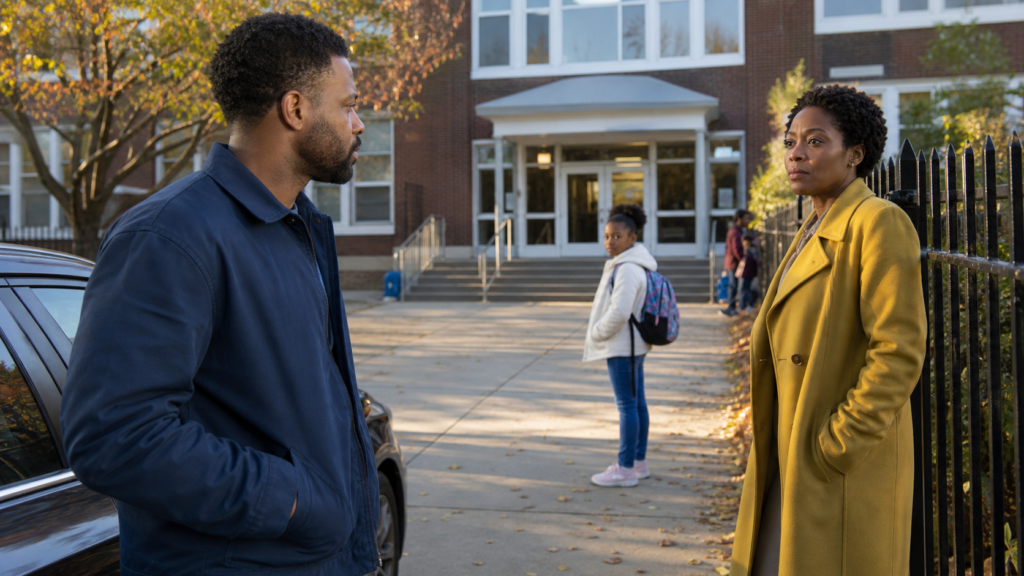
The first time I saw the woman outside my daughter’s school, she was standing in a yellow coat with both hands in her pockets.
It was a bright Friday afternoon. Children poured through the gates, teachers called names over the noise, and parents leaned against their cars while pretending not to check their phones. Nothing about the day looked dangerous.
Still, the woman was watching my daughter.
Not the crowd. Not the entrance. Nia.
My twelve-year-old came down the steps with her purple backpack bouncing against her shoulders. The woman straightened as soon as she saw her. For one second, her face softened with such recognition that I wondered whether they had met before.
Then Nia spotted me and ran to the car.
“Dad, can we get fries?”
I looked past her. The woman had turned away.
“Who is that?” I asked.
Nia followed my eyes. “The lady in yellow? I don’t know.”
“Has she spoken to you?”
“No. She just smiles sometimes.”
Sometimes.
That word stayed with me all the way home.
She Had Been There Before
My wife, Simone, was chopping peppers when we entered the kitchen. Sunlight filled the room, and the radio played an old song we used to dance to before bills, school schedules, and twelve years of marriage turned romance into careful planning.
I told her about the woman.
The knife stopped against the cutting board.
Only for a moment—but I noticed.
“Yellow coat?” she asked.
“You know her?”
“No. I was picturing what you described.”
Simone resumed chopping too quickly. “Schools attract strange people. Tell the office.”
Her answer should have reassured me. Instead, it made my chest tighten.
That night I checked Nia’s phone. I hated doing it, but fear has a way of turning privacy into a luxury. There were no messages from strangers. No secret account. No unfamiliar number.
There was, however, a photograph in her deleted folder.
It showed the woman in the yellow coat standing near the fence. The picture had been taken through a classroom window three weeks earlier.
Nia had typed one sentence beneath it:
She looks like Mom.
I stared until the resemblance appeared. The same high cheekbones. The same deep-set eyes. Even the same habit of pressing her lips together when nervous.
The following Friday, I left work early.
I Walked Across the Street
The woman arrived at 2:48 p.m.
This time she wore a green sweater, but I recognized her immediately. She stood beside the fence and watched the school doors.
I crossed the street before I could talk myself out of it.
“Why are you watching my daughter?”
She flinched, then looked directly at me. “You must be Marcus.”
Hearing my name made every muscle in my body tense.
“How do you know me?”
“From photographs.”
“Whose photographs?”
She glanced toward the school entrance. “Simone’s.”
I stepped between her and the gate. “If you come near my child again, I’m calling the police.”
“I haven’t approached her. I promised I wouldn’t.”
“Promised who?”
The woman swallowed. “Your wife.”
Children began appearing behind the glass doors. She reached into her bag slowly and removed an envelope.
“My name is Alana Price,” she said. “Ask Simone why she told you I was dead.”
She placed the envelope on the hood of my car and walked away.
Inside were six photographs.
In the oldest, Simone was about sixteen, grinning beside a girl who could have been her twin. In another, they wore matching graduation gowns. The final photograph was recent. Alana stood outside a hospital room beside an older woman I recognized as Simone’s mother—the same woman whose funeral we had attended nine years earlier.
On the back, someone had written:
Mom woke up asking for Simone.
My Wife Had Buried an Entire Family
I didn’t confront Simone in front of Nia. I waited until our daughter went upstairs, then laid the photographs across the dining table.
The color drained from my wife’s face.
“Where did you get these?”
“Alana. The sister you said died before we met.”
Simone lowered herself into a chair.
For years, she had told me that an accident took her sister and that grief destroyed her relationship with her mother. I never questioned the story. Some wounds should be approached gently, and Simone had always cried when she spoke about them.
Now I understood that the tears were real, even if the death was not.
“She was supposed to stay away,” Simone whispered.
“From you or from Nia?”
“From all of us.”
“Your mother is alive too?”
Simone covered her face. “She had a stroke in April.”
I pulled out the chair opposite her. “Start at the beginning. No more edited version.”
For several seconds, only the refrigerator hummed.
Then my wife told me the truth.
When Simone was nineteen, her mother, Lorraine, controlled every dollar she earned and every decision she made. Alana, three years older, had spent most of their childhood protecting her. But after their father died, Lorraine’s control became worse. She opened credit accounts in both daughters’ names, borrowed money, and blamed Alana when creditors arrived.
Alana eventually reported the fraud.
Their mother was arrested.
Simone saw it as betrayal. She testified for Lorraine and accused Alana of exaggerating. The case collapsed, but the family did too. Alana left the state. Lorraine told everyone her eldest daughter was dead to her.
Years later, when Simone met me, she shortened that cruel sentence into a lie that was easier to explain: My sister died.
“Why tell me your mother died?” I asked.
“Because she found us,” Simone said. “She wanted money. She threatened to tell you what I had done in court. I paid her to disappear. When you asked why she stopped calling, I panicked.”
I looked at the woman I had shared half my adult life with and felt as if I were sitting across from a skillful stranger.
“And Alana?”
“She contacted me after the stroke. Mom can’t speak properly. Alana is caring for her alone. She wanted me to visit.”
“So why was she watching Nia?”
Simone’s eyes filled. “Because Nia is named after her.”
The Name I Never Questioned
Our daughter’s full name is Nia Alana Brooks.
Simone had chosen the middle name. She told me it belonged to a childhood friend who once saved her from drowning.
That part, apparently, was true in a different way.
Alana had saved Simone many times—by taking punishment meant for her, hiding grocery money, and eventually confronting the financial abuse that Simone had been too afraid to face.
“She asked for one photograph of Nia,” Simone said. “I refused. Then she found the school online through an award announcement. I told her she could look from a distance once, but she kept returning.”
“You allowed a stranger to watch our child without telling me.”
“She’s not a stranger to me.”
“She is to Nia. And she was to me because you made her one.”
Simone began to cry, but I was too angry to comfort her.
I slept in the guest room that night.
The next morning, Nia stood in the doorway wearing her school sweatshirt.
“Are you and Mom getting divorced?”
Children never need the entire truth to notice when a house changes temperature.
“I don’t know,” I answered honestly. “But none of this is your fault.”
She sat on the edge of the bed. “Is the lady her sister?”
I turned toward her. “Why would you ask that?”
“They have the same eyes. And last week Mom was crying in the car after she saw her.”
Nia had understood more from a school window than I had understood in twelve years of marriage.
We Met in Daylight
I called Alana from the number written inside the envelope. We agreed to meet at a crowded café on Sunday afternoon. I chose a table outside where nothing could be hidden by shadows.
Simone came with me.
When Alana arrived, the sisters stood facing each other without speaking. They looked alike, but pain had shaped them differently. Simone seemed ready to run. Alana looked tired of chasing.
“I shouldn’t have gone to the school,” Alana said first. “I told myself I only wanted to see her once. That was selfish. I’m sorry.”
“You scared my husband,” Simone replied.
“You told your husband I was dead.”
The sentence landed between them.
Alana explained that Lorraine’s stroke had damaged her speech and movement. Doctors did not know how much she would recover. During clearer moments, she repeatedly tried to say Simone’s name.
“She doesn’t deserve forgiveness because she’s sick,” Alana said. “And you don’t owe her a visit. But I couldn’t keep carrying the decision for you.”
Simone stared at her coffee. “Why did you keep the photographs?”
“Because you were my sister even when I wasn’t yours.”
My wife finally looked up.
No dramatic music played. No one embraced. Reconciliation, I learned, does not always begin with forgiveness. Sometimes it begins with three people sitting in uncomfortable daylight, refusing to tell another lie.
The Decision We Have Not Made
It has been eleven days since that meeting.
Alana no longer waits outside the school. Nia knows she has an aunt but has not met her yet. Simone has started therapy and given me access to the financial records she kept hidden. I discovered the payments to Lorraine, but no other secret accounts.
Tomorrow, Simone plans to visit the rehabilitation hospital.
She asked me to go with her.
Part of me wants to support the woman I married. Another part wonders whether standing beside her too quickly would teach her that twelve years of deception can be repaired by one honest conversation.
Nia wants to meet Alana. Alana says she will respect whatever decision we make. Simone says she is finally ready to tell our daughter the whole truth—but I am not convinced a twelve-year-old should carry the weight of mistakes made before she was born.
So our family is paused between two versions of itself: the one built on a lie, and the one that might still be built from what remains.
Why the Ending Remains Unsettled
The adults in this story created the secret, but Nia and Alana would inherit its consequences. For that reason, the ending does not use a child’s forgiveness to repair adult mistakes. Simone must first accept responsibility, disclose the financial records, and begin doing the slower work that an apology cannot replace.
The hospital visit remains unresolved because reconciliation is not the same as access. The family can choose compassion while still setting boundaries, and those choices may change as more truth becomes available.
This is an original work of fiction. Names, characters, places, and events are invented.