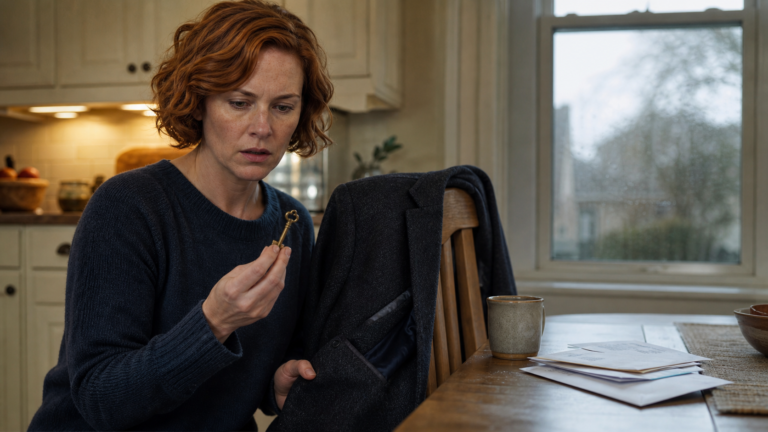
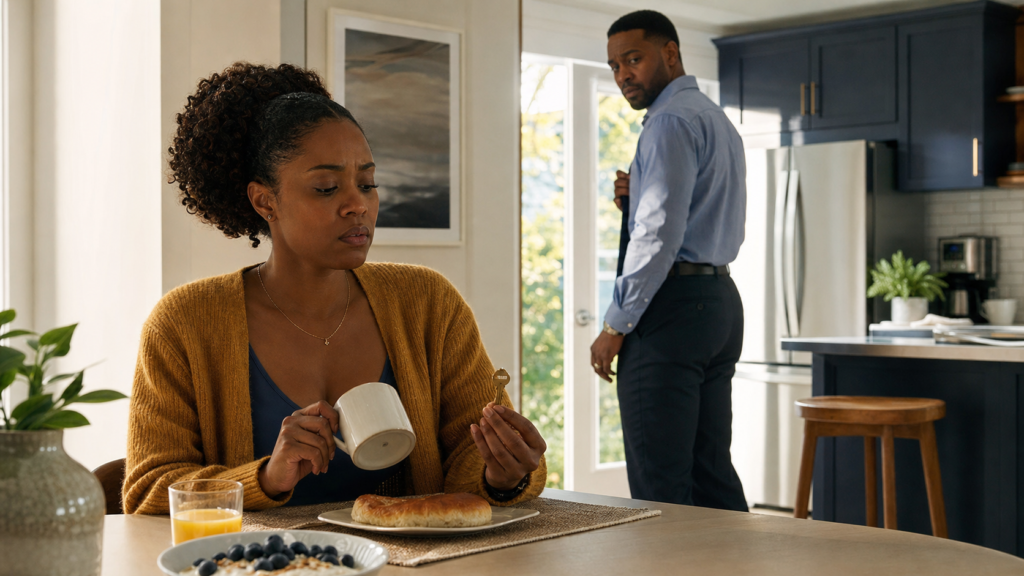
The key beneath his coffee cup was still warm when I picked it up.
I noticed it at 7:18 on a Tuesday morning, after he kissed my forehead, grabbed his briefcase, and told me he would be late because of a client dinner.
It was a small brass key with a white plastic tag. Someone had written 4B on it in blue ink.
Daniel never forgot things. In eleven years of marriage, he had never misplaced his wallet, left his phone at home, or driven away without checking the back door twice. Yet there it was, pressed into a faint ring of spilled coffee as if it had been waiting for me.
I picked it up and called his name.
He stopped in the open doorway. Morning light fell across one side of his face.
“You forgot this.”
For half a second, he looked frightened.
Then the expression disappeared.
“That’s from the office,” he said. “Storage room.”
He crossed the kitchen too quickly and reached for it. I closed my fingers around the key.
“Your office storage rooms use electronic cards.”
Daniel smiled, but his eyes did not. “The old building still has keys.”
“What old building?”
His phone buzzed. He glanced at the screen, turned it face down, and kissed me again.
“I’m already late, Mara. Leave it on the counter. I’ll get it tonight.”
Then he walked out without the key.
The Address I Wasn’t Supposed to Find
I tried to be reasonable. Daniel managed commercial properties. A numbered key could belong to almost anything. I told myself that suspicion was not evidence, and that eleven years should weigh more than one strange look in a kitchen.
But at 9:06, while searching the hall closet for an umbrella, I found a receipt in the pocket of his gray coat.
Kingston Court Apartments — Unit 4B.
The receipt was for a replacement bathroom mirror. The payment card ended in the same four digits as our joint savings account.
I sat on the stairs and read it three times.
Daniel and I had spent four years building that savings account. It was supposed to be the down payment on a larger home, one with a small backyard and a room that could become a nursery if the adoption agency ever called us back.
I texted him.
What is Kingston Court?
The message showed as read. No answer came.
At 10:20, I called his office. His assistant told me Daniel had taken the morning off for a personal appointment.
By 10:35, I was driving across town with the key in my coat pocket.
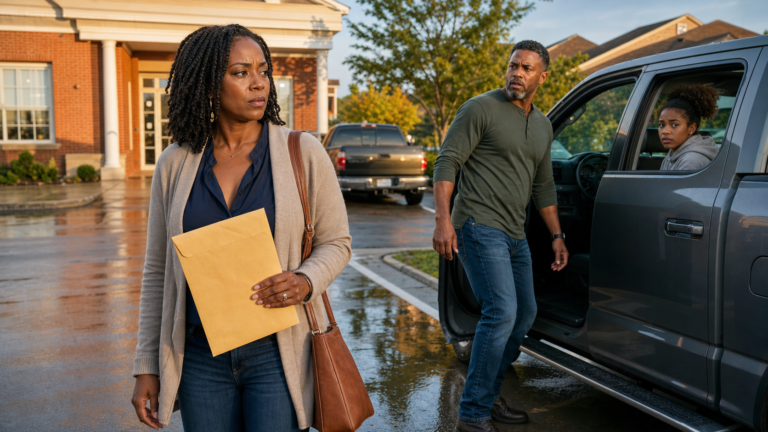
Kingston Court was not a luxury building. It stood between a laundromat and a pharmacy, its brick walls faded by years of sun. Children drew chalk flowers on the pavement. An older man watered plants from a second-floor balcony.
I climbed the stairs slowly.
Apartment 4B was at the end of the corridor.
I could hear a woman speaking inside.
“He said he would tell her,” she said. “He promised me this time.”
Another voice answered, softer and younger. “He always promises.”
My hand shook so badly that the key scraped the lock twice before it turned.
The Woman in Apartment 4B
The door opened onto a small living room bright with midday sun. A young Black woman stood near the window, one hand resting on her pregnant stomach. She could not have been more than twenty-two.
An older woman sat on the sofa beside a stack of unopened baby gifts.
Both of them stared at me.
The young woman looked so much like Daniel that my anger briefly forgot how to move.
She had his eyes. His narrow chin. Even the small crease between her eyebrows was his.
“You’re Amara,” she whispered.
I kept one hand on the open door. “Who are you?”
The older woman rose. “My name is Lauren.”
I knew that name.
Years earlier, Daniel had mentioned a woman named Lauren from his first job. He had described her as a former colleague who moved away before we married.
The young woman stepped forward.
“I’m Imani,” she said. “Daniel is my father.”
The room tilted.
“No.” The word came out quietly. “Daniel doesn’t have children.”
Lauren’s face hardened with a sadness that looked old. “Daniel has a daughter. He just never had the courage to tell his wife.”
I looked at Imani again. She was not a child. I calculated without wanting to.
Daniel and I had been married for eleven years. We had dated for three before that. Imani was twenty-one.
She had been born long before me.
For one desperate moment, relief rushed through my body. A hidden daughter was a betrayal, but not the betrayal I had imagined outside the door.
Then Lauren said, “He came back into our lives two years ago.”
The relief vanished.
“Came back how?” I asked.
Neither woman answered.
I reached into my purse for my phone. “Call him.”
Imani swallowed. “Mrs. Cole—”
“Call your father.”
She did.
Daniel answered on the first ring.
“Imani?” His voice came through the speaker. “Is everything all right?”
“She’s here,” Imani said.
Silence.
Then Daniel asked the question that ended the last piece of trust I still had.
“Which one?”
What Daniel Had Been Protecting
He arrived eighteen minutes later.
Daniel stopped inside the doorway when he saw me, Lauren, and Imani standing in the same room. He looked less like a man surprised by disaster than a man who had always known the disaster was scheduled.
“Amara, let me explain.”
“Start with ‘which one.’”
He closed the door behind him.
“I thought Imani meant you or Lauren.”
“That does not improve it.”
Lauren folded her arms. “Tell her everything, Daniel.”
He looked at Lauren with a familiarity that made my stomach turn.
“Imani was born when I was twenty-four,” he said. “I was scared. Lauren and I were already falling apart. I sent money, but I wasn’t a father. When Imani contacted me two years ago, I wanted to make it right.”
“By renting her an apartment with our savings?”
“She was living in a bad situation.”
“You could have told me.”
“I was afraid you’d leave.”
I laughed once, without humor. “So you lied to make sure I stayed.”
Daniel moved toward me. I stepped back.
“There’s more,” Lauren said.
He turned sharply. “Don’t.”
That single word told me the truth before she did.
Lauren picked up her phone and opened a folder of screenshots. Messages filled the screen—late-night apologies, hotel confirmations, photographs of meals, and promises written in Daniel’s careful sentences.
I should have chosen you the first time.
After the adoption falls through, I’ll tell her.
We can finally be a family for Imani and the baby.
I stopped reading.
“How long?”
Lauren looked at Daniel, not me. “Eight months.”
Imani covered her mouth. “Mom, you said it was over.”
“It is over,” Lauren replied. “It ended last week.”
Daniel’s voice dropped. “Lauren is angry. She’s trying to punish me.”
“No,” Lauren said. “I’m finally refusing to help you punish everybody else.”
Imani began to cry. She had believed the apartment was a gift from a guilty father. She had not known her mother and Daniel were sleeping together. In that moment, the three of us understood that Daniel had not built one lie. He had built separate rooms for each of us and spent years making sure the doors never opened at the same time.
The Signature That Changed Everything
I wanted to leave. I should have left.
But the receipt in my pocket reminded me of the savings account.
“Show me the lease,” I said.
Daniel’s face changed again.
Imani pointed toward a drawer beneath the television. Inside was a folder with the rental agreement, utility bills, and a loan document from Daniel’s company.
My name appeared on the last page.
The signature looked like mine.
It was not.
Daniel had used our house as security for a private loan large enough to cover the apartment, Imani’s medical expenses, and several payments to Lauren’s catering business.
“You forged my signature.”
“I was going to replace the money before you noticed.”
“With what?”
He had no answer.
My phone was already recording. I had started it when he walked through the door, a habit learned from years of negotiating contracts for my design clients. Daniel had just admitted enough to turn a marriage crisis into a legal one.
He saw the red recording symbol and reached for the phone.
Imani stepped between us.
“Don’t touch her,” she said.
Daniel stared at his daughter as if betrayal were something only other people could commit.
“After everything I’ve done for you?”
Imani wiped her face. “You didn’t do it for me. You did it so you could feel like a good man without becoming one.”
He flinched.
That was the first honest thing anyone had said all day.
The Person Who Left the Key
Two days later, Daniel moved into a hotel under advice from his lawyer. I froze the joint accounts, reported the forged signature, and postponed every decision that did not need to be made immediately.
Lauren disappeared from the apartment before the end of the week.
Imani stayed.
She called me one afternoon and asked if we could meet at a café. I almost refused. Then I remembered how she had stood between Daniel and me.
She arrived carrying the white tag from the key.
“There’s something you should know,” she said.
“I think I know enough.”
“You found the key because of me.”
Imani explained that Daniel had promised for months to tell me about her. Every time he postponed it, she felt more like evidence he was trying to hide. She had placed the apartment key in the side pocket of his briefcase with a note addressed to me.
Daniel had found the note and destroyed it.
But the key had fallen through a tear in the pocket lining. It must have slipped out when he set the briefcase on the kitchen chair, then been pushed beneath his cup.
“I wanted you to know I existed,” she said. “I didn’t know about my mother and him. I swear.”
I believed her.
Not because I was ready to trust again, but because shame had made her quiet while Daniel’s shame had always made him controlling.
“None of this is your fault,” I told her.
Her eyes filled. “He said you hated children. He said that was why he couldn’t tell you.”
I looked out the café window at a father lifting his little girl onto his shoulders.
Daniel and I had spent three years trying to adopt.
He had watched me paint a spare bedroom pale yellow. He had held my hand when our first placement fell through. All that time, he had a daughter across town who believed I was the reason he stayed away.
Some betrayals are not one terrible act. They are hundreds of small decisions, repeated until an entire life becomes false.
What I Chose to Keep
The divorce took nine months.
The fraud investigation took longer.
I sold the house after the loan was removed from my name. I could not drink coffee in that kitchen without seeing the key, and I refused to let one room become the rest of my life.
Imani gave birth to a healthy boy in early spring. She named him Micah. I was not family in any ordinary sense, but ordinary had stopped being a useful word.
Once a month, she and I met for lunch. We did not talk about Daniel unless we had to. We talked about work, childcare, and the strange courage required to build a future from information you never asked to receive.
On Micah’s first birthday, Imani handed me a small wrapped box.
Inside was the brass key from apartment 4B, polished and mounted in a simple wooden frame.
Beneath it, she had written:
Some doors ruin the life you knew. Some doors save you from living inside it forever.
I hung it in my new office.
Not because I wanted to remember Daniel.
Because I wanted to remember the woman who picked up the key, asked the question, and refused to put it back down.
The Ordinary Object at the Center
A small key can be explained away more easily than a confession, which is why it drives this story. It places the narrator between suspicion and proof and forces her to decide when asking a difficult question becomes more honest than protecting a comfortable routine.
The story is less interested in catching a liar than in showing how repeated secrecy changes a person’s confidence in her own observations. Her most important decision is not opening a door; it is refusing to put the evidence back and silence herself.
This is an original work of fiction. Names, characters, places, and events are invented.