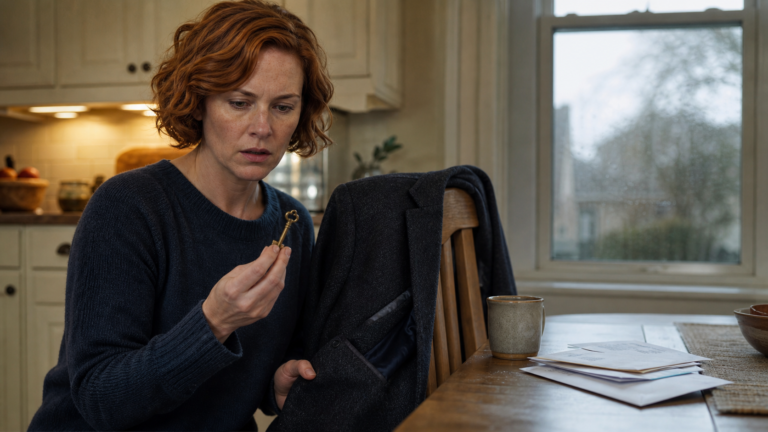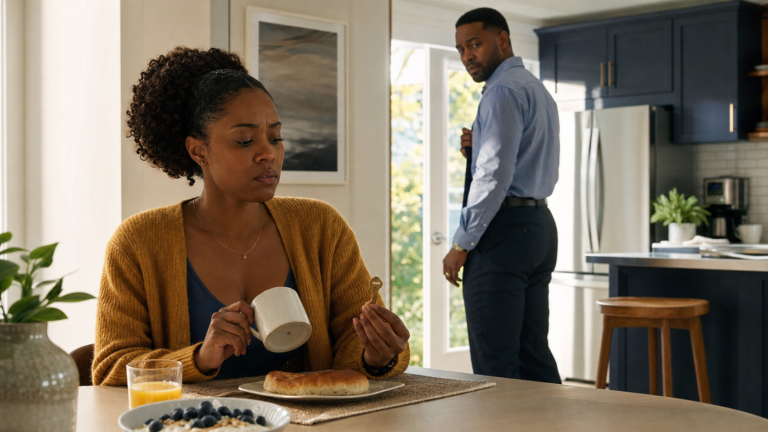
My husband asked me to pretend we had never met.
The message arrived at 5:42 on a rainy Tuesday, while I was standing in our kitchen with one shoe on and a grocery bag splitting across the floor.
Come to the Bellmont Hotel at seven. Wear the green dress. Sit at the bar. If I approach you, act like I’m a stranger.
I read it twice.
Darius and I had been married for eleven years. We had survived a failed business, my mother moving into our guest room for nine months, and the kind of argument about paint colors that ends with two adults sleeping on opposite sides of a king-size bed. We were not a couple who played elaborate games.
I called him. He rejected the call.
Then another message appeared.
Please, Lena. Just for tonight.
Table Nine
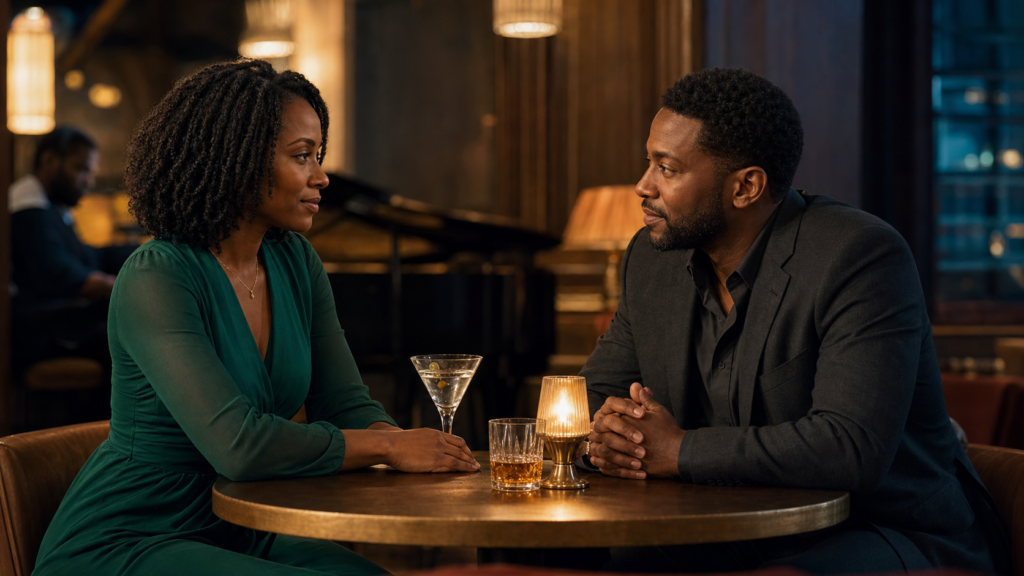
The Bellmont bar looked like a place where people whispered expensive secrets. Amber lamps glowed against dark wood. A pianist played softly enough that every pause in the room felt intentional.
I wore the green dress because curiosity is stronger than dignity when you have been married long enough.
At exactly seven, Darius entered.
He wore the charcoal suit from our tenth anniversary. He had trimmed his beard. For a second, I smiled automatically.
He walked past me.
He took a seat two stools away, ordered sparkling water, and looked around as though he had never seen the room—or me—before.
Five minutes passed.
Then he turned.
“Excuse me,” he said. “Is anyone sitting here?”
His voice was polite and careful.
I remembered the instruction. “No.”
He sat across from me.
“I’m Darius.”
“Lena.”
“That’s a beautiful name.”
It was exactly what he had said the night we first met at a crowded book launch in Atlanta. Back then, I had laughed and told him he needed a better opening line.
Tonight, I said, “Do you use that line on every woman?”
Relief flashed across his face.
“Only the ones in green dresses.”
For the next twenty minutes, he recreated our first conversation. He asked what I did for work. I told him I designed public spaces and hated buildings that made people feel small. He said he taught high school history and secretly judged adults who could not name three Supreme Court cases.
He remembered the joke about my crooked little finger. He remembered that I hated olives but always ordered drinks that came with them. He remembered the name of the author whose book we had pretended to discuss while watching each other.
Then he asked, “Do you have brothers or sisters?”
I stopped smiling.
“You know I have a brother.”
Darius stared at me.
The performance disappeared from his face.
“Right,” he whispered. “Of course.”
The First Crack
I reached across the table. “What is this?”
He pulled his hand away too quickly.
“Stay in the game.”
“I’m done with the game.”
“Please.”
The pianist shifted into a song Darius had played at our wedding. His eyes followed the melody as if it came from another room.
“Where did we get married?” I asked.
He smiled, but it was the smile he used when a student asked a question he could not answer.
“The garden.”
“What garden?”
“Lena—”
“What was it called?”
He looked at the candle between us.
We had married in the courtyard of the Auburn Avenue library where my father used to take me on Saturdays. Darius had insisted on that location because, he said, every marriage should begin in a place full of stories.
He had forgotten.
I stood so fast my chair scraped the floor.
“Sit down,” he said.
“How long?”
He did not pretend not to understand.
“Four months.”
The room seemed to tilt, although nothing moved.
He told me he had begun losing small pieces of time in March. A student asked about an assignment he had no memory of giving. He parked at school one morning and could not remember which classroom was his. He called our dentist to confirm an appointment and discovered he had already attended it the day before.
He had seen a neurologist alone.
“They’re still testing,” he said. “It could be several things. Some treatable. Some not.”
“And you didn’t tell me?”
“I wanted one evening before the truth became the only thing in the room.”
“You brought the truth here with you.”
My voice came out louder than I intended. A couple near the piano glanced toward us.
Darius lowered his eyes. “I know.”
The Envelope Beneath His Chair
I wanted to leave. I wanted to throw my drink against the wall. I wanted to rewind four months and inspect every ordinary morning for evidence.
Instead, I noticed a brown envelope beneath his chair.
My name was written on it.
Inside was a small memory card and a list of dates.
March 12. March 19. April 2. April 16. Twenty-three dates in all.
“What are these?”
“First meetings,” he said.
On each date, Darius had gone somewhere alone and recorded a video introducing himself to me.
In the first, filmed in his classroom, he said, “My name is Darius Cole. If you’re watching this, I may not remember the woman holding the phone. Her name is Lena. She is not a nurse, a visitor, or someone trying to trick me. She is my wife.”
In another, he stood in our backyard.
“Lena laughs when she’s furious, which can be confusing. She needs silence in the morning. She will tell you she doesn’t want the last piece of pie, but she does. Give it to her.”
The later videos were harder to watch.
He repeated sentences. He lost words. Once, he looked off-camera for nearly a minute before whispering, “I forgot why I came out here.”
Then he faced the lens again.
“But I remember that she made this place home.”
I closed the video.
“You made instructions for yourself,” I said.
“Not only for me.”
He pointed to the last file.
The Message He Had Made for Me
In the final recording, Darius sat at our kitchen table. Morning light fell across his face.
“Lena,” he began, “you are going to think love means proving yourself to me every day. It doesn’t.”
I looked across the hotel table. Darius was watching me watch him.
On the screen, he continued.
“If I become afraid of you, it will not be because you failed. If I forget our wedding, it will not erase the eleven years after it. If caring for me empties you, choose help. Choose rest. Choose yourself without calling it betrayal.”
My throat tightened.
“And if one day I meet you as a stranger, don’t spend the whole day forcing me to remember. Tell me your name. Sit beside me. Let me decide whether I like you again.”
The recording ended.
For several seconds, the only sound was the pianist and rain touching the windows.
I hated him for making the video alone.
I loved him for knowing exactly what guilt would do to me.
“Why tonight?” I asked.
He rubbed his thumb against the edge of the table.
“This morning I woke up and didn’t know who was sleeping beside me.”
The sentence struck harder than any diagnosis.
“For how long?”
“Maybe thirty seconds.”
“And then?”
“Then you snored.”
I laughed before I could stop myself. The laugh broke into something else, and I covered my face.
Darius moved closer but did not touch me until I reached for him.
Meeting My Husband Again
We stayed until the staff began clearing empty glasses.
We did not make promises about forever. We made appointments: one with his neurologist, one with a counselor, one with the school district. We decided who would hold copies of the medical documents. We agreed that secrecy had already taken enough from us.
Before leaving, Darius returned to the stool two seats away.
“What are you doing?” I asked.
“I’d like to finish the evening.”
He approached me again, slower this time.
“Excuse me,” he said. “Is anyone sitting here?”
I looked at the man I had known for eleven years: the history teacher who burned rice, the husband who sang off-key, the frightened person who had tried to protect me by suffering alone.
“No,” I said. “But I should warn you—I’m married.”
He nodded gravely. “Is he a good man?”
I thought about it.
“Most days.”
“Do you love him?”
“Every day. That doesn’t mean every day is easy.”
He held out his hand.
“I’m Darius.”
I took it.
“Lena.”
“That’s a beautiful name.”
“You need a better opening line.”
His smile arrived slowly, then completely.
Three weeks later, the doctors gave us a name for what was happening. The name helped with treatment, paperwork, and plans. It did not make us brave. Some mornings we were terrified. Some evenings we argued about whether he had forgotten something or I had.
But once a month, we returned to the Bellmont.
Sometimes Darius remembered the game before we arrived. Sometimes he needed the note in his pocket.
On the fourth visit, he sat across from me and studied my face for so long that my heart began to race.
Then he said, “Have we done this before?”
I could have told him everything.
Instead, I smiled.
“Maybe,” I said. “Would that stop you from sitting down?”
He considered the question.
“No.”
So we began again—not because our history had disappeared, but because love, when memory becomes uncertain, sometimes has to be willing to introduce itself.
Love Without Reliable Memory
This story treats memory loss as more than a device for a romantic reveal. Lena cannot restore Darius by repeating the correct facts, and love does not give her control over what he remembers. Their monthly introductions become a practical ritual that respects both their history and his changing present.
The Bellmont scenes were written to hold grief and humor together. Lena remains a wife and also becomes someone her husband may need to meet again, with boundaries, treatment plans, arguments, and uncertainty still part of their life.
Fiction notice: This original story is a work of fiction. Names, characters, places, and events are invented.