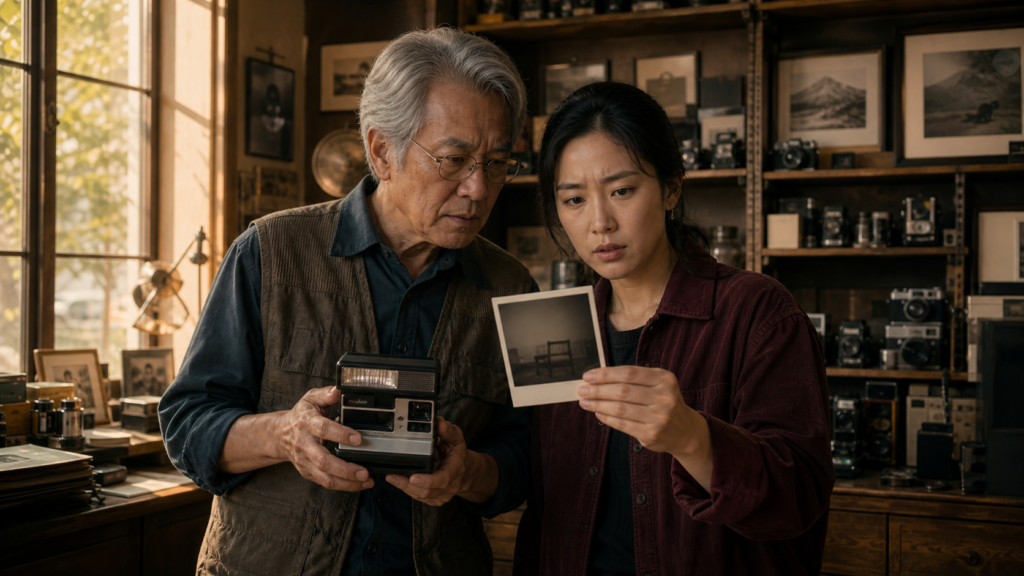
The photograph dated tomorrow slid out of my father’s camera at 4:17 on a Thursday afternoon.
There was no film inside.
I knew that because I had opened the camera myself, held the empty compartment toward the window, and told my father for the third time that the machine was broken. He only watched the blank square develop between my fingers.
First came a gray wall. Then a wooden chair. Then me.
In the picture, I stood inside his studio wearing the same burgundy jacket I had on now. My left hand was raised as if I were warning someone to stop. Behind me, the front window was shattered. Across the white border, in my father’s narrow handwriting, were three words:
FRIDAY. 4:17 P.M.
Tomorrow.
My father, Jun Park, looked at the image and whispered, “This one came early.”
The Shop We Were Closing
Park Camera & Repair had survived forty-three years, two recessions, a fire in the bakery next door, and the invention of phones that made everyone think they were photographers. It could not survive my father’s failing memory.
Three months earlier, he had called the police because he believed a stranger was sleeping in his apartment. The stranger was his own reflection in the hallway mirror. A week later, he left a kettle burning and walked to the studio without shoes.
I had returned to Seattle to close the shop and move him into an assisted-living apartment near mine. He had agreed to everything with surprising calm—until I reached for the old instant camera beneath the counter.
“Not that one,” he said.
It was a heavy black camera with worn leather at the corners. My mother had used it when she and my father opened the shop. She died when I was nine, and the camera had not worked since.
“It has no film,” I said.
“That has never stopped it.”
I wanted to blame the sentence on his memory. Instead, I looked again at the photograph of tomorrow.
The broken glass looked real enough to cut me.
The Photograph Dated Tomorrow
I asked him who had written the date.
“You did,” he said.
“That’s your handwriting.”
“Today it is.” He tapped the image. “Tomorrow, perhaps it belongs to you.”
That was the kind of answer he gave when he did not know an answer. Beautiful, useless, and impossible to argue with.
I placed the photograph in my purse and carried on packing. At six, a man named Victor Hale entered the shop. He wore a charcoal coat and introduced himself as the representative of the company buying the building.
“Mr. Park signed the final transfer,” he said. “We need the premises empty by tomorrow at five.”
I had never seen the transfer.
Victor produced a copy. My father’s signature looked correct, but the sale price was less than half the building’s value.
“He would never agree to this.”
Victor glanced at my father, who was arranging lens caps by size. “He did agree. Six months ago.”
“Six months ago he was already under medical evaluation.”
Victor’s smile did not move his eyes. “Then you should speak to your attorney.”
Before leaving, he noticed the old camera on the counter.
For the first time, his confidence slipped.
“Where did you find that?” he asked.
My father stepped between Victor and the camera. “It found her.”
Victor left without another word.
A Second Impossible Image
At 9:03 that night, the camera clicked by itself.
My father and I were upstairs in the tiny apartment above the shop, eating noodles from paper cartons. We both heard the mechanical snap below us.
I found another photograph resting in the output slot.
This one showed my father sitting in the wooden chair from the first image. Victor stood behind him, one hand on his shoulder. On the floor lay a red metal cashbox I had not seen since childhood.
The border was marked FRIDAY. 4:11 P.M.
Six minutes before the broken window.
My father stared at the picture for a long time.
“Your mother hid the originals,” he said.
“Originals of what?”
“The building papers. The real ones.”
He told me that Victor’s father had once owned half the block. After my mother died, he repeatedly tried to buy the studio. My father refused. Then, six months ago, Victor began visiting with forms, claiming they were routine tax documents.
“Why didn’t you tell me?”
“I tried.” His voice cracked. “Some mornings I remembered the warning but forgot who to warn.”
He pointed to the cashbox in the photograph. “Your mother kept everything there.”
We searched until midnight. The box was not beneath the floorboards, inside the safe, or behind the darkroom shelves. My father became agitated, then suddenly calm.
“The chair,” he said. “She always said a good portrait hides what the subject cannot carry.”
The wooden chair in both photographs had belonged to my mother.
I turned it over. A square of fabric had been stitched beneath the seat. Behind it was a brass key.
Friday at 4:11
The key opened a storage cabinet at the train station. Inside we found the red cashbox.
It contained the original deed, tax records, letters from Victor’s father, and a small cassette labeled in my mother’s handwriting: IF THEY RETURN.
We listened in the car.
My mother’s voice filled the silence between us.
She explained that Victor’s father had forged maintenance debts to force local shop owners to sell cheaply. She had collected proof from five families and hidden copies in the box. She had planned to take them to a reporter the week after she died.
Her death had been an accident. The documents proved no murder, no grand conspiracy surrounding her final night. Somehow, that made the recording more painful. She had simply run out of time.
At 3:40 Friday afternoon, I sent digital copies to an attorney and a local investigative journalist. Then I called Victor.
“The originals are at the studio,” I lied. “Come get them.”
My father heard me and said, “The picture already warned you.”
“The picture showed what might happen,” I replied. “It didn’t tell us what we had to do.”
At exactly 4:11, Victor entered the shop.
He saw my father sitting in the wooden chair and the red cashbox on the floor. The scene matched the photograph perfectly.
Victor closed the door behind him.
“You don’t understand what those papers will do,” he said.
“They’ll return stolen buildings to people who never agreed to sell.”
“They’ll destroy my family.”
My father looked up at him. “Your family made that choice before mine had a chance.”
Victor moved toward the cashbox.
I raised my left hand. “Stop.”
For one frozen second, I realized I was standing exactly as I had in the first photograph.
Then Victor lunged—not for the box, but for the camera on the counter.
My father grabbed his coat. Victor twisted away and struck the display case. The front window shattered beneath his shoulder. Glass fell outward in a bright, terrible wave.
The clock above the door changed to 4:17.
What the Camera Could Not Show
Victor was cut but alive. The police arrived two minutes later. My phone had recorded his entire conversation, including his demand that we surrender the evidence.
By evening, the photograph had come true in every visible detail.
But it had hidden the most important part: no one died. My father was not helpless. And I was not too late.
Over the following weeks, the building transfer was suspended. Three other shop owners joined the case. The newspaper ran my mother’s evidence on its front page.
I did not sell the studio.
Instead, we converted half of it into a small gallery and rented the other half to a young camera technician who promised not to throw away anything older than himself. My father moved into the apartment near mine, but he came to the gallery every Saturday.
Some days he remembered every lens he had ever repaired. Some days he called me by my mother’s name.
On both kinds of days, I sat with him.
A month after the gallery opened, I placed the old camera in a locked glass case. We had never found film for it, and it had produced no more photographs.
Then, during closing, I heard the familiar mechanical click.
A final picture waited in the slot.
It showed the gallery many years from now. The walls were crowded with photographs. An older woman stood beside the wooden chair, teaching a little girl how to hold a camera.
The woman’s face was turned away, but she wore my burgundy jacket.
There was no date on the border.
Only one sentence, written in handwriting that looked partly like my father’s and partly like mine:
Some futures wait until you choose them.
Why the Photograph Gives No Clear Answer
The camera shows a possible future without explaining how it will happen. That limitation matters: a complete prophecy would remove the characters’ responsibility, while an incomplete image forces them to act using evidence from the present.
The final photograph has no date because the gallery is not guaranteed. It becomes possible only after the narrator chooses preservation, cooperation, and care for her father over the quickest escape from uncertainty.
Fiction notice: This original story is a work of fiction. Names, characters, places, and events are invented.