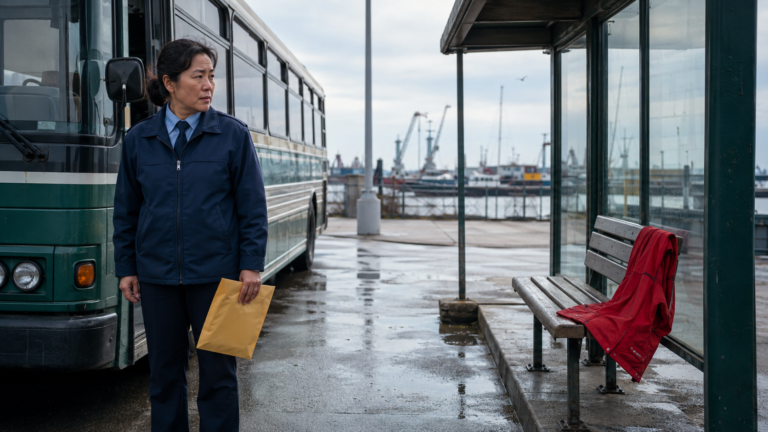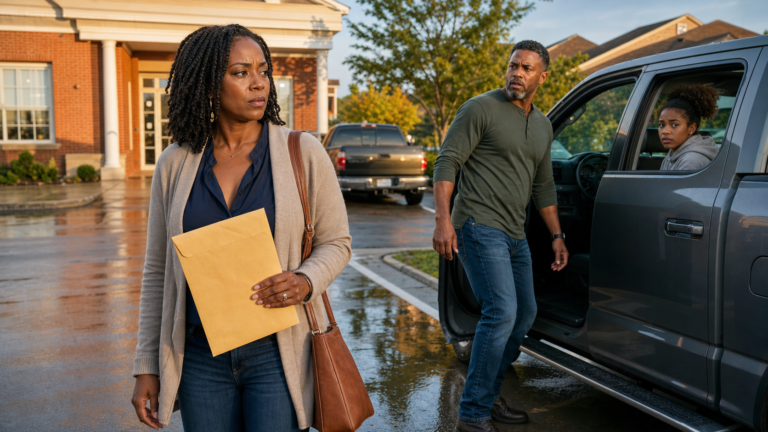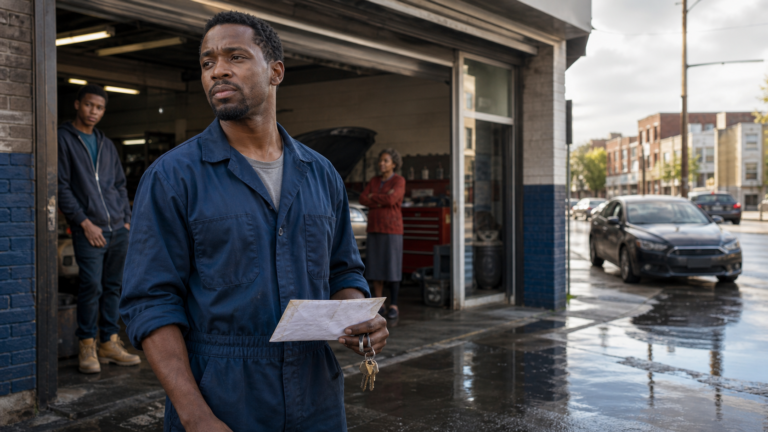
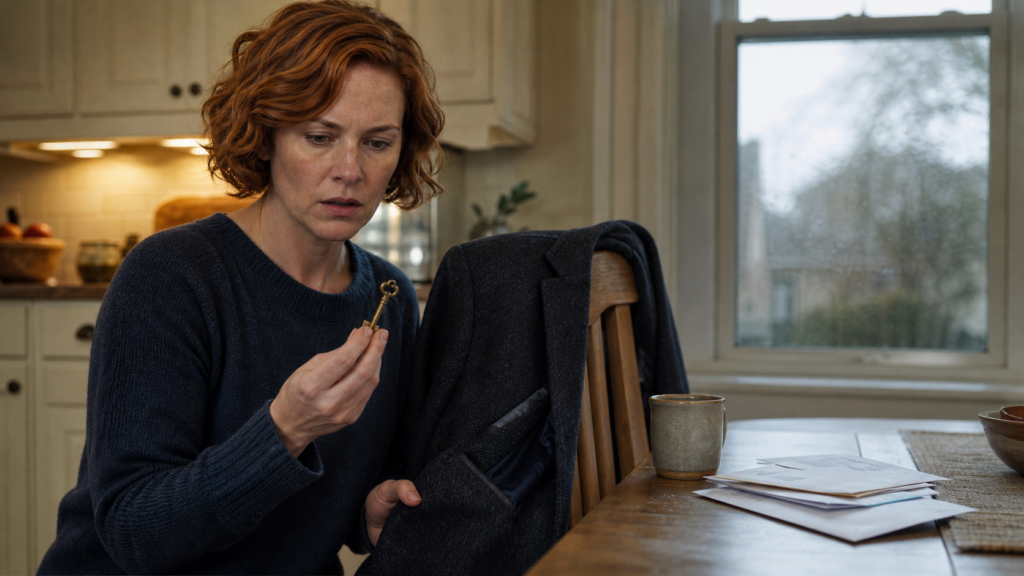
The key was still warm when I pulled it from my husband’s coat. I did not know it would become the first clue in a marriage secret story that had been unfolding around me for seven years.
Not warm from the room. Not warm from my hand. Warm the way a coin feels after someone has carried it against their body for hours.
I stood in our kitchen with Mark’s charcoal coat draped over one arm and the little brass key resting in my palm. Rain tapped the window above the sink. The clock on the stove read 2:17 p.m.
Mark had texted me twenty minutes earlier: Flight delayed again. Don’t wait up for dinner.
He was supposed to be at the airport.
The key had a flat oval tag stamped with two numbers: 214. Beside it, folded into the pocket lining, was a receipt from Hawthorne Court Apartments. The date at the top was that morning. The tenant name was N. Hale. My husband’s name was listed under “authorized visitor.”
The Lie That Arrived Before Dinner
Mark and I had been married for fourteen years. We had survived my mother’s illness, his father’s bankruptcy, two miscarriages, and the year our son Owen stopped speaking to anyone except the school counselor. I knew the sound of Mark’s honest silence and the shape of his dishonest one.
Lately, his silences had changed. He had begun leaving the table to answer calls. He kept his phone face down. Every Thursday he came home smelling faintly of peppermint tea, although he hated peppermint.
I had noticed. I had chosen not to build a story from it. Now a story sat in my palm.
I called him.
“Are you boarding?” I asked.
There was a pause, followed by the hollow announcement of a terminal loudspeaker.
“Almost,” he said. “Why?”
I looked through the kitchen doorway. His suitcase was missing. His passport was gone. Everything supported his lie so perfectly that I almost admired the construction.
“No reason. Safe flight.”
“Love you, Jules.”
“Love you too.”
When the call ended, I searched Hawthorne Court. It was eighteen minutes away, in a restored brick building near the old train station. I put the key in my pocket and drove there.
Apartment 214
The lobby smelled of floor polish and wet wool. There was no doorman, only a row of brass mailboxes and an elevator with a mirror scratched near the buttons.
On the second floor, apartment 214 stood at the end of a narrow hallway.
I told myself I would knock. I did not.
The key turned.
Inside, afternoon light fell across a small, neat living room. A blue blanket lay folded on the sofa. Two mugs sat in the sink. A pair of women’s boots waited by the door.
My chest tightened.
On a shelf stood a photograph of Mark beside a young woman with pale blond hair. She looked about nineteen. His arm rested around her shoulders. They were both laughing. The girl had Mark’s gray eyes.
Behind me, the lock clicked.
“Who are you?” a voice asked.
The young woman from the photograph stood in the doorway holding a paper grocery bag. Oranges rolled across the floor when the bag slipped from her hands.
She stared at the key in my palm. “You’re Julia,” she whispered.
It was not a question.
“And you’re N. Hale.”
Her face lost its color. “Naomi. My name is Naomi.”
“How do you know my name?”
She glanced toward the photograph. “Because Mark told me about you.”
I waited for her to say the sentence I feared: He’s leaving you. He loves me. We didn’t mean for this to happen.
Instead, she said, “He’s my father.”
The Daughter I Never Knew
The room seemed to tilt, although nothing moved.
“Mark doesn’t have a daughter.”
Naomi bent slowly to collect the oranges. Her hands trembled. “He does.”
She told me her mother, Ellen Hale, had dated Mark for one summer when they were both twenty. They separated before Ellen knew she was pregnant. Years later, Ellen married another man who raised Naomi as his own. Mark learned the truth only after Naomi’s stepfather died—or that was the version Naomi had been given.
“When did he find you?” I asked.
“Seven months ago.”
Seven months. The Thursday calls. The peppermint tea. The sudden trips that produced no photographs.
“Why the apartment?”
“My mother is in hospice two blocks away. I came to stay near her. Mark pays half the rent.”
“And today?”
“He brought groceries before going to the airport.”
She studied my face with an expression that made me feel cruel for existing. “He said he was going to tell you after his trip.”
I laughed once. It sounded like a cough. “Men are always about to tell the truth immediately after the moment they’re caught.”
Naomi flinched. “Please don’t blame him for me.”
“I don’t blame him for you. I blame him for making me the only stranger in my own marriage.”
Then I saw a wooden box beneath the coffee table. Its lid was open. Inside were cards, photographs, and envelopes tied with green ribbon.
The top envelope was addressed to Mark. The postmark was from 2019.
Seven Years Hidden in a Box
“You said seven months,” I whispered.
Naomi followed my eyes. “That’s when I met him.”
I pulled the envelope free. The paper had softened at the folds.
Mark, she asks about you more often now. I don’t know how much longer I can keep saying you weren’t ready…
The date was seven years old.
There were more letters. One each year. Ellen had told Mark about Naomi long before he claimed to know. He had replied to some of them; copies of his answers sat beneath hers.
I have a family now.
Julia has already survived too much.
I will contact Naomi when the time is right.
He had known. Not for seven months. For seven years.
Naomi read over my shoulder. Her mouth opened, but no sound came.
“He told me Mom had only contacted him last winter.”
For one strange second, she and I were not wife and secret daughter. We were simply two women standing inside the same lie from opposite sides.
Her phone rang on the counter. The screen showed Dad.
Neither of us moved. It rang again.
“Answer it,” I said.
Naomi pressed the speaker button.
“Hey,” Mark said. Airport noise filled the room. “Did you find the soup? I left it in the—”
“I found the letters,” Naomi said.
Silence.
Then Mark said her name very softly.
I stepped closer to the phone. “She isn’t alone.”
The airport noise continued for several seconds. A boarding announcement called passengers to Gate 12.
“Julia,” he said.
“Come home.”
“My flight—”
“Come home, Mark. Or don’t. But if you walk onto that plane, you’ll return to an empty house.”
I ended the call.
What He Finally Admitted
Mark arrived at our house shortly after six. His suitcase wheels left two wet lines across the hallway floor.
Naomi sat beside me at the dining table. The letters were spread between us.
He stopped when he saw her. “You brought her here?”
“She brought the truth,” I said. “Sit down.”
For fourteen years, Mark had been the calm one. That evening, he looked like a man who had reached the end of a bridge and discovered there was no road behind him.
He admitted everything.
Ellen had contacted him when Naomi was twelve. At first, she asked for nothing except acknowledgment. Mark wrote back but refused to meet. He told himself he was protecting our fragile family. Later, shame made every year harder to explain than the one before it.
“When Ellen got sick, I couldn’t hide anymore,” he said.
Naomi’s voice was flat. “So you lied to me instead.”
“I was afraid you wouldn’t speak to me if you knew.”
“You didn’t give me the choice.”
He looked at me. “I planned to tell you.”
“You planned to tell me a version that protected you.”
Mark lowered his head.
I wanted to shout. Instead, I asked the question that mattered.
“If I hadn’t found the key, when would you have told me the letters existed?”
He could not answer.
That silence was the first completely honest thing he had given me all day.
The Door the Key Really Opened
Mark slept in a hotel that night.
Naomi stayed in our guest room because she was too shaken to return to the apartment alone. At three in the morning, I found her sitting on the kitchen floor, drinking peppermint tea.
“That’s why he smelled like it,” I said.
She looked embarrassed. “He hates it.”
“I know.”
For the first time, we both smiled.
She told me about nursing school, her mother’s stubbornness, and the stepfather who had loved her without needing biology to make it real. I told her about Owen and showed her a photograph of the half brother who did not know she existed.
“Are you going to leave him?” she asked.
“I don’t know.”
That was the truth. Not a dramatic answer, but an honest one.
The next morning, Mark returned. I gave him three conditions: he would tell Owen himself, he would stop deciding which truths other people could survive, and we would begin counseling before I decided whether our marriage still had a future.
Then I placed the brass key on the table.
“This never belonged in your pocket,” I said.
He looked at Naomi. She picked it up.
Months have passed since that day. Ellen died in early spring. Naomi finished her semester and now visits Owen most weekends. Mark and I still attend counseling. Some days I recognize the man I married; other days I recognize only the man who hid seven years inside a wooden box.
People ask whether finding Naomi saved our family or broke it.
The answer is neither.
The key opened a door. What stood behind it had always been there.
We are simply no longer pretending the wall is solid.
Why the Key Matters
The key is more than evidence of a hidden room. It represents the decisions Mark made on behalf of everyone around him: who was allowed to know the truth, when they were allowed to know it, and how much pain they were expected to carry. The story treats secrecy as a loss of consent, not merely a dramatic surprise.
We deliberately avoided an instant reconciliation. Counseling, uncertainty, and Naomi choosing where the key belongs leave the family with work still to do. Discovery changes their relationships, but it does not automatically repair them.
This is an original work of fiction. Names, characters, places, and events are invented.