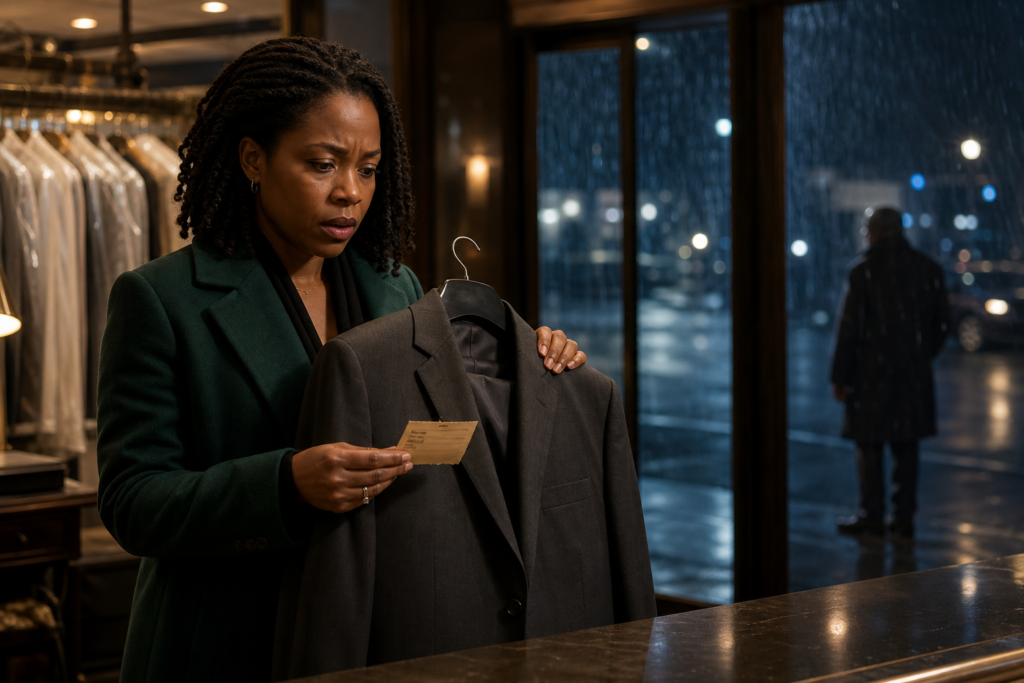
The suit my father was buried in came back from the cleaner twelve years after his funeral.
It arrived on a Thursday evening, five minutes before closing, wrapped in clear plastic and carrying a yellow claim ticket with my name on it.
AMARA BROOKS — PAID IN FULL.
I stood behind the counter of Brooks & Lane Tailoring with a measuring tape around my neck and three pins between my lips. Outside, rain blurred the headlights on Peachtree Street. Inside, the last steam press hissed like someone trying to keep a secret.
“There has to be a mistake,” I told the delivery driver.
He checked his phone. “Picked up from Bell’s Cleaners. Special release order.”
Bell’s had closed eight years ago.
I pulled the plastic aside.
The charcoal wool was soft beneath my fingers. The left lapel had a tiny crescent-shaped burn. Inside the jacket, stitched in gold thread, were the initials E.B.
My mother had embroidered them herself.
Elijah Brooks had worn that suit inside a closed casket while hundreds of people filled New Hope Baptist Church and told us what a good man he had been.
I dropped the hanger.
The Receipt Dated Tomorrow
My husband, Marcus, arrived ten minutes later and found me sitting on the floor.
He was a calm man by profession and temperament—a middle-school counselor who could talk a furious twelve-year-old into handing over a chair before it became a weapon. But when he saw the initials, all the color left his face.
“You’re sure?” he asked.
“I chose the lining. I watched Mama sew it.”
He checked the pockets. Empty. Then he studied the claim ticket.
On the reverse, someone had written an address and a time.
14 Mercer Street. Friday. 6:10 p.m. Come alone if you want the truth.
Friday was tomorrow.
“You’re not going,” Marcus said.
“That wasn’t a question.”
“Amara, somebody knows exactly where to cut you.”
He was right. My father’s death had divided my life into before and after. Before, I believed adults eventually explained everything. After, I learned that grief could enter a house without answering a single question.
Daddy had supposedly died in a warehouse fire outside Macon. The damage was so severe that the funeral director advised us not to view the body. Identification came from his watch, his wedding ring, and dental records supplied by a clinic that closed six months later.
I had been twenty-four and exhausted enough to accept whatever official voice spoke most gently.
Now a dead man’s suit hung between me and my husband.
“I’m going,” I said.
Marcus picked up the hanger. “Then you’re not going alone.”
What My Mother Refused to Say
We drove to my mother’s house that night.
Ruth Brooks opened the door in a blue robe, saw the suit, and slammed the door in our faces.
I caught it with my hand.
“Mama.”
“Take that thing away.”
“You recognize it.”
“I recognize trouble.”
Marcus quietly stepped back onto the porch, giving us the illusion of privacy.
I followed my mother into the kitchen. The room smelled of ginger tea and furniture polish. Nothing had changed since childhood except the woman moving through it. Her shoulders were smaller now.
“Was Daddy buried in this suit?” I asked.
She gripped the counter.
“Answer me.”
“It was on him when the funeral home closed the casket.”
“Did you see his face?”
Her silence changed the temperature of the room.
“Mama, did you see him?”
“No.”
I heard Marcus inhale from the doorway.
My mother sat down. “Three days before the fire, your father told me men were watching him. He had found payments hidden inside the shipping company’s books. Public contracts, fake vendors, money moving through churches and charities. He said if he spoke, people with important names would go to prison.”
“Why didn’t you tell the police?”
She laughed once, without humor. “One of the names was a police captain.”
“And after the fire?”
“A federal agent came. He said Elijah was dead. He told me questions would put you in danger.”
“You believed him?”
Her eyes filled. “I needed to.”
Then she told me something she had hidden for my entire life.
My father had a younger brother.
His name was Isaiah.
The Man Outside the Window
According to my mother, Elijah and Isaiah had looked so alike that teachers confused them even when they wore different clothes. But Isaiah disappeared from the family at nineteen after taking the blame for a robbery he said he did not commit.
My grandfather forbade anyone from speaking his name.
“Was Isaiah in the warehouse?” I asked.
“I don’t know.”
“Could he have been the body?”
“I don’t know.”
It was the third time she said it, and the first time I believed her.
At 6:05 the next evening, Marcus and I parked across from 14 Mercer Street.
The address belonged to an abandoned photography studio. Rainwater ran beneath the chained front door. A single light burned upstairs.
“Stay in the car,” I told Marcus.
He looked at me.
“Fine,” I said. “Stay three steps behind me.”
Inside, old portraits covered the walls: weddings, graduations, babies held by tired parents. At the far end of the room, a projector clicked on.
My father appeared on the wall.
He was older than I remembered but younger than he would be now. He wore the charcoal suit.
“Amara,” the recording began, “if you are seeing this, the agreement has ended—or someone has broken it.”
I moved closer until his face became light across my skin.
He explained that the warehouse fire had been arranged to kill him after he agreed to testify. Federal agents removed him hours before it happened. The man found inside was not Isaiah. He was a security guard named Walter Price, killed because he had returned for his medication.
The conspirators believed the body was Elijah’s. The government decided that belief offered better protection than any new identity.
“They made your mother choose,” he said. “A funeral with no body she could recognize, or a life where you might become leverage.”
I whispered, “No.”
On the screen, he seemed to hear me.
“I chose too, baby girl. Do not put all of this on Ruth.”
The film stopped.
Behind us, a floorboard creaked.
An older Black man stood near the entrance, rain shining on his coat.
He had my father’s eyes.
I could not breathe.
“Amara,” he said.
Marcus stepped between us.
The man raised both hands. “My name is Isaiah.”
The Brother Who Came Back
Isaiah did not ask me to trust him. He placed a folder on a table and stepped away.
Inside were court records, sealed testimony, and photographs of my father under another name. There were birthday cards Elijah had written to me every year but never mailed. Twelve cards. Twelve apologies.
The final document was a death certificate dated six weeks earlier.
Samuel Reed, the name assigned to my father in protection, had died of an aneurysm in New Mexico.
“He really is gone,” Isaiah said. “Just not when you were told.”
I hit him.
The sound echoed through the studio.
Marcus did not stop me. Isaiah did not defend himself.
“Why now?” I demanded.
“Elijah left instructions. When the last defendant died or went to prison, the suit and the recording were to come to you. The final man died on Monday.”
“Why do you have the suit?”
Isaiah looked toward the frozen image of his brother.
“Because it was mine first.”
The crescent burn came from a Fourth of July sparkler when the brothers were seventeen. Isaiah had lent Elijah the suit for a job interview. Years later, Elijah chose it for the staged funeral because it contained no traceable purchase under his own name.
“And Bell’s Cleaners?” Marcus asked.
“The owner kept one locked storage room after the business closed. He owed Elijah his life.”
Every answer was possible. Together, they felt impossible.
Isaiah handed me a small key.
“There’s one more thing in the inside hem.”
The Last Stitch
Back at my shop, I placed the suit beneath the cutting lamp.
My mother arrived before I called her. Maybe grief has its own alarm system.
I opened the hem carefully. A narrow brass key fell onto the table, along with a strip of fabric covered in my father’s handwriting.
Ruth knows the song. Amara knows the place.
Mama began to cry.
The song was “A Change Is Gonna Come,” which my father sang whenever he was afraid. The place was the old upright piano in our childhood home, the one he refused to sell even after three keys stopped working.
Inside its bench, behind a panel I had never noticed, we found a metal box.
It did not contain money.
It held copies of every letter my father had sent through his handler, including the ones my mother received and burned after reading.
I turned toward her.
“You heard from him.”
“Four times,” she said. “The last was seven years ago.”
“You let me believe he died without saying goodbye.”
“He begged me to keep you safe.”
“I was already safe. You were protecting the decision.”
She did not argue.
That was the part that hurt most.
At the bottom of the box lay a flash drive. On it was one short video recorded three months before my father’s real death.
He sat beneath a desert sky, thinner, gray at the temples.
“Amara, I have rehearsed explanations for twelve years,” he said. “Every version makes me sound either brave or innocent. I was neither. I was frightened, and I agreed to let your grief protect me.”
He looked away from the camera.
“You are allowed to hate me. Just do not build a home inside that hatred. It has terrible light.”
I laughed through my tears because it sounded exactly like him.
What I Did With the Suit
I did not forgive my mother that night. I did not welcome Isaiah into the family simply because we shared blood. Real life rarely arranges emotions as neatly as evidence.
But I listened.
Over the following months, Isaiah told me stories about two boys who switched places at school, sang harmony in church, and once shared a single good suit between them. My mother began answering questions without deciding which truths I could survive.
Marcus stayed beside me without trying to repair what was not his to fix.
As for the suit, I could not hang it in the shop and could not throw it away.
So I opened every seam.
From the charcoal wool, I made three small memory books—one for me, one for my mother, and one for Isaiah. Inside mine, I placed the twelve birthday cards my father never sent.
On the cover, I stitched the initials E.B. in gold thread.
The cleaner’s claim ticket remains in the first page.
Sometimes I look at its impossible date and think about how the dead return—not as ghosts, but as documents, fabric, lies, and voices saved by people who were too afraid to deliver them.
My father came back for one evening.
Long enough to tell the truth.
Not long enough to escape it.
Read more suspenseful family secrets in our Mystery Stories collection.
Memory, Grief, and Evidence
The returned suit gives grief a physical form: something familiar comes back carrying information the family was not prepared to examine. The mystery works because memory and evidence do not arrive in the same order, leaving the characters to decide which version of the past they can trust.
The story does not suggest that one discovery can resolve mourning. Instead, the suit opens a conversation that had been delayed by fear, allowing the living characters to separate what they know from what they only hoped was true.
Fiction notice: This original story is a work of fiction. Names, characters, places, and events are invented.